Dual Kidney Transplantation Offers Prolonged Graft Survival
Ekaterina Fedorova, Sofia Nehring Firmino, David Foley, Jacqueline Garonzik‐Wang, Dixon Kaufman, Jon Odorico, David Aufhauser, Nikole A. Neidlinger, Carrie Thiessen, Jennifer Philip, Kelly M. Collins, Josh Mezrich, David Al‐Adra, Didier Mandelbrot, Brad C. Astor, Sandesh Parajuli

TL;DR
Dual kidney transplants from nonstandard donors offer better long-term kidney survival without worse short-term outcomes compared to single kidney transplants.
Contribution
Demonstrates that dual kidney transplantation improves medium-term graft survival and supports increased organ utilization from complex donor kidneys.
Findings
Dual kidney transplants had lower rates of acute rejection and graft failure compared to single kidney transplants.
There was no significant difference in perioperative outcomes like delayed graft function or hospital stay between the two procedures.
Dual kidney transplants did not increase the risk of death with a functioning graft.
Abstract
Dual kidney transplantation (DKT), an uncommonly performed procedure, provides a unique opportunity to transplant nonstandard kidneys that might otherwise not be utilized. We compared perioperative and five‐year posttransplant outcomes between DKT, and single kidney transplants (SKT) performed at our institution. We analyzed all adult deceased donor kidney‐alone transplant recipients at our center between 2001 and 2020. Recipients of pediatric en bloc kidney transplants were excluded. Perioperative outcomes of interest included delayed graft function (DGF), posttransplant length of stay (LOS), rehospitalization, and reoperation. Five‐year outcomes included biopsy‐proven acute rejection (AR), death‐censored graft failure (DCGF), uncensored graft failure (UCGF), and death with functioning graft (DWFG). A total of 100 DKT and 3125 SKT recipients were included. DKT recipients were older…
Genes, proteins, chemicals, diseases, species, mutations and cell lines named across the full text — each resolved to its canonical identifier and authoritative record.
Click any figure to enlarge with its caption.
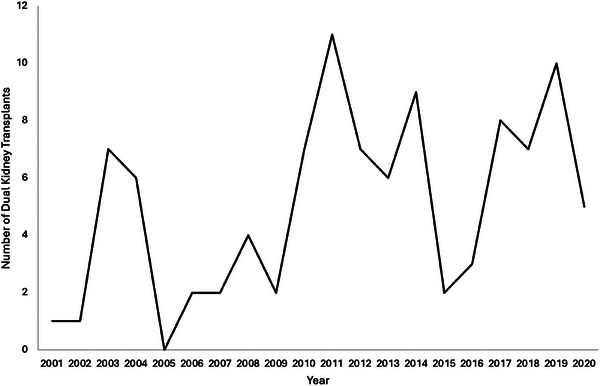 Figure 1
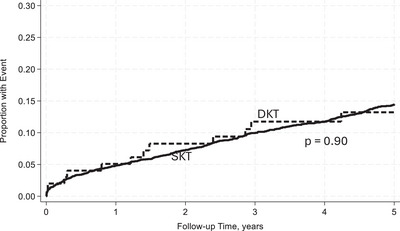 Figure 2
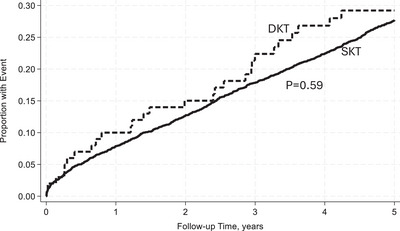 Figure 3
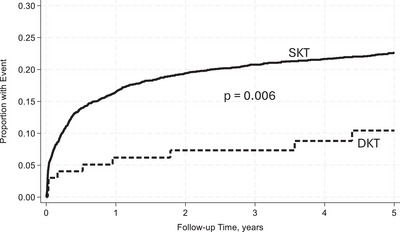 Figure 4
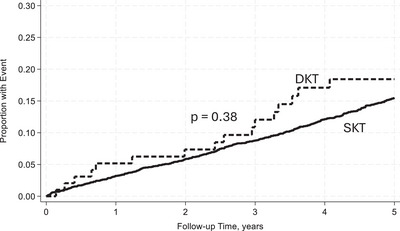 Figure 5
Peer Reviews
No public reviews on file for this paper yet. If you reviewed it on a platform where reviews are public (OpenReview, ICLR, NeurIPS, ICML), you can paste yours below so the community can read it here.
Videos
No videos yet. Explain this paper in a talk, walkthrough, or lecture? Add one.
Taxonomy
TopicsRenal Transplantation Outcomes and Treatments · Renal and Vascular Pathologies · Organ Donation and Transplantation