Proteomic profiling of equine airway mucus reveals compositional changes in asthmatic phenotypes
Florian Bartenschlager, Benno Kuropka, Philip Schmitz, Fiona Dumke, Katharina Landmann, Achim D. Gruber, Christoph Weise, Christiane L. Schnabel, Heidrun Gehlen, Lars Mundhenk

TL;DR
This study identifies changes in airway mucus proteins in horses with asthma, offering insights into disease mechanisms and potential biomarkers.
Contribution
The study provides the first detailed proteomic profile of equine airway mucus in asthmatic and healthy horses.
Findings
MUC4 was significantly elevated in both SEA and MEA and strongly correlated with neutrophil levels.
MUC5AC was increased in both asthmatic groups, while MUC5B was elevated only in SEA.
Functional analysis linked EA to inflammation, tissue remodeling, and coagulation pathways.
Abstract
Mucus hypersecretion and accumulation are hallmark features of equine asthma (EA), a meaningful respiratory disorder in horses occurring in mild to moderate (MEA) and severe (SEA) forms. Changes of the proteomic composition of airway mucus in EA are poorly understood. Using label-free quantitative liquid chromatography-mass spectrometry, we analyzed airway mucus from SEA (n = 10), MEA (n = 6), and healthy (n = 8) horses. We identified and quantified 2,275 proteins including gel-forming mucins MUC5AC and MUC5B and membrane-bound mucins MUC1 and MUC4. Compared with healthy controls, 130 proteins (SEA) and 103 (MEA) were significantly increased. 38 were elevated in SEA relative to MEA, 10 were higher in MEA. MUC4 was markedly increased in both, correlated with bronchoalveolar lavage neutrophils (ρ = 0.790, p = 4.9E-06), and distinguished excellently between healthy and asthmatics (AUC =…
Genes, proteins, chemicals, diseases, species, mutations and cell lines named across the full text — each resolved to its canonical identifier and authoritative record.
Click any figure to enlarge with its caption.
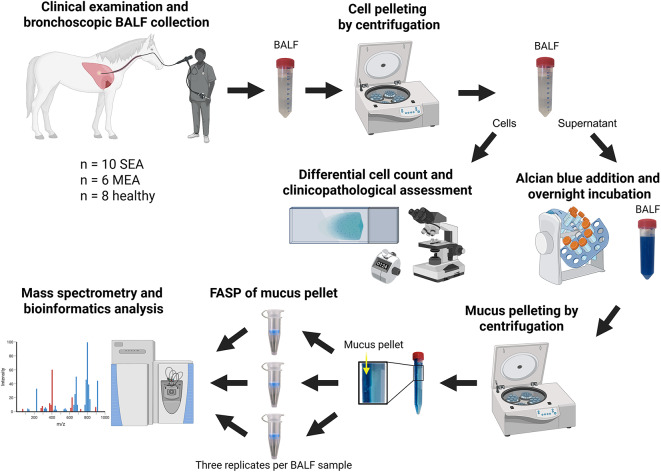 Figure 1
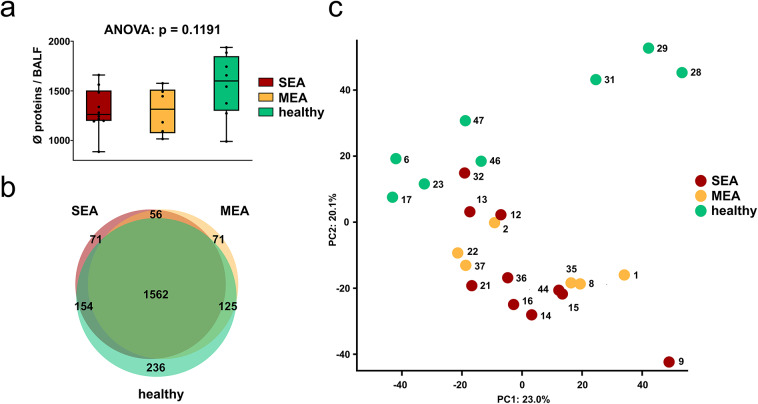 Figure 2
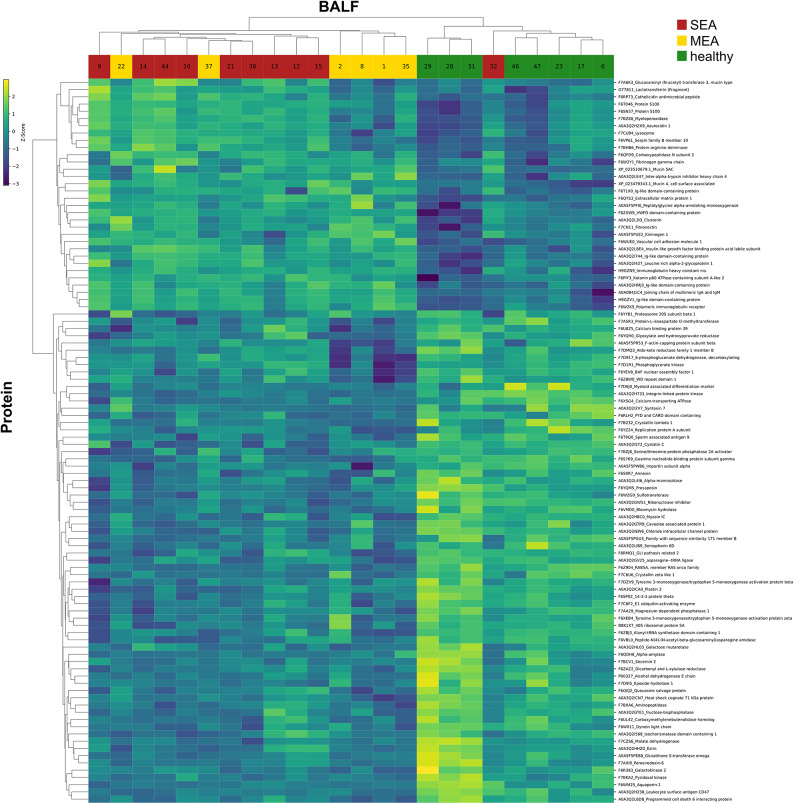 Figure 3
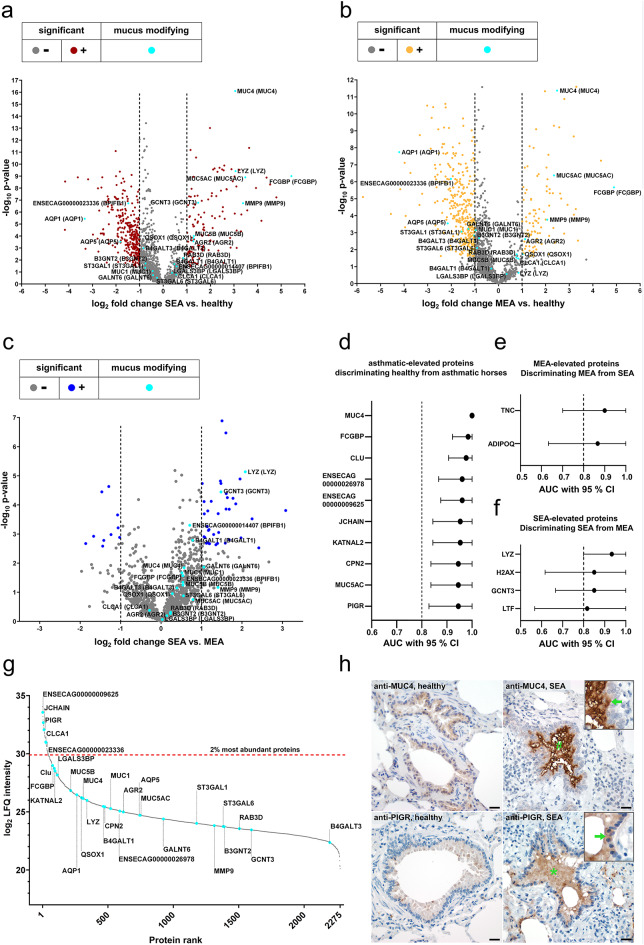 Figure 4
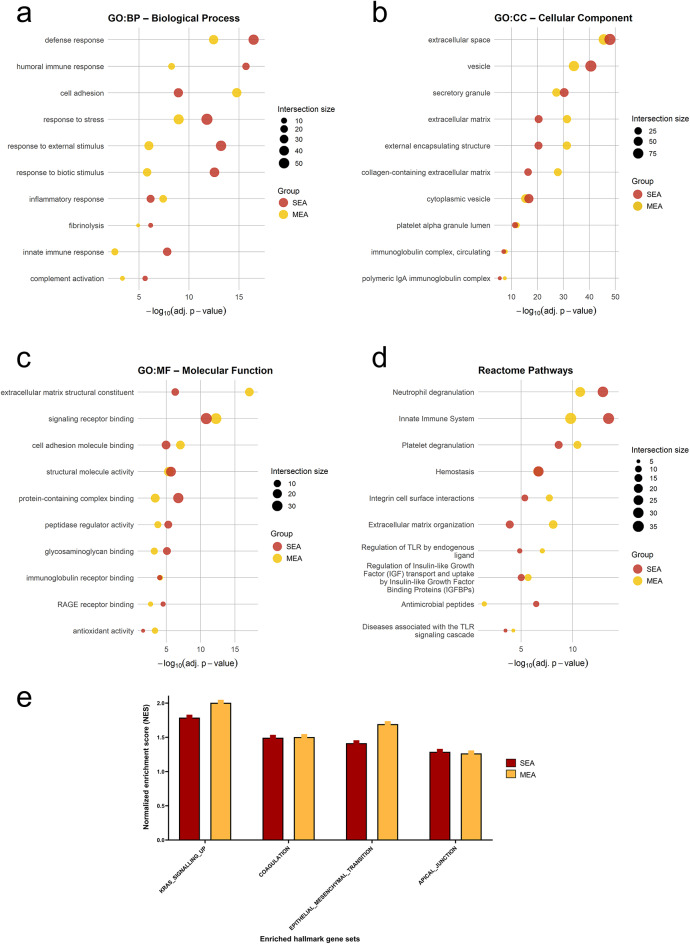 Figure 5
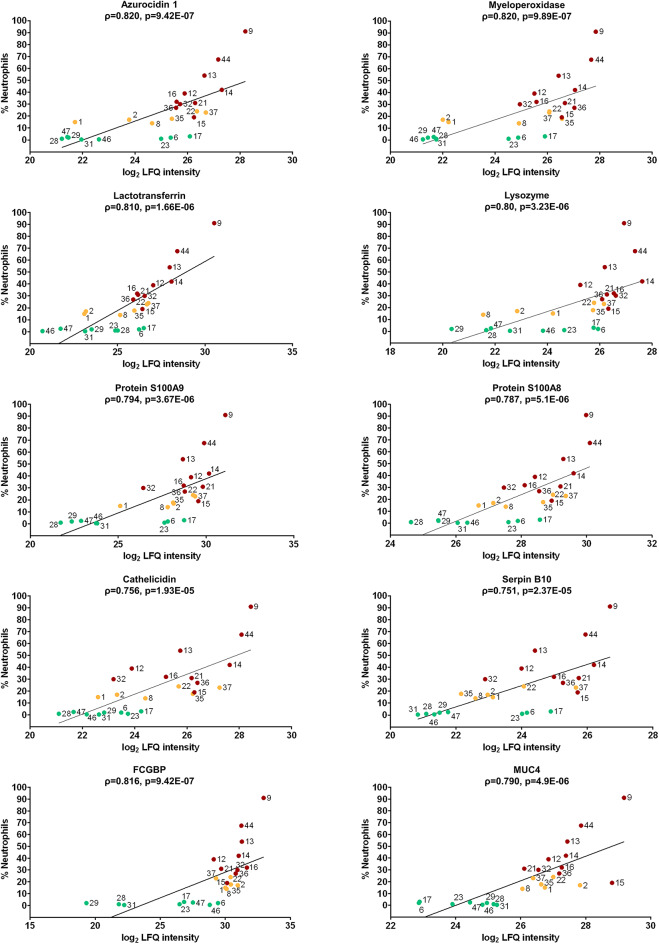 Figure 6
Peer Reviews
No public reviews on file for this paper yet. If you reviewed it on a platform where reviews are public (OpenReview, ICLR, NeurIPS, ICML), you can paste yours below so the community can read it here.
Videos
No videos yet. Explain this paper in a talk, walkthrough, or lecture? Add one.
Taxonomy
TopicsVeterinary Equine Medical Research · Glycosylation and Glycoproteins Research · Asthma and respiratory diseases