Leveraging molecular descriptors and explainable machine learning for monomer conversion prediction in photoinduced electron transfer-reversible addition-fragmentation chain transfer polymerization
Berna Alemdag, Azra Kocaarslan, Gözde Kabay

TL;DR
This paper introduces a machine learning model that predicts monomer conversion in a specific type of polymerization process using molecular descriptors and provides interpretable insights into the factors affecting conversion.
Contribution
The novel approach decomposes polymer systems into individual components and uses molecular descriptors with explainable ML to predict and interpret monomer conversion.
Findings
CatBoost was identified as the top-performing ML algorithm with an R2 of 0.84 for predicting monomer conversion.
SHAP analysis showed that monomer topological complexity, electronic polarization, and molecular weight explain over 60% of the model's predictive power.
The model generalized well to unseen (meth)acrylates and (meth)acrylamides with a MAE of 8.03.
Abstract
This study presents a molecular descriptor-based machine learning (ML) architecture for predicting monomer conversion in photoinduced electron transfer-reversible addition-fragmentation chain transfer (PET-RAFT) polymerization systems. Unlike traditional polymer informatics approaches that treat polymers as single units or use one-hot encoding for reaction components, we decompose each PET-RAFT system into its individual parts: monomer, RAFT agent, and photocatalyst. Next, each element was separately encoded using 2D molecular descriptors derived from SMILES. Using a literature-sourced dataset of 152 PET-RAFT systems, we systematically trained (with fivefold cross-validation, CV) and evaluated 10 ML algorithms. CatBoost showed greater stability across CV-folds (SD = ± 0.07) and was identified as the top performer for monomer conversion prediction (R2 = 0.84; RMSE = 10.04 pps; MAE = 8.16…
Genes, proteins, chemicals, diseases, species, mutations and cell lines named across the full text — each resolved to its canonical identifier and authoritative record.
Click any figure to enlarge with its caption.
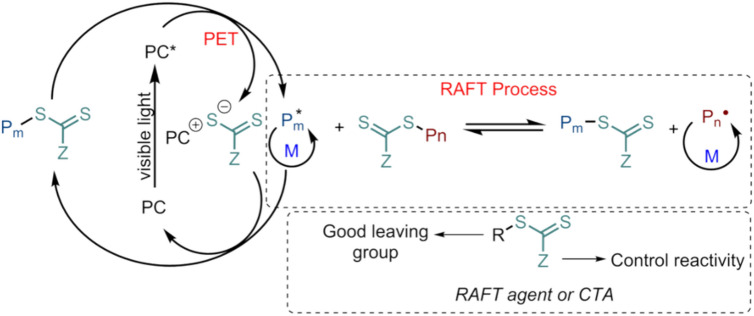 Figure 1
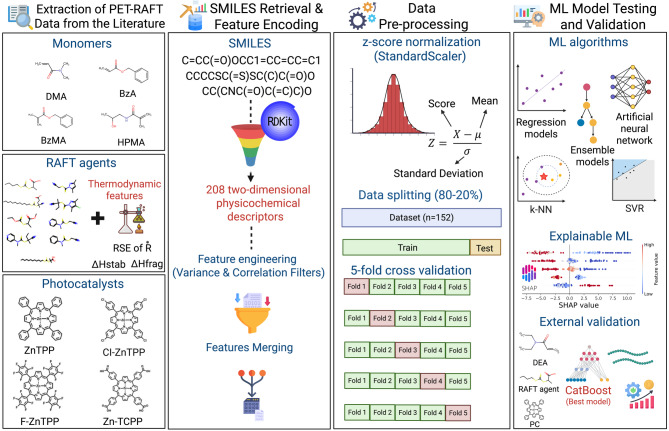 Figure 2
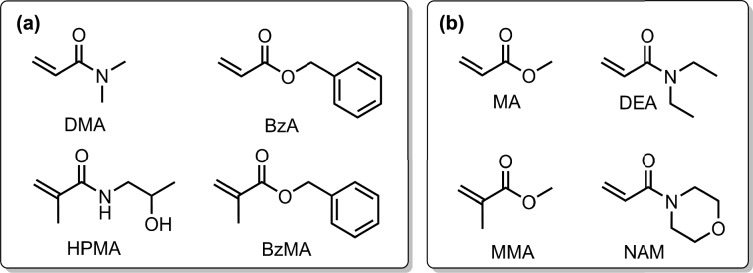 Figure 3
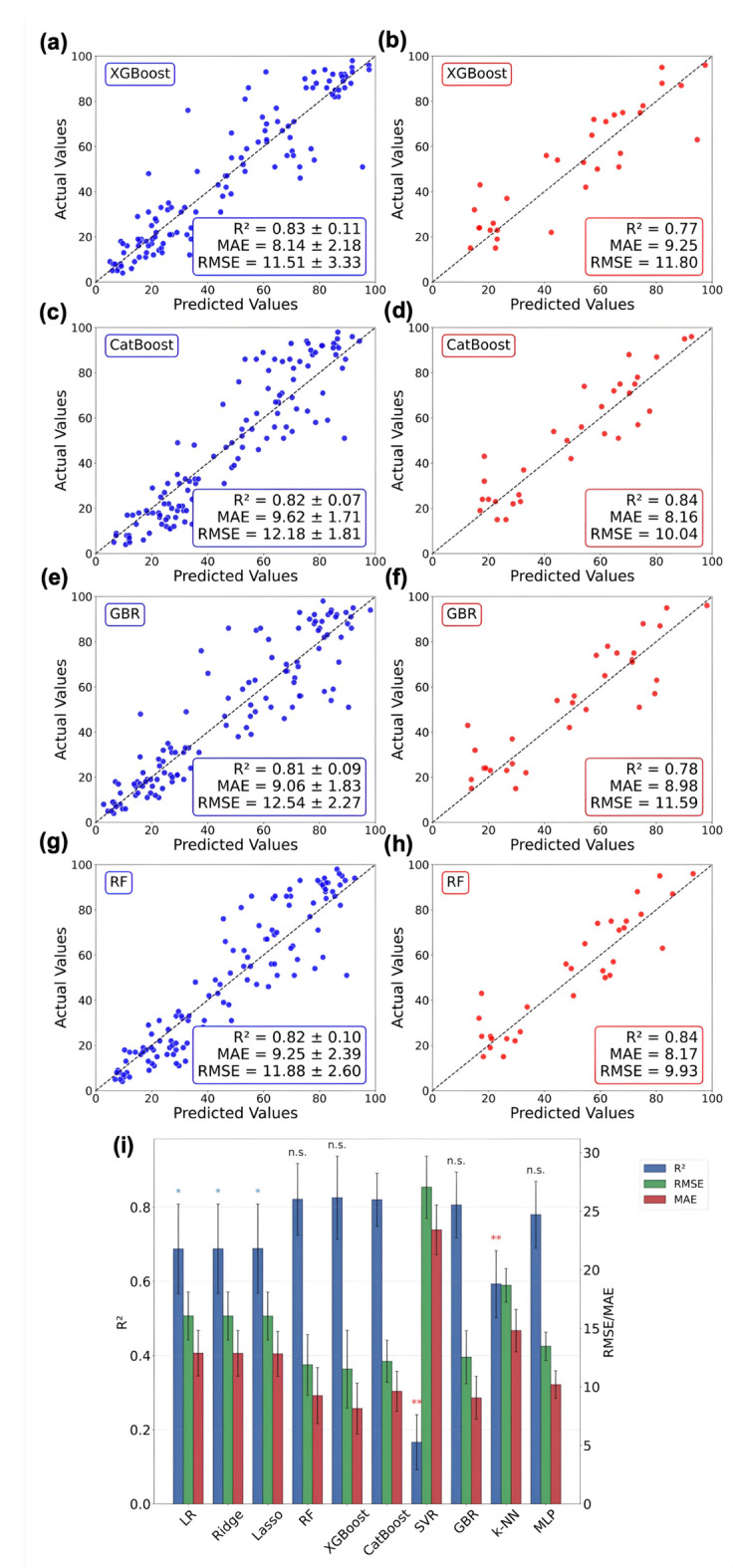 Figure 4
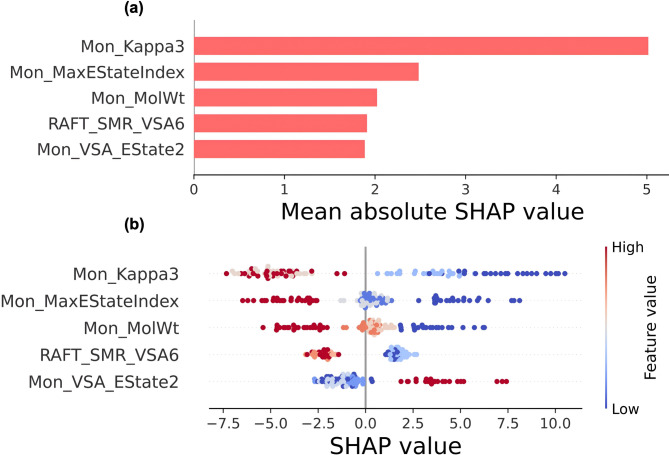 Figure 5
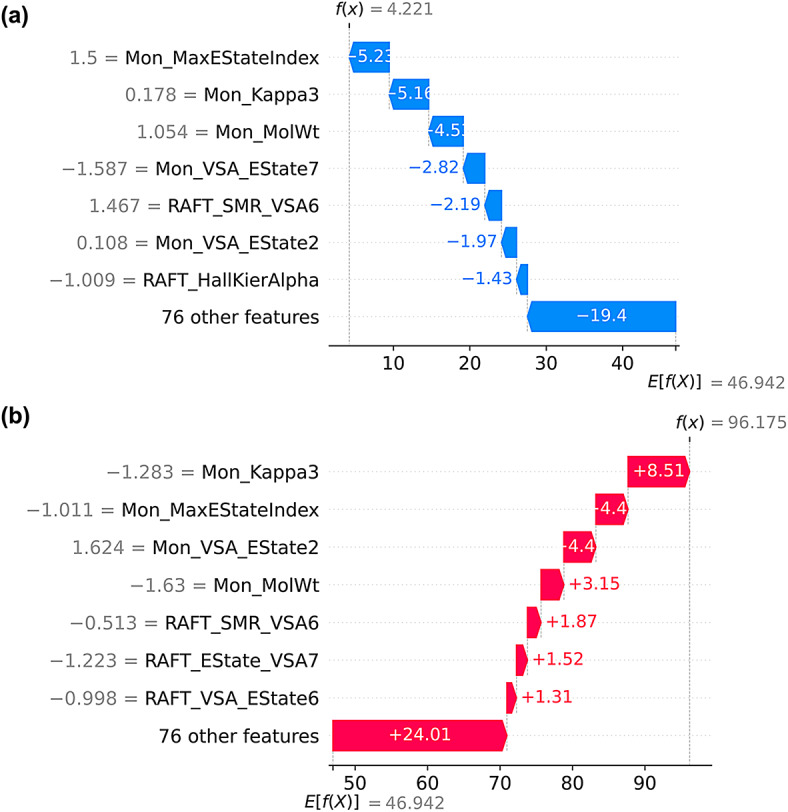 Figure 6
Peer Reviews
No public reviews on file for this paper yet. If you reviewed it on a platform where reviews are public (OpenReview, ICLR, NeurIPS, ICML), you can paste yours below so the community can read it here.
Videos
No videos yet. Explain this paper in a talk, walkthrough, or lecture? Add one.
Taxonomy
TopicsAdvanced Polymer Synthesis and Characterization · Photopolymerization techniques and applications · Click Chemistry and Applications