Comparison of Energy and Frequency of Nanosecond Q-switched ND-YAG Laser and Chlorhexidine on Reducing the Number of Oral Streptococcus Mutans Isolates: In Vitro Study: -
Faramarz Zakavi, Nazanin Kazemi, Azita Kaviani, Mohammad Sabaeian, Mohammad Hashemzadeh

TL;DR
This study compares the effectiveness of a laser and chlorhexidine in reducing Streptococcus mutans bacteria in the mouth.
Contribution
The study demonstrates that high-energy Q-switched Nd:YAG laser therapy is as effective as chlorhexidine in reducing S. mutans in vitro.
Findings
Laser energy and frequency significantly reduced S. mutans counts, with complete elimination at 30 mJ.
Inhibition zones were largest at 30 mJ/10 Hz, but chlorhexidine showed slightly larger zones without statistical significance.
Both laser therapy and chlorhexidine showed comparable antimicrobial efficacy against S. mutans.
Abstract
Streptococcus mutans is a facultative anaerobic coccus that is a part of the oral flora of humans. chlorhexidine also has some side effects. Today, Nd: YAG lasers have become very popular in dentistry and are used for various types of treatment. Therefore, this study aims to compare the effects of Chlorhexidine 2% and nanosecond (Nd: YAG) laser in reducing the number of oral Streptococcus mutans bacteria in the oral cavity. An in vitro experimental design was conducted using S. mutans ATCC 35668 cultured on Mueller-Hinton agar. Bacterial suspensions were standardized to a half-McFarland turbidity and distributed in 96-well plates. The antimicrobial activity of 2% CHX was assessed via the well-diffusion method. Laser irradiation was applied at varying energies (10, 20, 30 mJ) and frequencies (5, 10 Hz). Bacterial counts and inhibition zone diameters were measured, and data were analyzed…
Genes, proteins, chemicals, diseases, species, mutations and cell lines named across the full text — each resolved to its canonical identifier and authoritative record.
Click any figure to enlarge with its caption.
 Figure 1
 Figure 2
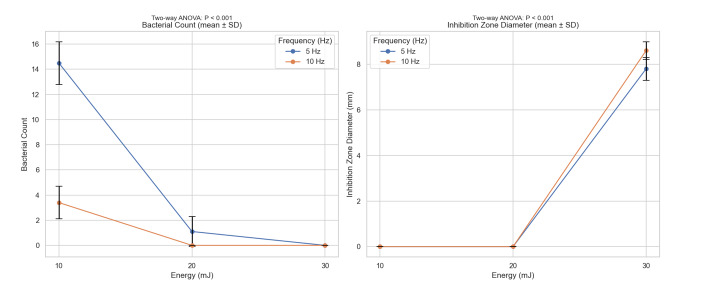 Figure 3
Peer Reviews
No public reviews on file for this paper yet. If you reviewed it on a platform where reviews are public (OpenReview, ICLR, NeurIPS, ICML), you can paste yours below so the community can read it here.
Videos
No videos yet. Explain this paper in a talk, walkthrough, or lecture? Add one.
Taxonomy
TopicsLaser Applications in Dentistry and Medicine · Endodontics and Root Canal Treatments · Oral microbiology and periodontitis research