Hypothesis: HPV E6 and COVID spike proteins cooperate in targeting tumor suppression by p53
Wafik S. El-Deiry

TL;DR
This paper hypothesizes that HPV E6 and SARS-COV-2 Spike proteins may work together to suppress tumor suppression by targeting p53.
Contribution
The novel contribution is the hypothesis that HPV-E6 and SARS-COV-2 Spike proteins may cooperate in suppressing tumor suppressor p53.
Findings
HPV E6 and E6-AP target p53 for degradation, contributing to cancer.
SARS-COV-2 Spike protein may suppress p53 function.
A case is mentioned where cancer recurred after mRNA vaccination.
Abstract
Human Papilloma Virus (HPV) is a causative agent in several cancers including cervical cancer, head and neck cancer, anal cancer, penile, vulvar and vaginal cancers. HPV through its virus-encoded protein E6 and the cellular E6-Associated Protein (E6-AP) target the tumor suppressor p53 protein for degradation thereby contributing to cancer development after HPV infection. As viruses cause cancer, the author previously hypothesized that SARS-COV-2 virus may be associated with cancer. More recent insights on the present hypothesis have come from studies suggesting (1) Spike protein of SARS-COV-2 may suppress p53 function, (2) cancer has been associated with mRNA vaccines that produce Spike, and (3) a case mentioned by Dr. Patrick Soon Shiong of a patient who survived HPV-associated head and neck cancer, but the tumor recurred after COVID mRNA vaccination including with liver metastases.…
Genes, proteins, chemicals, diseases, species, mutations and cell lines named across the full text — each resolved to its canonical identifier and authoritative record.
Click any figure to enlarge with its caption.
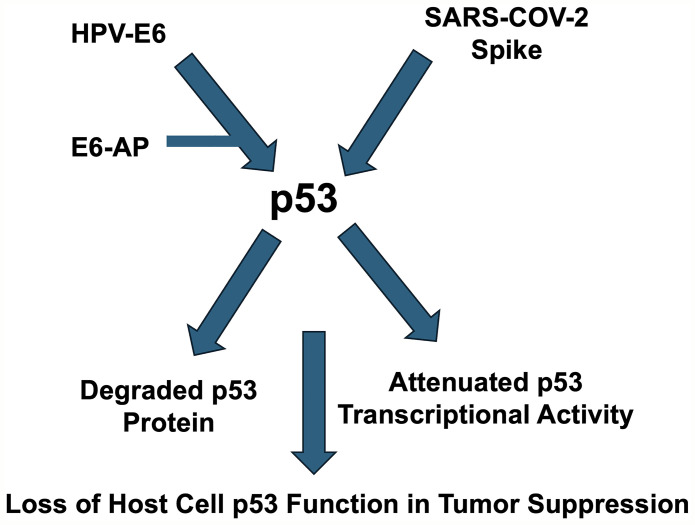 Figure 2
Peer Reviews
No public reviews on file for this paper yet. If you reviewed it on a platform where reviews are public (OpenReview, ICLR, NeurIPS, ICML), you can paste yours below so the community can read it here.
Videos
No videos yet. Explain this paper in a talk, walkthrough, or lecture? Add one.
Taxonomy
TopicsCervical Cancer and HPV Research · Head and Neck Cancer Studies · Polyomavirus and related diseases
It is known that HPV E6 targets the tumor suppressor protein p53 for degradation through the E6-AP thereby contributing to the development of cervical cancer, head and neck cancer, anal cancer and others [1–17].
When the COVID-19 pandemic started, I pursued studies “to better understand and modulate the host immune response to SARSCoV-2 to prevent or reduce disease severity in the current COVID-19 pandemic. Some effort (was) directed at blocking ACE2, the receptor SARS-CoV-2 uses to enter cells.” I further explained by March 24, 2020 (Figure 1) “while the host inflammatory response makes patients critically ill, the host innate immune system including natural killer (NK) cells is involved in fighting and eliminating virally infected cells. Over the last 25 years we have studied this innate immune system pathway that the immune system uses to eliminate transformed and cancer cells as well as virally infected cells. Natural killer cells secrete TRAIL which is involved in killing virally infected as well as transformed cells. This system can be triggered by p53 to suppress viral infection as well as cancer. Thus, our goal is to better understand and modulate the host immune response to increase the innate immune system early in SARS-CoV-2 infection while reducing the severe inflammation that occurs late. We further want to understand the impact of current therapeutics used to treat COVID-19 on both the innate immune system as well as the cellular inflammatory response.”
The proposal received a Brown University COVID-19 Research Seed Award in the amount of $40,000 for “Reducing the lethality of SARS-CoV-2 infection through immune modulation and drug discovery” in the Spring of 2020. Four publications emerged subsequently from these efforts [18–21]:
I listened to an interview (https://www.youtube.com/watch?v=tnVMjp9mCA0&t=2s) of Dr. Patrick Soon-Shiong by Chris Cuomo where I learned about a patient named Jim Johnson with a history of HPV-related head and neck cancer who by 2022 had survived his HPV-related cancer for 7 years and then he took the COVID vaccine. The “cancer was back with a vengeance,” and the tumor had metastasized to his liver. After I listened to what happened in this case, it occurred to me that there may be cooperation between HPV and COVID infection or COVID vaccination and suppression of p53.
A search of the literature for “cooperation between HPV and COVID in suppressing p53” found per an AI overview that there is “no evidence of a direct molecular “cooperation” between HPV and COVID-19 in suppressing p53, research indicates they both target the p53 pathway independently, and a COVID-19 infection may indirectly accelerate HPV-related cancer progression by impacting the host immune system.” I found a publication about “SARS-CoV-2 infection heighten[ing] the risk of developing HPV-related carcinoma in situ and cancer [22],” and a hypothesis that “COVID-19 can lead to rapid progression of cervical intraepithelial neoplasia by dysregulating the immune system [23].”
HYPOTHESIS
Based on existing literature discussed above, here is a schematic of the hypothesis that HPV E6 and COVID spike proteins may potentially cooperate in targeting tumor suppression by p53 (Figure 2). As depicted in Figure 2, the hypothesis put forth is that virally encoded proteins such as HPV-E6 or SARS-COV-2 Spike may cooperate in suppressing host defenses including tumor suppressor mechanisms involving p53. This hypothesis can be tested through epidemiologic studies looking at cancer incidence and recurrence among HPV-positive individuals who have either been infected by SARS-COV-2 or have been given COVID mRNA vaccines. Laboratory studies can test the impact of HPV-E6 combined with Spike protein on p53 expression and function.
Schematic depicting hypothesized cooperation between HPV and COVID in suppressing p53 and contributing to cancer.
The reference list from the paper itself. Each links out to its DOI / PubMed record.
- 1Münger K , Baldwin A , Edwards KM , Hayakawa H , Nguyen CL , Owens M , Grace M , Huh K . Mechanisms of human papillomavirus-induced oncogenesis. J Virol. 2004; 78:11451–60. 10.1128/JVI.78.21.11451-11460.2004. 15479788 PMC 523272 · doi ↗ · pubmed ↗
- 2Burd EM . Human papillomavirus and cervical cancer. Clin Microbiol Rev. 2003; 16:1–17. 10.1128/CMR.16.1.1-17.2003. 12525422 PMC 145302 · doi ↗ · pubmed ↗
- 3Alrefai EA , Alhejaili RT , Haddad SA . Human Papillomavirus and Its Association With Cervical Cancer: A Review. Cureus. 2024; 16:e 57432. 10.7759/cureus.57432. 38699134 PMC 11063572 · doi ↗ · pubmed ↗
- 4Liu Y , Ai H . Comprehensive insights into human papillomavirus and cervical cancer: Pathophysiology, screening, and vaccination strategies. Biochim Biophys Acta Rev Cancer. 2024; 1879:189192. 10.1016/j.bbcan.2024.189192. 39349261 · doi ↗ · pubmed ↗
- 5van den Borst E , Bell M , Op de Beeck K , Van Camp G , Van Keer S , Vorsters A . Lineages and sublineages of high-risk human papillomavirus types associated with cervical cancer and precancer: a systematic review and meta-analysis. J Natl Cancer Inst. 2025; 117:2461–76. 10.1093/jnci/djaf 118. 40378233 PMC 12682390 · doi ↗ · pubmed ↗
- 6Sabatini ME , Chiocca S . Human papillomavirus as a driver of head and neck cancers. Br J Cancer. 2020; 122:306–14. 10.1038/s 41416-019-0602-7. 31708575 PMC 7000688 · doi ↗ · pubmed ↗
- 7Fakhry C , Gillison ML . Clinical implications of human papillomavirus in head and neck cancers. J Clin Oncol. 2006; 24:2606–11. 10.1200/JCO.2006.06.1291. 16763272 PMC 4696042 · doi ↗ · pubmed ↗
- 8Gillison ML , Chaturvedi AK , Anderson WF , Fakhry C . Epidemiology of Human Papillomavirus-Positive Head and Neck Squamous Cell Carcinoma. J Clin Oncol. 2015; 33:3235–42. 10.1200/JCO.2015.61.6995. 26351338 PMC 4979086 · doi ↗ · pubmed ↗