Linking the epidemiology of coccidioidomycosis and environmental exposure through targeted genomic enrichment of Coccidioides posadasii
Jason W. Sahl, Nathan E. Stone, Daniel R. Kollath, Marieke Ramsey, Rebecca Ballard, Ana Braga, Amber I. Jones, Pierre Herckes, Matthew P. Fraser, Amelia Stout, Bridget M. Barker, Paul Keim, David M. Wagner

TL;DR
A new DNA enrichment method helps track the fungus causing Valley fever in the environment and links it to human cases.
Contribution
A targeted DNA capture system was developed to study Coccidioides posadasii in environmental samples without culturing.
Findings
The enrichment system successfully amplified and sequenced low-level C. posadasii DNA from complex samples.
Environmental DNA from air filters was linked to fatal Coccidioidomycosis cases in primates.
The method enables phylogenetic analysis of environmental C. posadasii strains over time.
Abstract
Valley fever, a disease caused by Coccidioides spp., is a fungal respiratory disease with an expanding range. Methods to culture the pathogen from soil, especially Coccidioides posadasii, are very challenging, limiting the genomics knowledge of environmental strains. In this study, we designed and tested a targeted DNA capture and enrichment system for the characterization of Coccidioides genomes without the need to culture. In this system, RNA probes are hybridized to Coccidioides DNA in a complex sample, followed by DNA amplification, sequencing, and analysis. Our enrichment system was targeted toward coding region sequences in C. posadasii str. Silveira and tested on control DNA spiked into soil; DNA hybridized to probes was then sequenced and correctly placed into a reference phylogeny, based on the known placement of the whole-genome sequence. We then applied the enrichment system…
Genes, proteins, chemicals, diseases, species, mutations and cell lines named across the full text — each resolved to its canonical identifier and authoritative record.
Click any figure to enlarge with its caption.
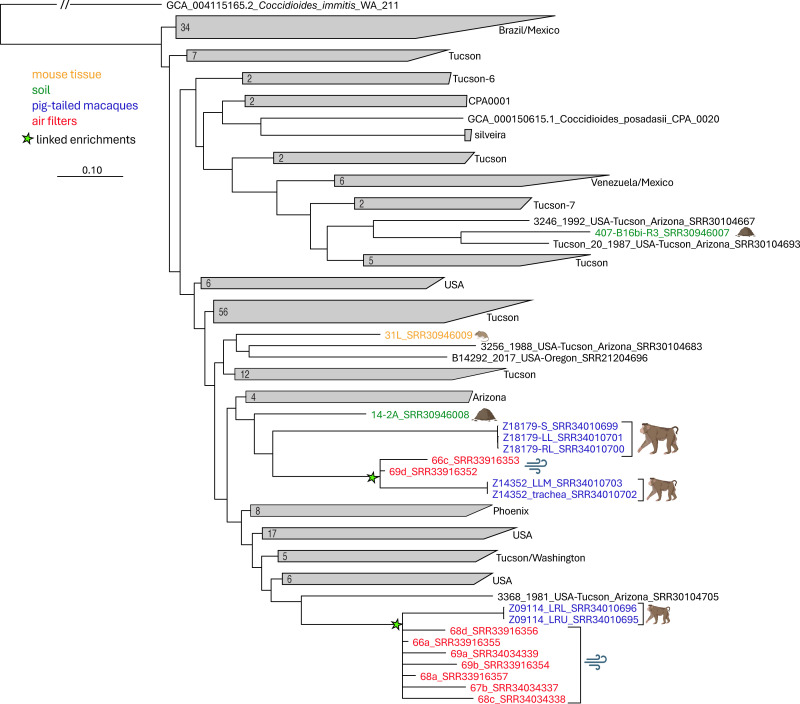 Figure 1
Peer Reviews
No public reviews on file for this paper yet. If you reviewed it on a platform where reviews are public (OpenReview, ICLR, NeurIPS, ICML), you can paste yours below so the community can read it here.
Videos
No videos yet. Explain this paper in a talk, walkthrough, or lecture? Add one.
Taxonomy
TopicsFungal Infections and Studies · Bartonella species infections research · Vector-borne infectious diseases