Performance of gradient diffusion strip and disk diffusion versus broth microdilution for lefamulin susceptibility testing of 422 Staphylococcus aureus isolates
Yujing Tian, Xiangning He, Xue Wu, Yanjun Liu, Xinying Wang, Yan Jin, Guojun Wang, Zhijun Zhang

TL;DR
This study compares simpler antibiotic susceptibility tests for lefamulin against a standard method using 422 Staphylococcus aureus isolates.
Contribution
The study evaluates the accuracy of gradient diffusion strips and disk diffusion for lefamulin susceptibility testing in clinical isolates.
Findings
Gradient diffusion strips showed 100% categorical agreement and 92.2% essential agreement with broth microdilution.
Disk diffusion achieved 99.5% categorical agreement but had a high very major error rate due to few non-susceptible isolates.
Both methods demonstrated high accuracy but require confirmation for borderline results.
Abstract
Lefamulin is a novel pleuromutilin antibiotic with potent activity against methicillin-resistant Staphylococcus aureus (MRSA). While broth microdilution (BMD) is the reference method for susceptibility testing, simpler alternatives such as MIC Test Strip (gradient diffusion strip [GDS]) and disk diffusion (DD) are urgently needed for routine laboratories. We evaluated the accuracy of GDS and DD compared to BMD for lefamulin against S. aureus. A total of 422 non-duplicate clinical isolates of S. aureus (256 methicillin-susceptible S. aureus [MSSA] and 166 MRSA) collected between December 2023 and December 2024 at the Affiliated Tai’an Central Hospital of Qingdao University were tested by BMD, GDS, and DD. Interpretation followed CLSI M100-S34 breakpoints (MIC ≤ 0.25 mg/L or zone diameter ≥ 23 mm = susceptible). BMD served as the reference to calculate categorical agreement (CA),…
Genes, proteins, chemicals, diseases, species, mutations and cell lines named across the full text — each resolved to its canonical identifier and authoritative record.
Click any figure to enlarge with its caption.
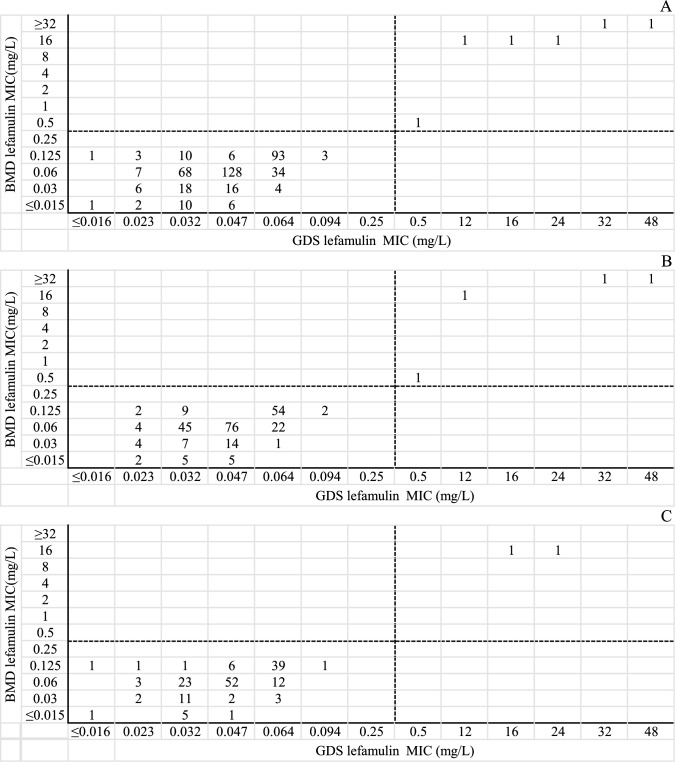 Figure 1
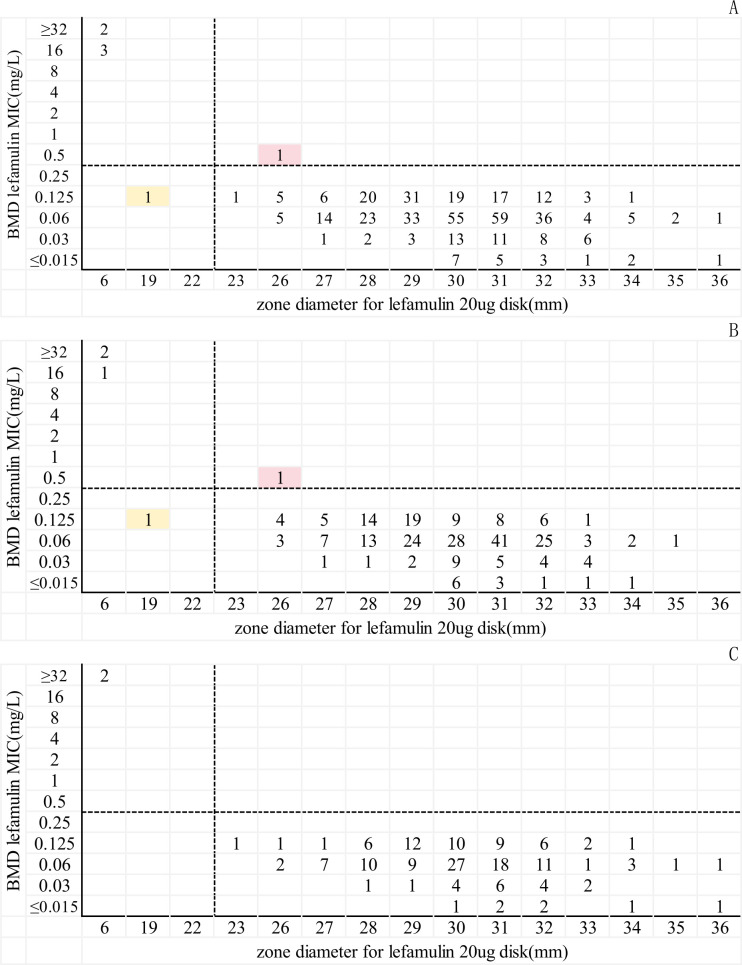 Figure 2
Peer Reviews
No public reviews on file for this paper yet. If you reviewed it on a platform where reviews are public (OpenReview, ICLR, NeurIPS, ICML), you can paste yours below so the community can read it here.
Videos
No videos yet. Explain this paper in a talk, walkthrough, or lecture? Add one.
Taxonomy
TopicsVeterinary medicine and infectious diseases · Coccidia and coccidiosis research · Diphtheria, Corynebacterium, and Tetanus