Challenges in accurate HDV RNA quantification: inter-assay variability and the impact of thermal shock
Felipe Pérez-García, Ana Virseda-Berdices, Carlos Pita-Martínez, Mario Muñoz Monte, Daniel Sepúlveda-Crespo, Helena Codina, Roberto Alonso, Lara Mesones, Sandra Rodrigo, Juan Macías, Luis Miguel Real, Juan Cuadros-González, Isidoro Martínez, Salvador Resino

TL;DR
This study compares three qRT-PCR assays for HDV RNA and finds significant differences in their quantitative results, which could affect treatment monitoring.
Contribution
The study reveals significant quantitative biases among HDV RNA assays and evaluates the impact of thermal shock on assay performance.
Findings
Inter-assay agreement was almost perfect but quantitative biases varied significantly between assays.
Thermal shock increased sensitivity in one case but worsened quantitative precision and correlation.
Assays cannot be interchangeably used for monitoring due to their quantitative discrepancies.
Abstract
Quantitative RT-PCR (qRT-PCR) is essential for monitoring hepatitis delta virus (HDV) RNA, yet assays lack standardization. We aimed to evaluate the performance of three qRT-PCR assays and to assess the impact of a pre-analytical thermal shock procedure. We conducted a comparative study using 206 samples (106 with anti-HDV antibodies and 100 anti-HDV-negative as a control group), which were tested in parallel with three qRT-PCR assays: Vircell, Certest, and Altona. Performance was evaluated for inter-assay agreement (kappa index), quantitative correlation (R²), and bias (Bland-Altman). Altona detected 56 HDV-RNA positive samples, whereas Vircell and Certest detected 55 positive samples. Inter-assay agreement was perfect comparing Vircell vs Certest (agreement = 100%, к = 1.000) and almost perfect comparing Altona with both Vircell and Certest (agreement = 99.5%, к = 0.988).…
Genes, proteins, chemicals, diseases, species, mutations and cell lines named across the full text — each resolved to its canonical identifier and authoritative record.
Click any figure to enlarge with its caption.
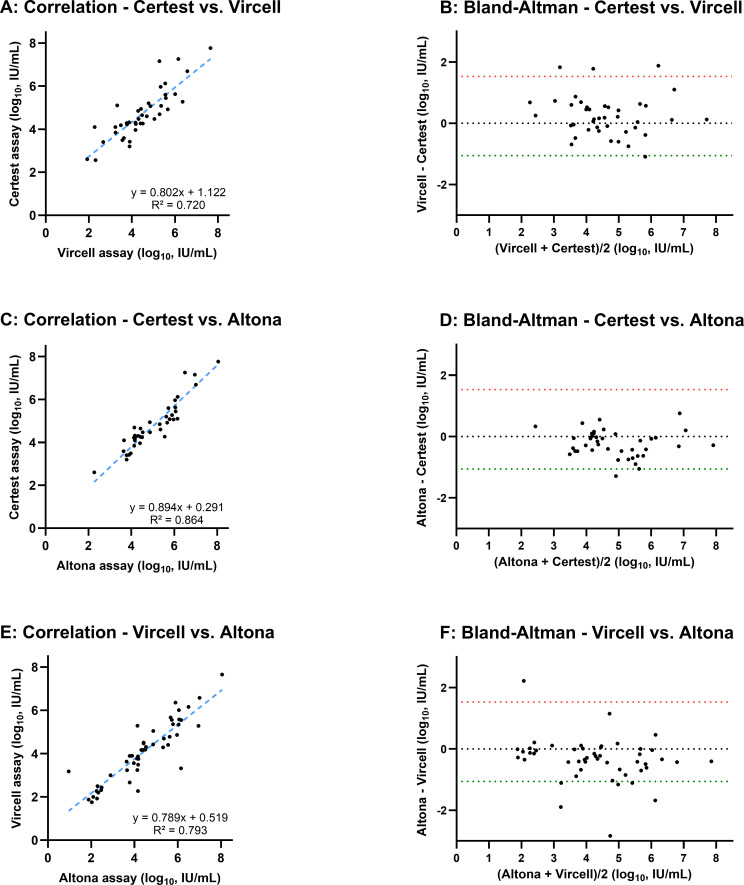 Figure 1
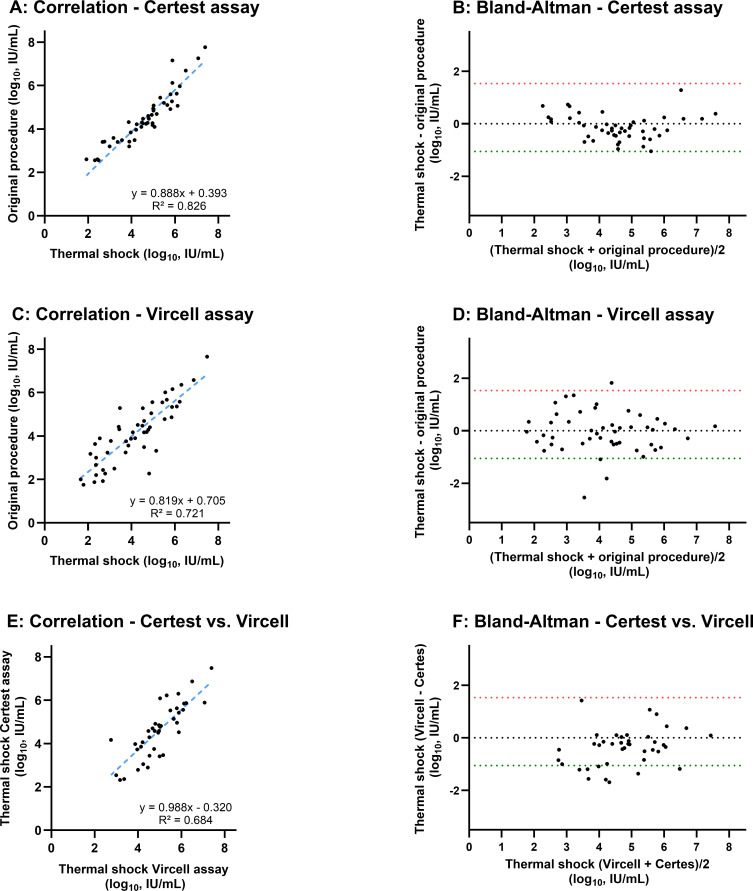 Figure 2
Peer Reviews
No public reviews on file for this paper yet. If you reviewed it on a platform where reviews are public (OpenReview, ICLR, NeurIPS, ICML), you can paste yours below so the community can read it here.
Videos
No videos yet. Explain this paper in a talk, walkthrough, or lecture? Add one.
Taxonomy
TopicsHepatitis B Virus Studies · Hepatitis C virus research · Hepatitis Viruses Studies and Epidemiology