Diagnostic value of blood culture growth patterns in distinguishing contaminants from pathogens
Eli Ben-Chetrit, Yigal Helviz, Phillip D. Levin

TL;DR
This study shows that blood culture growth patterns can help distinguish contaminants from true pathogens, improving antibiotic use.
Contribution
The study demonstrates that discordant growth of coagulase-negative staphylococci in blood culture sets has a high negative predictive value for true bacteremia.
Findings
Discordant CoNS-positive cultures have a 98.1% negative predictive value for true CoNS bacteremia.
Contaminants are more likely to grow in aerobic bottles compared to anaerobic bottles in discordant sets.
Discordant growth patterns can help clinicians make timely decisions about antibiotic use.
Abstract
Blood culture contamination is common, causing diagnostic uncertainty and unnecessary antibiotic use. Analyzing growth patterns within culture sets might offer diagnostic value. We retrospectively analyzed peripheral blood culture sets from 2019 and 2024. Growth pattern (one bottle [discordant] vs both bottles [concordant]) was analyzed according to clinical significance (contaminant vs true pathogen). Overall, 38,216 blood culture sets were analyzed, including 1,491 (3.9%) discordant and 1,938 (5.1%) concordant sets (remaining 34,787 [91.0%] sets were sterile). Discordant sets grew 1,060/1,491 (71.1%) contaminants and 431/1,491 (28.9%) true pathogens. Concordant sets grew 222/1,938 (11.4%) contaminants and 1,716/1,938 (88.5%) true pathogens (P < 0.001). Examining coagulase-negative staphylococci (CoNS) only (2019 data set), 629/642 (98.0%) discordant sets grew contaminants, while…
Genes, proteins, chemicals, diseases, species, mutations and cell lines named across the full text — each resolved to its canonical identifier and authoritative record.
Click any figure to enlarge with its caption.
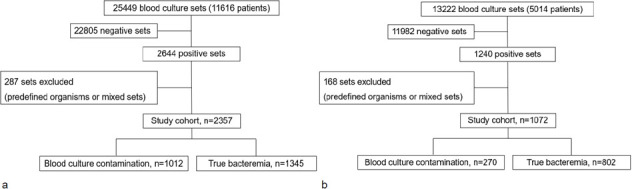 Figure 1
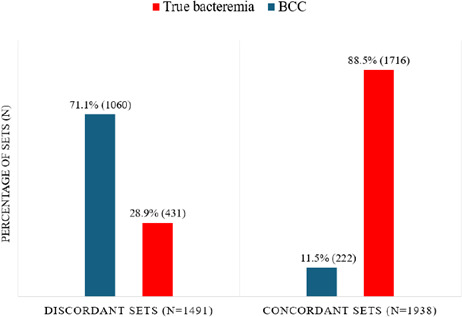 Figure 2
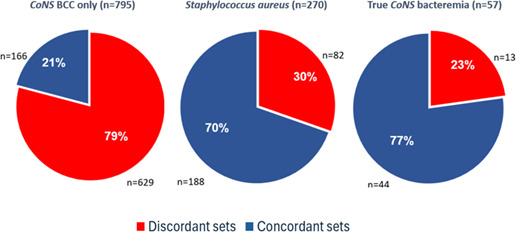 Figure 3
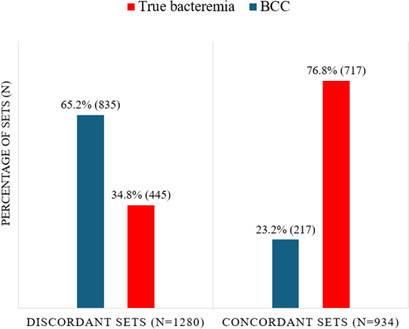 Figure 4
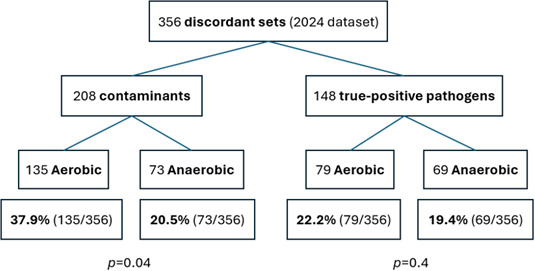 Figure 5
Peer Reviews
No public reviews on file for this paper yet. If you reviewed it on a platform where reviews are public (OpenReview, ICLR, NeurIPS, ICML), you can paste yours below so the community can read it here.
Videos
No videos yet. Explain this paper in a talk, walkthrough, or lecture? Add one.
Taxonomy
TopicsBacterial Identification and Susceptibility Testing · Neonatal and Maternal Infections · Sepsis Diagnosis and Treatment