A Comparative Study of Two Different Polarity Extracts of Angelica sinensis on Growth, Body Composition, and Metabolism in Juvenile Carp
Huatao Li, Haijing Liu, Guichuan Chen, Wang Xiong, Boyan Li, Qihui Yang, Jing Xu, Gangfu Chen

TL;DR
This study compares the effects of two extracts from Angelica sinensis on the growth and metabolism of juvenile carp, finding that each extract influences body composition and digestion differently.
Contribution
The study provides new insights into how different polarity extracts of Angelica sinensis affect fish metabolism and growth.
Findings
Low polarity extract (LPE) reduced weight gain and lipid accumulation while increasing protein accumulation in carp.
High polarity extract (HPE) enhanced weight gain, lipid accumulation, and protein digestion in carp.
LPE and HPE had contrasting effects on enzyme activities and metabolic rates in digestive organs.
Abstract
This study investigated the effects of low and high polarity extracts (LPE and HPE) of Angelica sinensis (AS) on growth, body composition, and metabolism in carp (Cyprinus carpio var. Jian). Over a 42‐day period, 780 fish were randomly separated into 13 groups with three replicate aquariums respectively. Thirteen groups received the feeding of basic diet, six LPE diets, and six HPE diets, respectively. The results indicated that dietary LPE decreased weight gain (WG), condition factor (CF), the activities of Na+, K+‐ATPase, γ‐glutamyl transpeptidase (γ‐GT), trypsin and lipase in digestive organs, plasma total amino acids (TAAs), triglyceride (TG) and ammonia levels, lipid productive value (LPV), and ammonia excretion rate (AER; p < 0.05), increased the activities of alkaline phosphatase (AKP), glutamate‐oxaloacetate transaminase (GOT), glutamate‐pyruvate transaminase (GPT), and…
Genes, proteins, chemicals, diseases, species, mutations and cell lines named across the full text — each resolved to its canonical identifier and authoritative record.
Click any figure to enlarge with its caption.
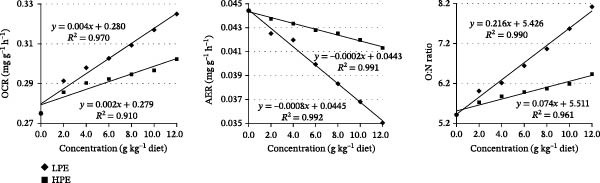 Figure 1
 Figure 2
 Figure 3
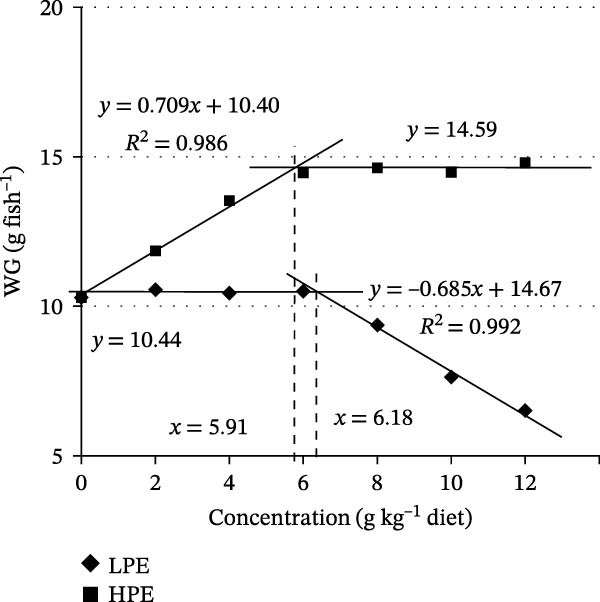 Figure 4
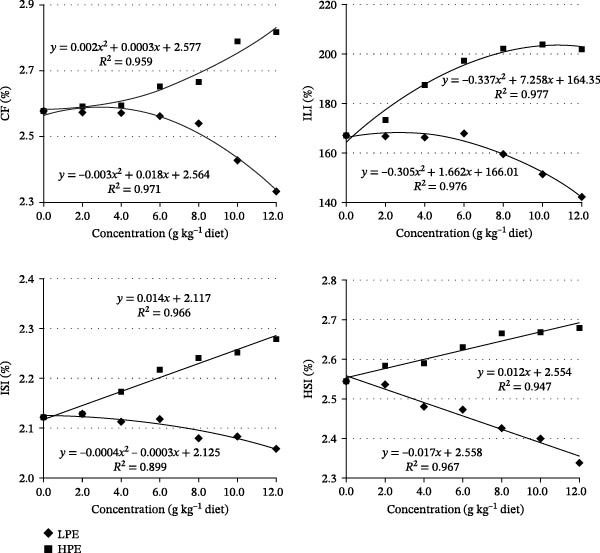 Figure 5
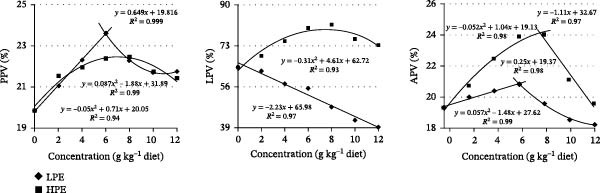 Figure 6
Peer Reviews
No public reviews on file for this paper yet. If you reviewed it on a platform where reviews are public (OpenReview, ICLR, NeurIPS, ICML), you can paste yours below so the community can read it here.
Videos
No videos yet. Explain this paper in a talk, walkthrough, or lecture? Add one.
Taxonomy
TopicsAquaculture Nutrition and Growth · Aquaculture disease management and microbiota · Reproductive biology and impacts on aquatic species