Extra-axial cerebrospinal fluid volumes from 6 to 24 months of age are associated with poorer executive function at school-age in children with and without autism
Yichi Zhang, Joshua Rutsohn, Sun Hyung Kim, Juhi Pandey, Robert T. Schultz, Lonnie Zwaigenbaum, Catherine Burrows, Stephen R. Dager, Tanya St. John, Annette M. Estes, Robert C. McKinstry, Natasha Marrus, John R. Pruett, Martin Styner, Heather C. Hazlett, Joseph Piven

TL;DR
Higher cerebrospinal fluid volumes in infants are linked to worse executive function in school-age children, regardless of autism diagnosis.
Contribution
The study shows that increased infant cerebrospinal fluid volumes predict poorer executive function later, even in children without autism.
Findings
Higher EA-CSF volumes in infancy correlate with poorer executive function at school age.
This association holds across children with and without autism and across familial risk groups.
EF deficits are more severe in children with autism compared to typically developing peers.
Abstract
Abnormally increased extra-axial cerebrospinal fluid (EA-CSF) volume is present as early as 6 months in infants later diagnosed with autism and is associated with symptom severity at the age of diagnosis, but it is unknown whether early EA-CSF enlargement has long-term impacts on other clinical domains. Executive function (EF) deficits are frequently observed in children with autism and are linked with worse academic outcomes, higher anxiety, and lower adaptive functioning. The current study examines the association between EA-CSF volume at infancy and EF at school age in a longitudinally phenotyped cohort of children with either high (HL) or low (LL) familial likelihood for autism. In this prospective study, 239 infants underwent MRI scans during natural sleep at 6, 12, and 24 months of age. HL was defined as having an older sibling with autism. The sample was divided into three…
Genes, proteins, chemicals, diseases, species, mutations and cell lines named across the full text — each resolved to its canonical identifier and authoritative record.
Click any figure to enlarge with its caption.
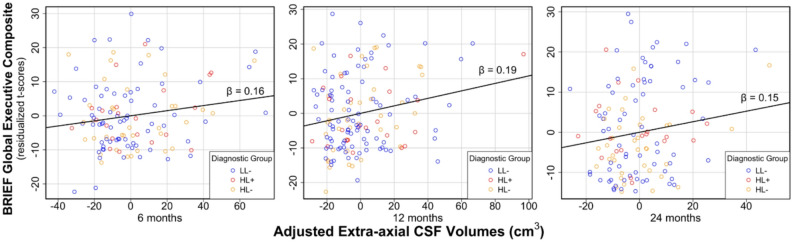 Figure 1
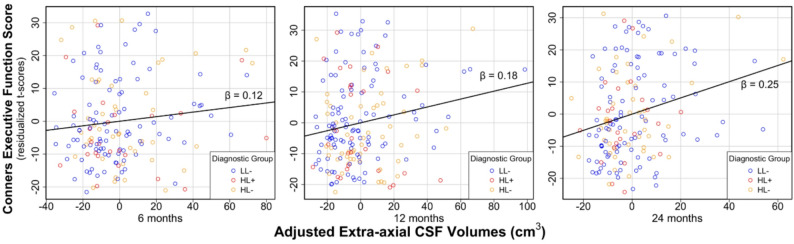 Figure 2
Peer Reviews
No public reviews on file for this paper yet. If you reviewed it on a platform where reviews are public (OpenReview, ICLR, NeurIPS, ICML), you can paste yours below so the community can read it here.
Videos
No videos yet. Explain this paper in a talk, walkthrough, or lecture? Add one.
Taxonomy
TopicsAutism Spectrum Disorder Research · Neonatal and fetal brain pathology · Infant Development and Preterm Care