Safety of leadless versus transvenous pacemakers in patients with low body surface area: a matched-pair analysis
Sirin Apiyasawat, Natcha Soontornmanokati, Tachapong Ngarmukos, Nilubon Methachittiphan

TL;DR
The study compares the safety of leadless pacemakers in patients with low body surface area and finds no increased risk of complications compared to transvenous pacemakers.
Contribution
This study provides new evidence on the safety of leadless pacemakers in patients with low body surface area, particularly in Asian populations.
Findings
Low-BSA LP patients had similar complication rates as normal-BSA LP patients.
No significant difference in complications was found between low-BSA LP and matched transvenous pacemaker patients.
Findings suggest LPs may be safe in low-BSA patients despite concerns about venous access.
Abstract
Leadless pacemakers (LPs) avoid lead- and pocket-related issues but require large venous access, which raises safety concerns in patients with a small body surface area (BSA), particularly in Asian populations. We defined low BSA as < 1.46 m², based on validated 3D-derived anthropometric standards for Chinese adults. To assess procedural complication rates of LP implantation in patients with low BSA. We analyzed LP implantations from 2016 to 2025 at a single center in Thailand. Of 59 patients, 25 (42.4%) had low BSA. We conducted two comparisons: (1) low- vs. normal/high-BSA LP patients and (2) low-BSA LP patients with a 1:2 age-, sex-, and BSA-matched transvenous pacemaker (TVP) cohort. The primary outcome was major device-related complications. LP patients were elderly (median 79 years) with high comorbidity (median Charlson Comorbidity Index [CCI], 7.0). In the matched analysis,…
Genes, proteins, chemicals, diseases, species, mutations and cell lines named across the full text — each resolved to its canonical identifier and authoritative record.
Click any figure to enlarge with its caption.
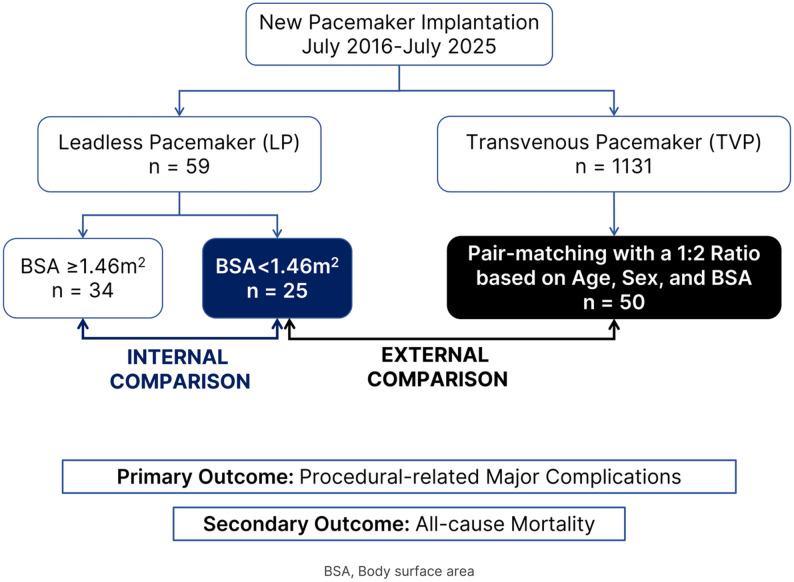 Figure 1
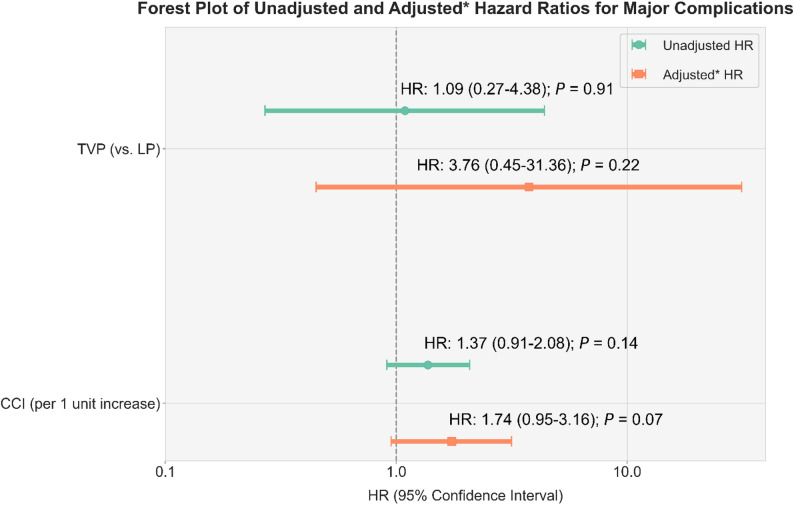 Figure 2
Peer Reviews
No public reviews on file for this paper yet. If you reviewed it on a platform where reviews are public (OpenReview, ICLR, NeurIPS, ICML), you can paste yours below so the community can read it here.
Videos
No videos yet. Explain this paper in a talk, walkthrough, or lecture? Add one.
Taxonomy
TopicsCardiac pacing and defibrillation studies · Mechanical Circulatory Support Devices · ECG Monitoring and Analysis