Horizontal gene transfer and gene loss drove the divergent evolution of host dependency in Micrarchaeota
Yang-Zhi Rao, Yu-Xian Li, Ze-Wei Li, Yan-Ni Qu, Brian P Hedlund, Tom A Williams, Yan-Ling Qi, Qi-Jun Xie, Hai-Long Yang, Yuan-Qi Zhang, Hong-Chen Jiang, Marike Palmer, Mang Shi, Wen-Sheng Shu, Zheng-Shuang Hua, Wen-Jun Li

TL;DR
This study shows how some archaea in the Micrarchaeota group evolved to be less host-dependent through gene transfer and metabolic gains.
Contribution
The study identifies new metabolic genes in Micrarchaeota and proposes that horizontal gene transfer enabled reduced host dependency.
Findings
Certain Micrarchaeota lineages have complete glycolysis and biosynthetic pathways, suggesting host-independent lifestyles.
Putative free-living associated genes (pFLAGs) were acquired via horizontal gene transfer, not inherited from ancestors.
Genome streamlining in some lineages is linked to thermal adaptation, contrasting with metabolic expansion in others.
Abstract
The DPANN superphylum is a deep-branching radiation of archaea with small cell and genome sizes. Most DPANN lineages are predicted or validated to be host-dependent. However, certain lineages have substantial biosynthetic capacities and are potentially less dependent on hosts, or even free-living. Here, we reconstructed 163 Micrarchaeota genomes, comprising 48 assigned to previously undescribed orders and 115 affiliated with known orders. Investigation of their genetic repertoire revealed substantial metabolic capacity in Norongarragalinales-, Anstonellales- and the newly proposed Wunengiarchaeales-associated lineages, including complete or near-complete glycolysis and de novo biosynthetic pathways for nucleotides, amino acids, cofactors and cell envelopes. We classified genes related to the central metabolism but which are uncommon in DPANN archaea as putative free-living associated…
Genes, proteins, chemicals, diseases, species, mutations and cell lines named across the full text — each resolved to its canonical identifier and authoritative record.
Click any figure to enlarge with its caption.
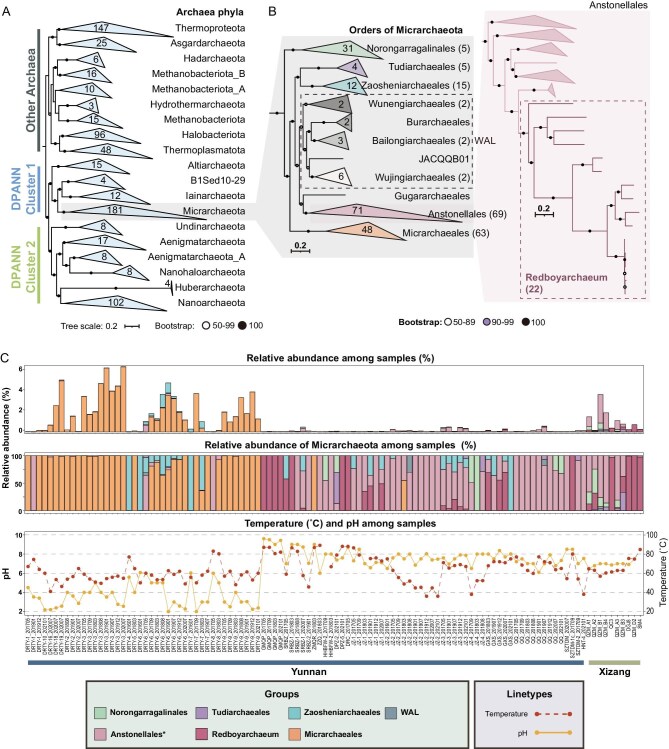 Figure 1
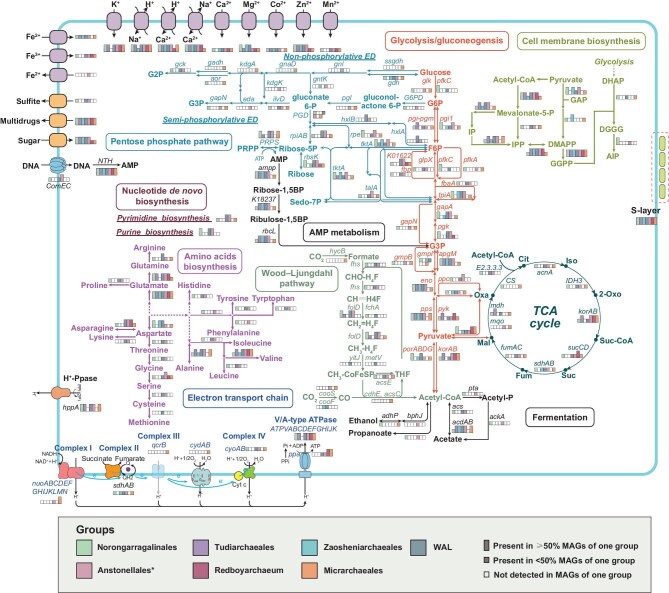 Figure 2
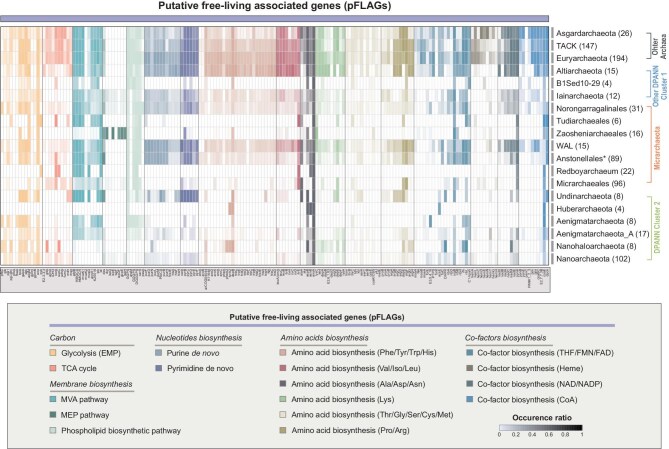 Figure 3
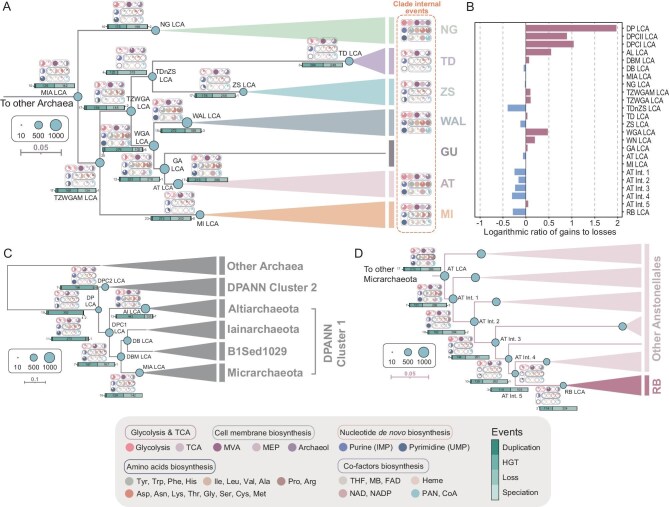 Figure 4
Peer Reviews
No public reviews on file for this paper yet. If you reviewed it on a platform where reviews are public (OpenReview, ICLR, NeurIPS, ICML), you can paste yours below so the community can read it here.
Videos
No videos yet. Explain this paper in a talk, walkthrough, or lecture? Add one.
Taxonomy
TopicsGenomics and Phylogenetic Studies · Microbial Community Ecology and Physiology · Insect symbiosis and bacterial influences