EasyHybrid: An Interactive Graphical Environment for Quantum, Classical and Hybrid Simulations with pDynamo3
Jose Fernando R. Bachega, Gustavo Hagen, Carlos Sequeiros-Borja, Kai Nikklas, Jorge Chahine, Luis Fernando M. S. Timmers, Martin J. Field

TL;DR
EasyHybrid is a user-friendly tool for running quantum and hybrid simulations in chemistry, making complex tasks easier with a graphical interface.
Contribution
The novelty is an integrated graphical environment for hybrid QC/MM simulations with advanced visualization and analysis tools.
Findings
EasyHybrid supports a wide range of simulations like reaction scans and molecular dynamics.
It offers 3D visualization and interactive editing for large biomolecular systems.
The platform integrates tools for efficient QC/MM setup and trajectory analysis.
Abstract
We present EasyHybrid, a free and open-source graphical interface for hybrid quantum chemical/molecular mechanical (QC/MM) simulations built on the pDynamo3 library. The software provides an intuitive environment for preparing, inspecting, and editing molecular systems, while supporting a broad range of simulations, including reaction coordinate scans, molecular dynamics, normal-mode analysis, Nudged Elastic Band, and umbrella sampling. Key features include advanced 3D visualization of large biomolecular systems, interactive editing, flexible atom selection, system pruning for efficient QC/MM setup, orbital and electrostatic potential surfaces, automated log parsing, and trajectory analysis. EasyHybrid integrates these tools into a single platform, offering a familiar yet specialized environment for quantum chemistry and hybrid QC/MM simulations.
Genes, proteins, chemicals, diseases, species, mutations and cell lines named across the full text — each resolved to its canonical identifier and authoritative record.
Click any figure to enlarge with its caption.
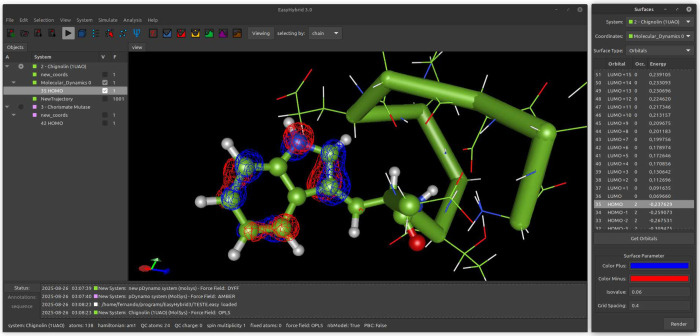 Figure 1
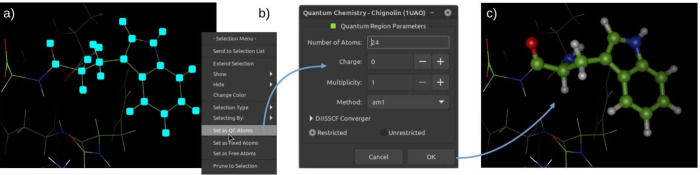 Figure 2
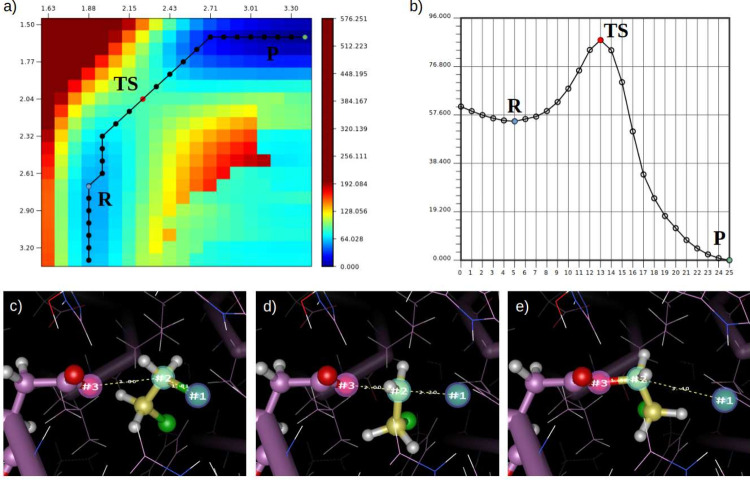 Figure 3
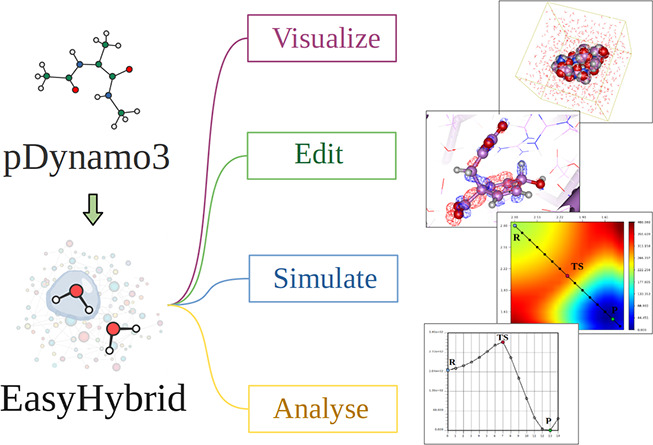 Figure 4
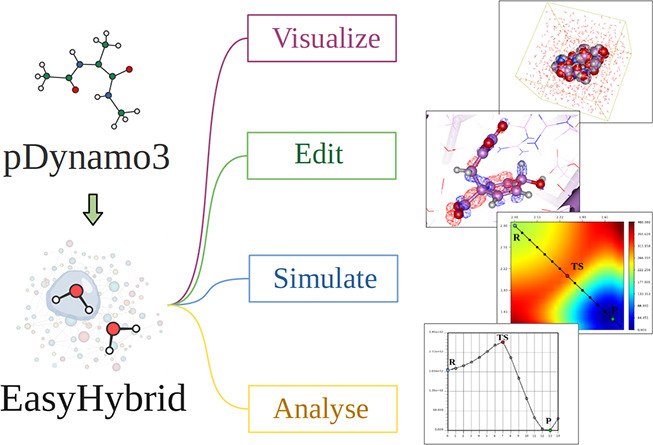 Figure 5
Peer Reviews
No public reviews on file for this paper yet. If you reviewed it on a platform where reviews are public (OpenReview, ICLR, NeurIPS, ICML), you can paste yours below so the community can read it here.
Videos
No videos yet. Explain this paper in a talk, walkthrough, or lecture? Add one.
Taxonomy
TopicsMachine Learning in Materials Science · Protein Structure and Dynamics · Crystallography and molecular interactions