Unraveling abundance from occurrence: Modeling an endangered rodent population with low capture probability
Abby E. Bratt, Cheryl S. Brehme, Robert N. Fisher, Aaron J. Bertoia, Darryl I. MacKenzie

TL;DR
This paper introduces a new method to estimate population abundance for elusive species like the Pacific pocket mouse using occupancy and detection data, which is more practical than traditional methods.
Contribution
The study presents a novel Bayesian approach to predict abundance from occupancy and detection data for species with low capture probability.
Findings
Occupancy and detection were positively correlated with density but could not fully explain all density variation.
The Bayesian method effectively integrates uncertainty in site-level abundance for population-level predictions.
The approach is applicable to other species with low capture probability and limited resources for direct density estimation.
Abstract
Predicting population abundance while accounting for uncertainty is an essential task for managers of endangered species but is often hindered by the challenge and expense of comprehensive data collection. Many traditional methods for estimating abundance of rare or elusive species are costly and logistically difficult, with occupancy‐based methods being a popular alternative. While the theoretical relationship between occupancy and abundance is well studied, there are few examples of methodological approaches for predicting abundance from occupancy. This study presents a novel approach to bridge the gap between abundance and occurrence for species with low capture probability, using the Pacific pocket mouse (Perognathus longimembris pacificus; PPM) in Southern California, USA, as a model system. PPM have been monitored across three subpopulations in this region using track tubes to…
Genes, proteins, chemicals, diseases, species, mutations and cell lines named across the full text — each resolved to its canonical identifier and authoritative record.
Click any figure to enlarge with its caption.
 Figure 1
 Figure 2
 Figure 3
 Figure 4
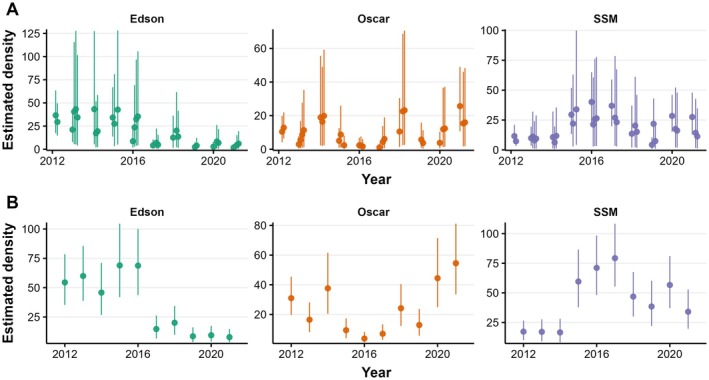 Figure 5
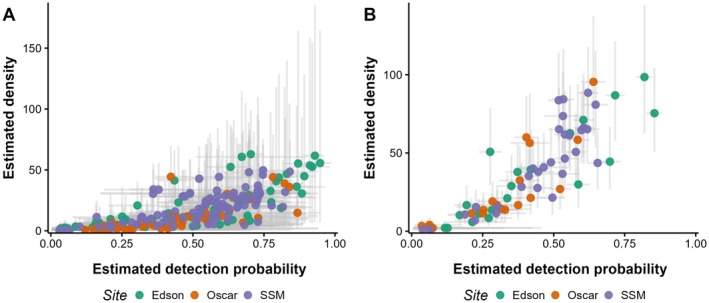 Figure 6
Peer Reviews
No public reviews on file for this paper yet. If you reviewed it on a platform where reviews are public (OpenReview, ICLR, NeurIPS, ICML), you can paste yours below so the community can read it here.
Videos
No videos yet. Explain this paper in a talk, walkthrough, or lecture? Add one.
Taxonomy
TopicsAnimal Ecology and Behavior Studies · Wildlife Ecology and Conservation · Species Distribution and Climate Change