Invasive Group A Streptococcal Disease in Persons Experiencing Postpandemic Homelessness in Canada
Caroline Kassee, Halima Dabaja-Younis, Lucie Richard, Alyssa R. Golden, Zoe Zhong, Vanessa Allen, Huda Almohri, Irene Armstrong, Mahin Baqi, Kevin R. Barker, Sergio Borgia, Aaron Campigotto, Sumon Chakrabarti, Wayne L. Gold, Rachel K. Hink, Christopher Kandel, Ian Kitai

TL;DR
In Canada, homeless people had a 70-fold higher rate of severe strep infections than housed people after the pandemic, with different risk factors and bacteria strains involved.
Contribution
Shows that homeless populations face a disproportionately higher burden of iGAS infections with distinct epidemiological patterns post-pandemic.
Findings
iGAS incidence was 70.7-fold higher among persons experiencing homelessness compared to housed individuals.
Persons experiencing homelessness were more likely to have nonintact skin and inject drugs, and less likely to be immunocompromised.
Different emm types caused iGAS in homeless versus housed populations, with emm49, 74, 80, 82, and 92 prevalent in homeless individuals.
Abstract
During the post–COVID-19 pandemic resurgence, how did invasive group A streptococcal (iGAS) infection compare between persons experiencing homeless (PEH) and housed persons? This cross-sectional study demonstrated that iGAS increased among both PEH and housed persons; PEH were less likely to be immunocompromised, but more likely to be persons who inject drugs, to have nonintact skin, and to present with soft tissue infection. iGAS was 70.7-fold more common among PEH than housed persons and emm types causing disease were different between the groups. The post–COVID-19 pandemic iGAS resurgence included PEH despite very different iGAS epidemiology between PEH and housed persons. Both invasive group A streptococcal (iGAS) infections and the number of persons experiencing homelessness (PEH) are increasing. Protection of PEH from the burden of iGAS infections requires understanding of its…
Genes, proteins, chemicals, diseases, species, mutations and cell lines named across the full text — each resolved to its canonical identifier and authoritative record.
Click any figure to enlarge with its caption.
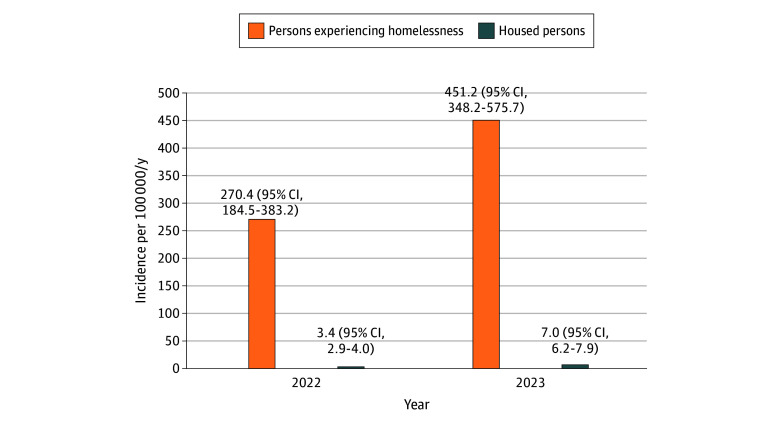 Figure 1
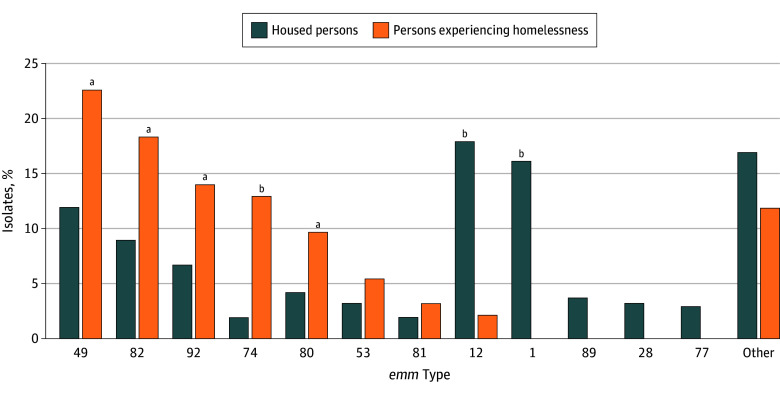 Figure 2
Peer Reviews
No public reviews on file for this paper yet. If you reviewed it on a platform where reviews are public (OpenReview, ICLR, NeurIPS, ICML), you can paste yours below so the community can read it here.
Videos
No videos yet. Explain this paper in a talk, walkthrough, or lecture? Add one.
Taxonomy
TopicsStreptococcal Infections and Treatments · Pneumonia and Respiratory Infections · Dermatological and COVID-19 studies