Colour stability of Siloczest LSR 120 against Cosmesil M511 maxillofacial silicones under simulated environmental ageing conditions
Pavankumar Koralakunte Ravi, Anurag Jain, Sunitha Naveen Shamnur, Nandeeshwar Doddabasavaiah Basvapura

TL;DR
This study compares how two types of silicone materials used in facial prostheses change color over time when exposed to simulated environmental conditions.
Contribution
The study provides a direct comparison of Siloczest LSR 120 and Cosmesil M511 under combined environmental stressors relevant to clinical use.
Findings
Both materials showed color changes, but Cosmesil M511 was more stable under neutral soap and combined sunlight and sweat.
Siloczest LSR 120 showed higher discoloration under neutral soap and combined conditions, but changes were within clinically acceptable limits for darker skin tones.
The combination of sweat and sunlight caused the greatest color degradation, especially in Siloczest LSR 120.
Abstract
Maxillofacial prostheses play a vital role in rehabilitating facial form and function, with long-term colour stability being a key determinant of patient satisfaction. These prostheses are routinely exposed to ultraviolet radiation, sweat, and cleaning agents, which may compromise their appearance over time. To compare the colour stability of two maxillofacial silicone elastomers, Siloczest LSR 120 and Cosmesil M511 under simulated ageing conditions replicating clinical exposures. A total of 80 samples (40 per material) were fabricated and divided into four subgroups based on ageing conditions: sunlight, artificial sweat, immersion in neutral soap, and a combination of sunlight and sweat. Colour measurements were recorded before and after 6 months of ageing, except for neutral soap (30 hours) using the Commission Internationale de l’Eclairage Lab* ( CIE L*a*b*) system via a…
Genes, proteins, chemicals, diseases, species, mutations and cell lines named across the full text — each resolved to its canonical identifier and authoritative record.
Click any figure to enlarge with its caption.
 Figure 1
 Figure 2
 Figure 3
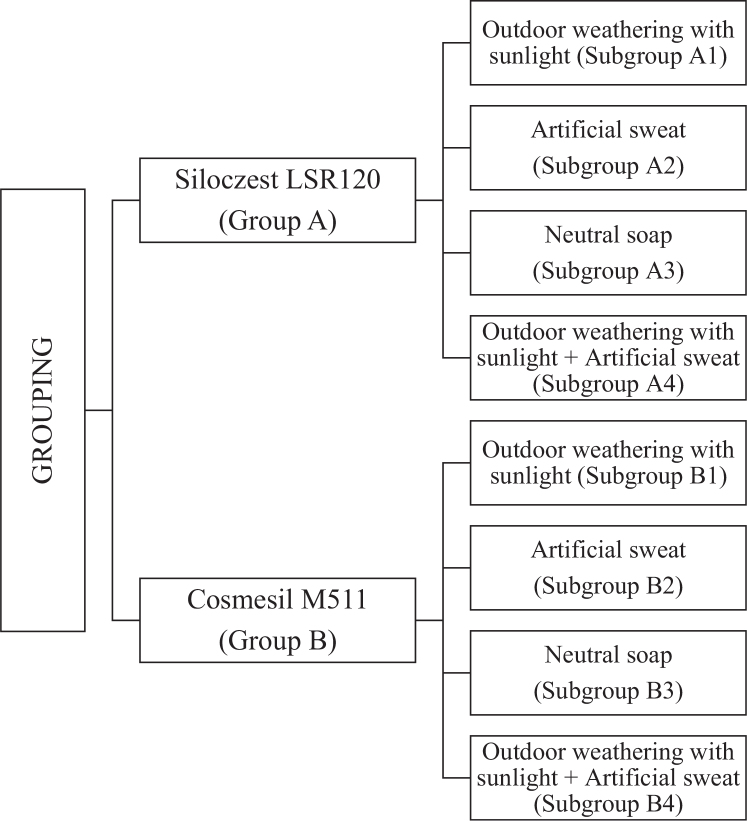 Figure 4
Peer Reviews
No public reviews on file for this paper yet. If you reviewed it on a platform where reviews are public (OpenReview, ICLR, NeurIPS, ICML), you can paste yours below so the community can read it here.
Videos
No videos yet. Explain this paper in a talk, walkthrough, or lecture? Add one.
Taxonomy
TopicsReconstructive Facial Surgery Techniques · Ocular Disorders and Treatments · Facial Rejuvenation and Surgery Techniques