Impact of Thoracic Duct Resection on Postoperative Body Composition Trajectory After Oesophagectomy: A Prospective Cohort Study
Tae Hee Hong, Young Ho Yang, Ha Eun Kim, Byung Jo Park, Chang Young Lee, Jin Gu Lee, Dae Joon Kim

TL;DR
This study finds that thoracic duct resection during oesophagectomy leads to a temporary but significant loss of muscle mass in the first three months post-surgery.
Contribution
The study is the largest to date examining longitudinal body composition changes after thoracic duct resection using serial bioelectrical impedance analysis.
Findings
Thoracic duct resection was associated with a more pronounced decline in skeletal muscle mass indices during the first three months post-surgery.
Muscle mass recovery began around three months post-surgery, with no significant differences in sarcopenia-related indices by 12 months.
The observed muscle loss appeared to be procedure-related rather than tumor-related, as similar patterns were seen in early-stage patients.
Abstract
Thoracic duct resection (TDR) is frequently performed during radical oesophagectomy to improve locoregional control in oesophageal squamous cell carcinoma (ESCC). However, its impact on postoperative body composition—particularly skeletal muscle mass—remains unclear. This study aimed to evaluate the extent and temporal pattern of postoperative changes in adiposity‐ and sarcopenia‐related indices following TDR. In this prospective cohort study, 347 patients with ESCC who underwent curative oesophagectomy between May 2018 and June 2022 were included. Patients were classified into a TDR group (n = 288) and a thoracic duct preservation group (n = 59). Body composition was assessed using bioelectrical impedance analysis (BIA) at six time points: preoperatively and 1, 2, 3, 6 and 12 months postoperatively, yielding 1925 measurements. Metrics analysed included body mass index (BMI), fat mass…
Genes, proteins, chemicals, diseases, species, mutations and cell lines named across the full text — each resolved to its canonical identifier and authoritative record.
Click any figure to enlarge with its caption.
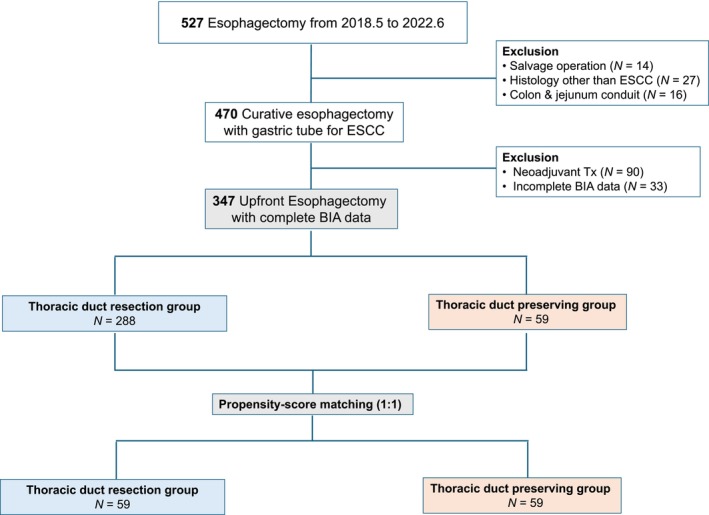 Figure 1
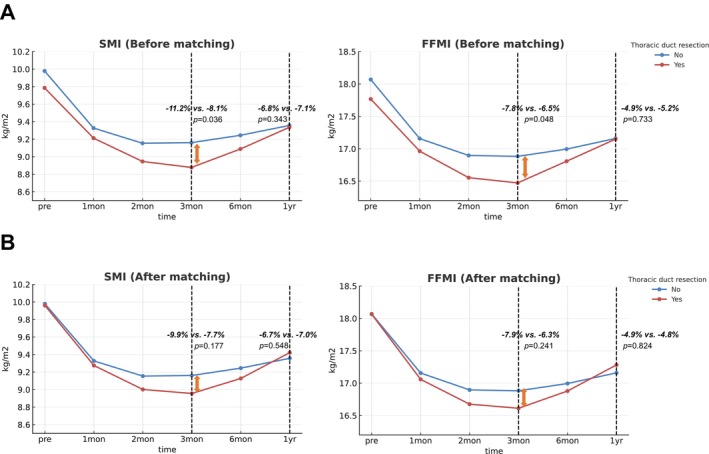 Figure 2
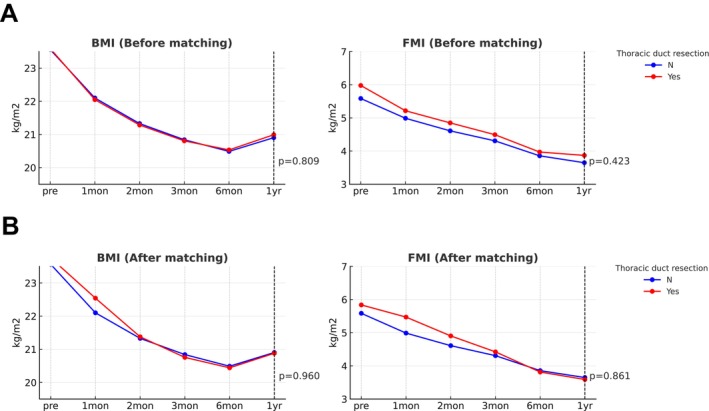 Figure 3
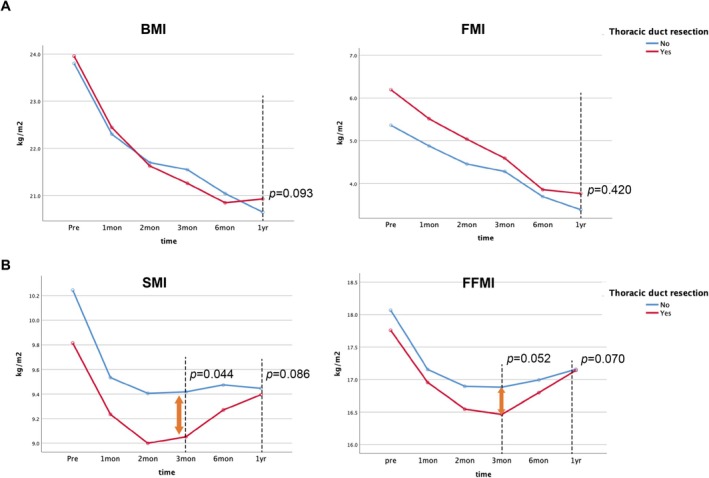 Figure 4
Peer Reviews
No public reviews on file for this paper yet. If you reviewed it on a platform where reviews are public (OpenReview, ICLR, NeurIPS, ICML), you can paste yours below so the community can read it here.
Videos
No videos yet. Explain this paper in a talk, walkthrough, or lecture? Add one.
Taxonomy
TopicsEsophageal Cancer Research and Treatment · Nutrition and Health in Aging · Body Composition Measurement Techniques