Rethinking Gleason pattern quantification in predicting metastasis: results of 20 years of follow‐up in the Rotterdam section of the European Randomized Study of Screening for Prostate Cancer
Lisa J Kroon, Sebastiaan Remmers, Ivo I de Vos, Charlotte F Kweldam, L Lucia Rijstenberg, Roderick C N van den Bergh, Monique J Roobol, Geert J L H van Leenders

TL;DR
This study shows that the amount of Gleason pattern 3 in prostate cancer biopsies does not predict metastasis when the amounts of more aggressive patterns are known.
Contribution
The study reveals that Gleason pattern 3 length does not affect metastasis prediction when absolute lengths of patterns 4 and 5 are considered.
Findings
Absolute lengths of Gleason patterns 4 and 5 are significantly associated with metastasis-free survival.
The presence of invasive cribriform/intraductal carcinoma improves the model's discriminative ability.
Gleason pattern 3 length is not a significant predictor of metastasis-free survival.
Abstract
The Gleason grading system for prostate cancer (PCa) is based on the proportions of Gleason patterns (GP) 3–5. While pure GP3 has minimal metastatic potential, it is unclear whether GP3 quantity in the presence of GP4 and GP5 affects oncological outcomes. To assess the predictive value of PCa biopsy GP lengths on long‐term metastasis‐free survival (MFS). Prostate biopsies of 1,881 men with screen‐detected PCa who participated in the Dutch part of the European Randomized Study of Screening for Prostate Cancer (ERSPC) between 1993 and 2007 were revised for GP 3–5 length. Multivariable Cox regression analyses were used to evaluate the relationship between GP lengths and MFS truncated at 20 years, adjusting for clinical‐tumour stage (cT), prostate‐specific antigen (PSA), percentage positive biopsies and the presence of invasive cribriform/intraductal carcinoma (CR/IDC). On multivariable…
Genes, proteins, chemicals, diseases, species, mutations and cell lines named across the full text — each resolved to its canonical identifier and authoritative record.
Click any figure to enlarge with its caption.
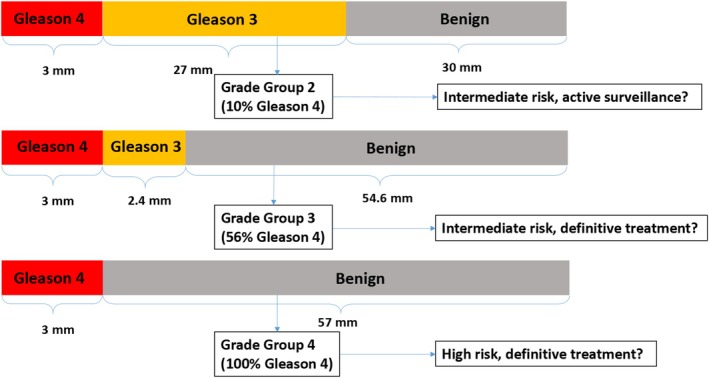 Figure 1
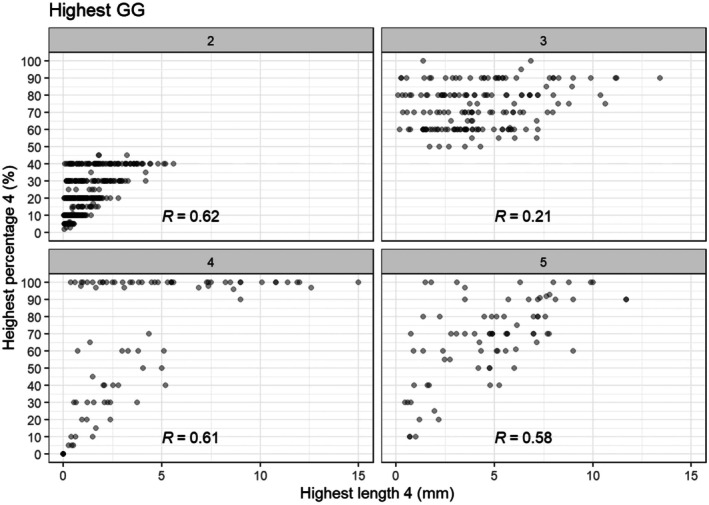 Figure 2
 Figure 3
Peer Reviews
No public reviews on file for this paper yet. If you reviewed it on a platform where reviews are public (OpenReview, ICLR, NeurIPS, ICML), you can paste yours below so the community can read it here.
Videos
No videos yet. Explain this paper in a talk, walkthrough, or lecture? Add one.
Taxonomy
TopicsProstate Cancer Diagnosis and Treatment · Prostate Cancer Treatment and Research · AI in cancer detection