Are glutathionylated aldehyde reductases the missing piece of the “catecholaldehyde hypothesis” in Parkinson's disease? A medical hypothesis concerning the detoxification of 4-hydroxynonenal (HNE) and 3,4-dihydroxyphenylacetaldehyde (DOPAL)
Rossella Rotondo, Marta Russo, Federico Iacovelli, Valeria Calabrese, Antonio de Iure, Maria Gaglione, Lorenza Leonardi, Gabriella Cocorocchia, Fabrizio Stocchi, Vilberto Stocchi, Maria Francesca de Pandis, Barbara Picconi

TL;DR
This paper explores how detoxifying harmful aldehydes like DOPAL may play a role in Parkinson's disease and suggests new ways to identify biomarkers and treatments.
Contribution
The paper proposes a novel detoxification pathway for DOPAL via glutathionylation and aldehyde reductases, extending the catecholaldehyde hypothesis.
Findings
DOPAL and its quinone derivative may be detoxified through glutathionylation, similar to HNE.
Glutathione-dependent aldehyde reductases like AKR1B1 and CBR1 could reduce GS-DOPAL to GS-DOPET.
Excretion of GS-DOPAL adducts may serve as early PD biomarkers and inform new therapies.
Abstract
The autotoxicity of the monoamine oxidase (MAO) reaction product 3,4-dihydroxyphenylacetaldehyde (DOPAL) is central to the “catecholaldehyde hypothesis”, which posits that interactions between DOPAL and the protein α-synuclein contribute to the degeneration of catecholaminergic neurons in Parkinson's disease (PD). Dopamine (DA) can undergo spontaneous or enzymatic oxidation, generating dopamine-quinone (DA-Q) and DOPAL, respectively. While growing evidence highlights the quinonization of numerous proteins in catecholaminergic cells due to the high reactivity of DA-Q, the electrophilic properties of DOPAL and its quinone derivative (DOPAL-quinone, DOPAL-Q) have received less attention, along with potential detoxification pathways. Here, we propose a refinement of the “catecholaldehyde hypothesis” by extending the detoxification machinery described for 3-glutathionyl-4-hydroxynonenal…
Genes, proteins, chemicals, diseases, species, mutations and cell lines named across the full text — each resolved to its canonical identifier and authoritative record.
Click any figure to enlarge with its caption.
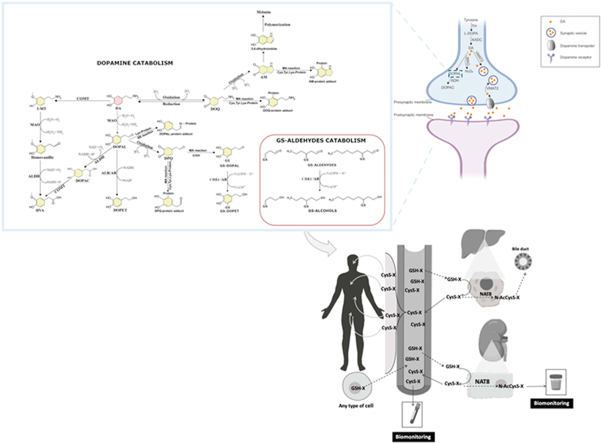 Figure 1
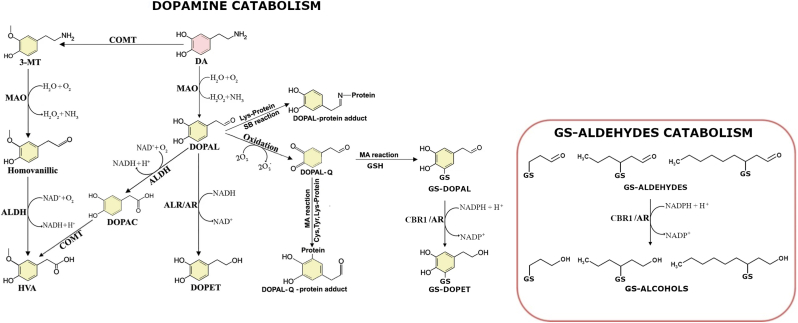 Figure 2
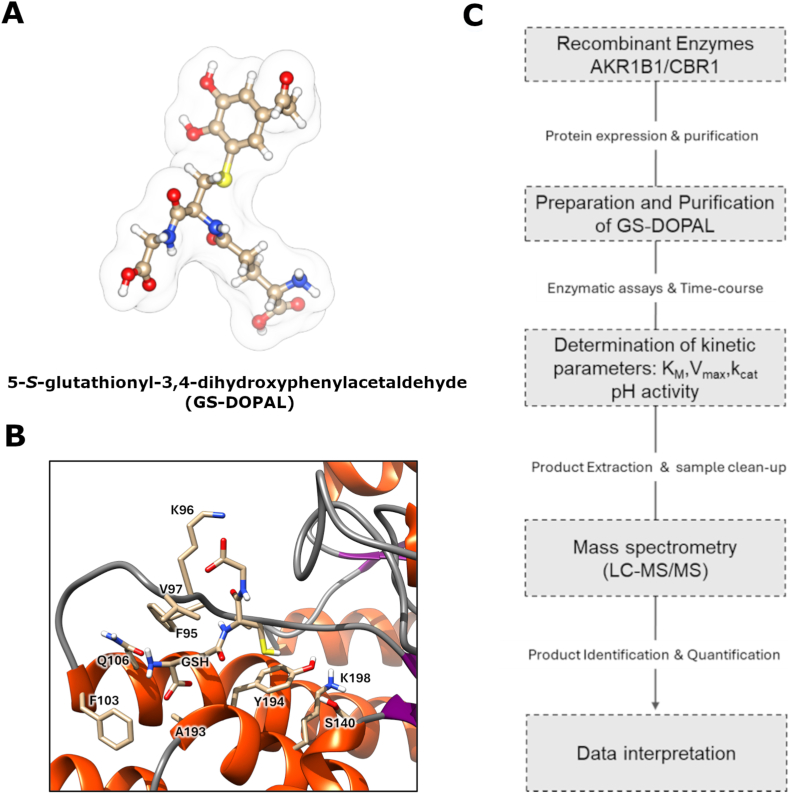 Figure 3
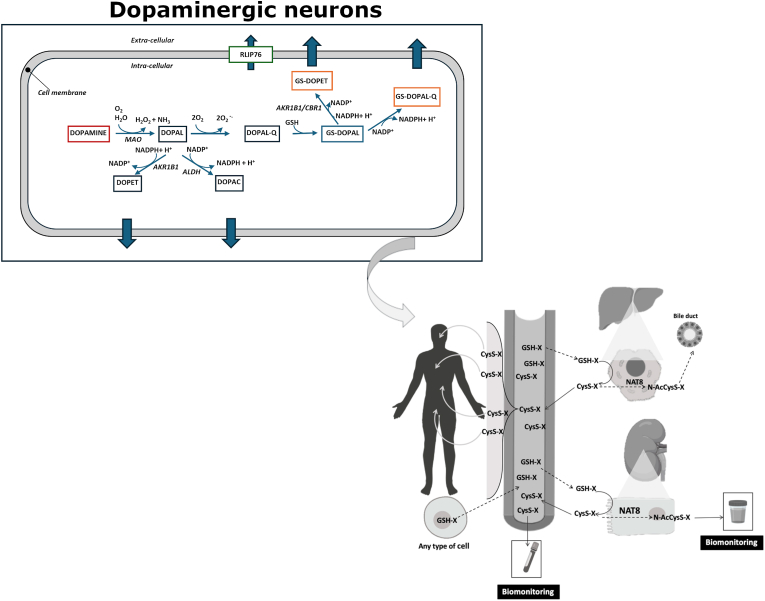 Figure 4
Peer Reviews
No public reviews on file for this paper yet. If you reviewed it on a platform where reviews are public (OpenReview, ICLR, NeurIPS, ICML), you can paste yours below so the community can read it here.
Videos
No videos yet. Explain this paper in a talk, walkthrough, or lecture? Add one.
Taxonomy
TopicsParkinson's Disease Mechanisms and Treatments · Microbial metabolism and enzyme function · Genomics, phytochemicals, and oxidative stress