Phenotypic Analysis of P‐Wave Morphology as a Key Determinant of Late Recurrence Post‐Ablation in Paroxysmal Atrial Fibrillation
Masamichi Yano, Yasuyuki Egami, Noriyuki Kobayashi, Ayako Sugino, Masaru Abe, Mizuki Ohsuga, Hiroaki Nohara, Shodai Kawanami, Kohei Ukita, Akito Kawamura, Koji Yasumoto, Naotaka Okamoto, Yasuharu Matsunaga‐Lee, Masami Nishino

TL;DR
This study finds that specific patterns in P-wave morphology, especially when combined, can predict the risk of arrhythmia recurrence after atrial fibrillation ablation.
Contribution
The study introduces a novel phenotypic classification based on P-wave morphology to predict late recurrence after catheter ablation for atrial fibrillation.
Findings
Phenotype 3, combining prolonged P-wave duration and low P-wave amplitude, showed the highest risk of late arrhythmia recurrence.
Phenotype 3 had significantly higher recurrence rates at 1 and 3 years compared to other phenotypes.
Phenotype 3 correlated with higher scores in low voltage area prediction models and clinical markers of advanced atrial remodeling.
Abstract
It remains unclear how P‐wave morphology characteristics can be used to stratify the risk of late recurrence after catheter ablation (CA) for atrial fibrillation (AF). Patients with paroxysmal AF who underwent an initial CA were enrolled. We investigated the association between P‐wave morphology (P‐wave duration (Pd), PQ interval, P‐wave amplitude (PWA) in leads II, V2, and V6) and late arrhythmia recurrence. Patients were classified into groups using statistical methods, and differences in recurrence and predictive scores for low voltage areas (LVA) among the groups were evaluated. A total of 1005 paroxysmal AF patients undergoing initial CA were included. Cox regression identified female sex, Pd > 124 ms, PQ > 196 ms, and low PWA in leads II, V2, and V6 as predictors of late recurrence. Hierarchical clustering defined three phenotypes: Phenotype 1 (isolated low PWA), Phenotype 2…
Genes, proteins, chemicals, diseases, species, mutations and cell lines named across the full text — each resolved to its canonical identifier and authoritative record.
Click any figure to enlarge with its caption.
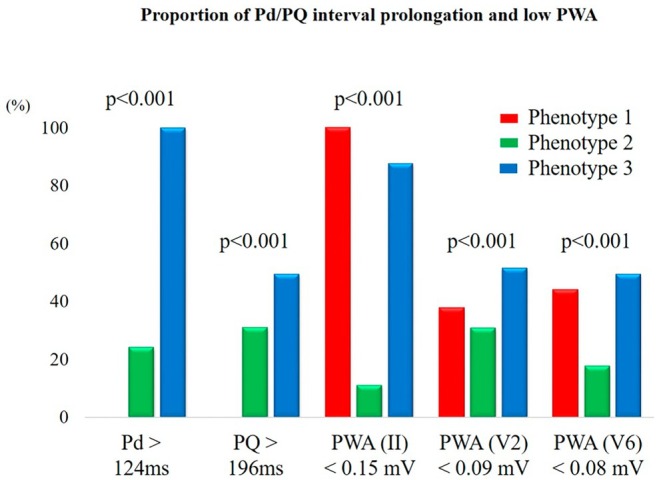 Figure 1
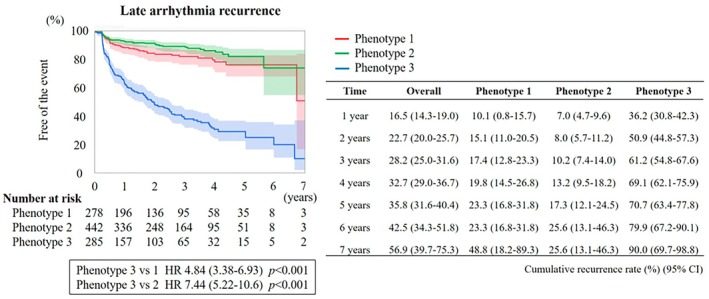 Figure 2
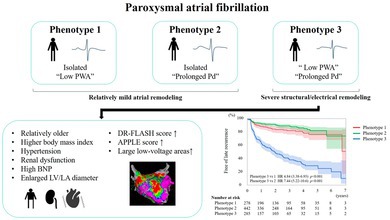 Figure 3
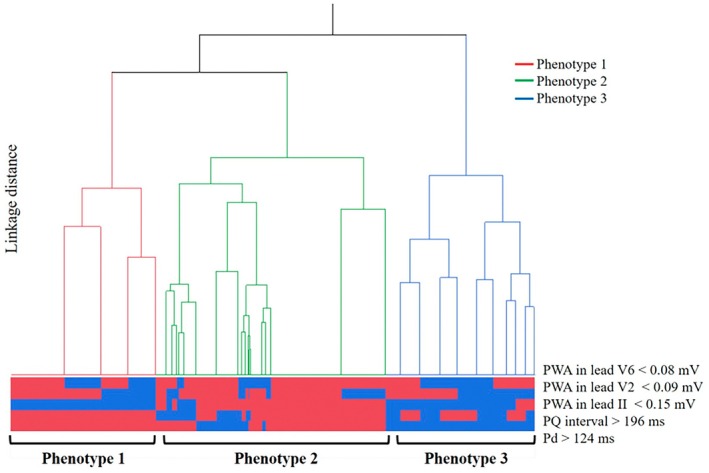 Figure 4
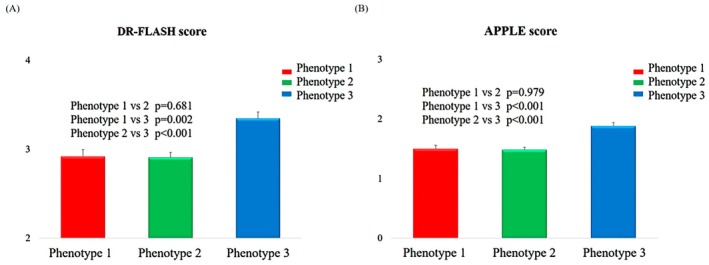 Figure 5
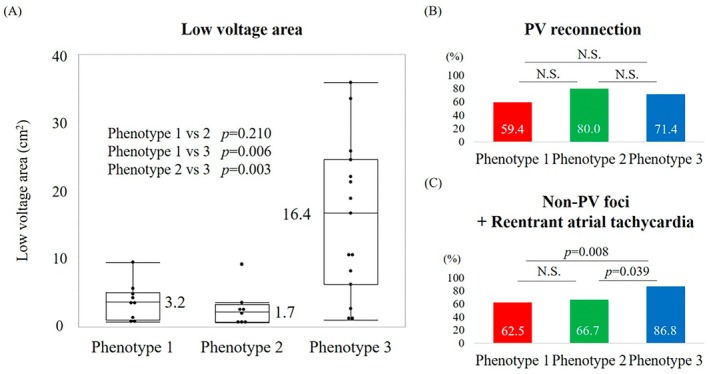 Figure 6
Peer Reviews
No public reviews on file for this paper yet. If you reviewed it on a platform where reviews are public (OpenReview, ICLR, NeurIPS, ICML), you can paste yours below so the community can read it here.
Videos
No videos yet. Explain this paper in a talk, walkthrough, or lecture? Add one.
Taxonomy
TopicsAtrial Fibrillation Management and Outcomes · Cardiac Arrhythmias and Treatments · Cardiac electrophysiology and arrhythmias