Architect of Frailty Biology and Champion of Translational Geroscience
Peter M. Abadir, Brian Buta, Karen Bandeen‐Roche

TL;DR
This paper honors Jeremy Walston's work in understanding frailty through biology and advancing aging research.
Contribution
Walston's novel integration of biological mechanisms with clinical frailty research transformed the field of geroscience.
Findings
Frailty is linked to chronic inflammation and mitochondrial dysfunction.
Leadership in studies like OAIC and SPRING advanced translational geroscience.
His work trained new researchers in aging science.
Abstract
Jeremy Walston helped transform frailty from a clinical syndrome into a biologically grounded condition, linking chronic inflammation, mitochondrial dysfunction, and impaired stress responses to loss of physiologic reserve. His leadership of the Johns Hopkins OAIC and SPRING studies advanced translational geroscience and trained a generation of investigators.
Genes, proteins, chemicals, diseases, species, mutations and cell lines named across the full text — each resolved to its canonical identifier and authoritative record.
Click any figure to enlarge with its caption.
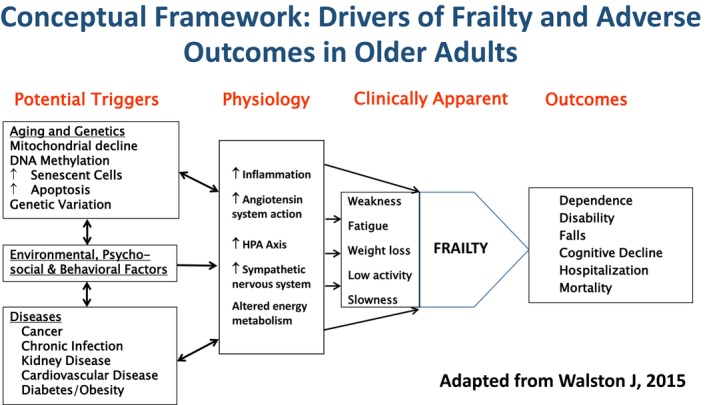 Figure 1
 Figure 2
Peer Reviews
No public reviews on file for this paper yet. If you reviewed it on a platform where reviews are public (OpenReview, ICLR, NeurIPS, ICML), you can paste yours below so the community can read it here.
Videos
No videos yet. Explain this paper in a talk, walkthrough, or lecture? Add one.
Taxonomy
TopicsGenetics, Aging, and Longevity in Model Organisms · Frailty in Older Adults · Aging and Gerontology Research