Night-eating syndrome is associated with food consumption frequency among Chinese college students
Zixuan Hao, Xiaoqin Guo, Qi Jing, Boyang Zhao, Mengyi Huang, Zhongyu Ren

TL;DR
This study finds that night-eating syndrome is linked to specific eating patterns, such as higher fruit and snack consumption, among Chinese college students.
Contribution
The study identifies novel associations between night-eating syndrome severity and distinct dietary behaviors in a large sample of Chinese college students.
Findings
NES is positively associated with higher consumption of fruits, vegetables, snacks, and sugary beverages.
NES is linked to more frequent breakfast and lunch consumption but not fast food or dinner frequency.
The study highlights distinctive eating patterns among college students with NES.
Abstract
Patients with night-eating syndrome (NES) exhibit circadian rhythm dysfunction and comorbidities, including insomnia, anxiety, and depression. Therefore, understanding its potential risks and consequences is crucial. This study examined associations between night-eating syndrome (NES), food consumption frequency, and the frequency of consuming three daily meals among Chinese college students. A total of 11,856 university students (mean age 18.8 years) participated in this large-scale cross-sectional study. NES was assessed using the Nocturnal Eating Questionnaire and categorized as no NES (score < 25), mild NES (25–30), or severe NES (> 30). Food consumption frequency was evaluated across five categories—fruits, vegetables, fast food, snacks, and sugary beverages. The frequency of consuming breakfast, lunch, and dinner was also recorded. Multivariate logistic regression analyses were…
Genes, proteins, chemicals, diseases, species, mutations and cell lines named across the full text — each resolved to its canonical identifier and authoritative record.
Click any figure to enlarge with its caption.
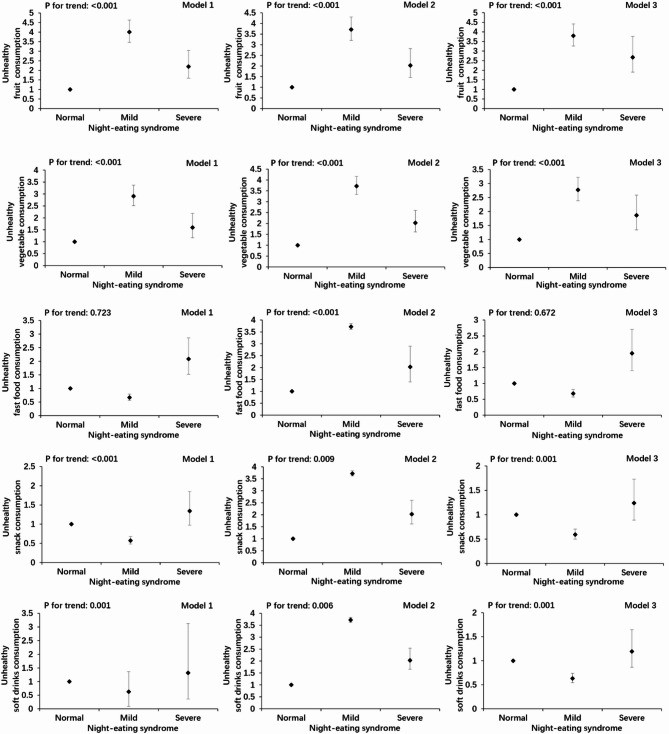 Figure 1
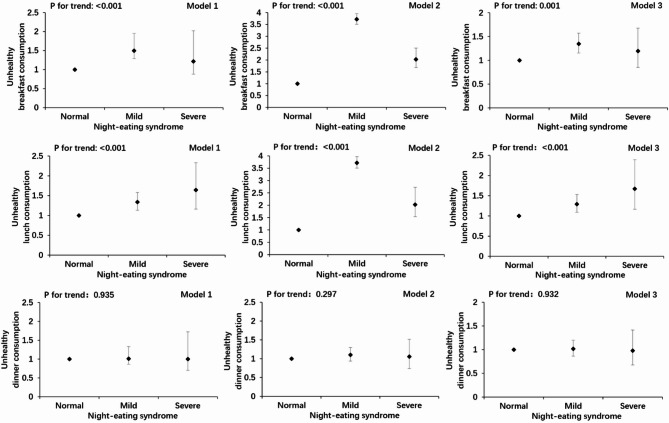 Figure 2
Peer Reviews
No public reviews on file for this paper yet. If you reviewed it on a platform where reviews are public (OpenReview, ICLR, NeurIPS, ICML), you can paste yours below so the community can read it here.
Videos
No videos yet. Explain this paper in a talk, walkthrough, or lecture? Add one.
Taxonomy
TopicsEating Disorders and Behaviors · Culinary Culture and Tourism · Dietary Effects on Health