Artificial intelligence-derived transition zone PSA density as a triage tool to reduce unnecessary prostate systematic biopsies in MRI-negative men
Jiaheng Shang, Jingyun Wu, Ruiyi Deng, Meixia Shang, Pengsheng Wu, Jianhui Qiu, Jingcheng Zhou, Lin Cai, Xiaoying Wang, Kan Gong, Yi Liu

TL;DR
This study shows that a new AI-based measure of prostate-specific antigen density can better predict significant prostate cancer in men with negative MRI scans, potentially reducing unnecessary biopsies.
Contribution
The study introduces AI-derived transition zone PSA density as a superior triage tool for detecting clinically significant prostate cancer in MRI-negative patients.
Findings
TZ-PSAD outperformed conventional PSAD with an AUC of 0.718 versus 0.686.
A TZ-PSAD threshold of 0.35 ng/mL/cc identified 20.1% csPCa cases versus 4.1% below threshold.
TZ-PSAD was a strong independent predictor of imaging-invisible csPCa.
Abstract
The study aimed to assess the predictive performance of transition zone PSA density (TZ-PSAD) compared to conventional PSA density (PSAD) in detecting clinically significant prostate cancer (csPCa) among patients with negative pre-biopsy MRI findings. The study included 606 patients with negative MRI findings who subsequently underwent transrectal ultrasound-guided systematic biopsy. AI software automatically measured prostate and zonal volumes, from which PSAD and TZ-PSAD (total PSA/transition zone volume) were calculated. Diagnostic performances were evaluated using ROC curve analysis, risk stratification was applied to select patients needing biopsy, and independent predictors of imaging-invisible csPCa were determined through univariate and multivariate analyses. 51 patients (8.4%) were diagnosed with csPCa. TZ-PSAD demonstrated significant superior discriminative ability (AUC =…
Genes, proteins, chemicals, diseases, species, mutations and cell lines named across the full text — each resolved to its canonical identifier and authoritative record.
Click any figure to enlarge with its caption.
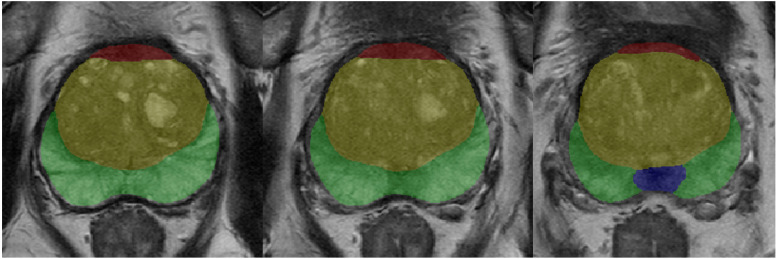 Figure 1
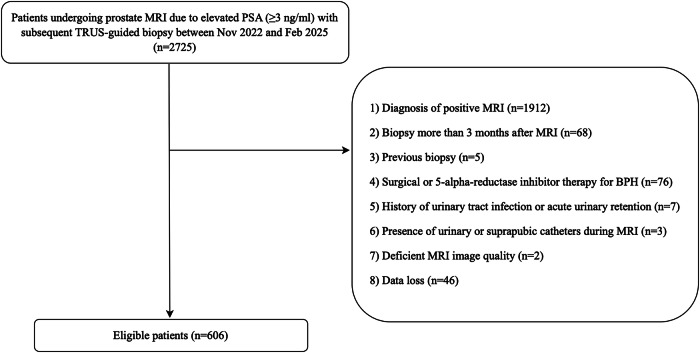 Figure 2
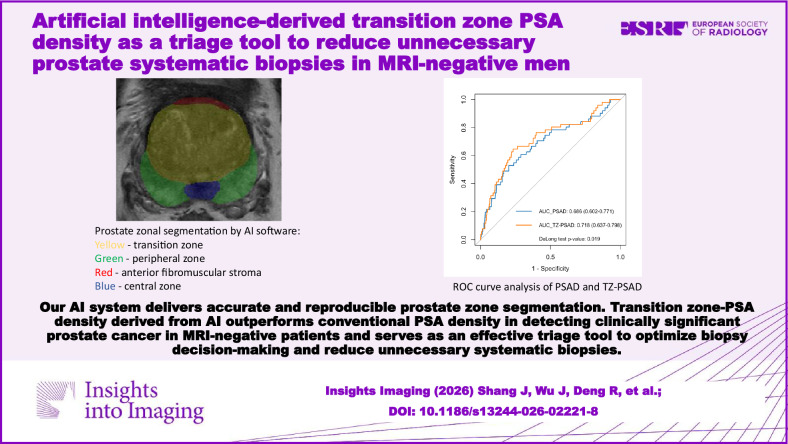 Figure 3
Peer Reviews
No public reviews on file for this paper yet. If you reviewed it on a platform where reviews are public (OpenReview, ICLR, NeurIPS, ICML), you can paste yours below so the community can read it here.
Videos
No videos yet. Explain this paper in a talk, walkthrough, or lecture? Add one.
Taxonomy
TopicsProstate Cancer Diagnosis and Treatment · Advanced Radiotherapy Techniques · MRI in cancer diagnosis