No Partner, No Children? Union Formation, Assortative Mating, and Educational Inequalities in Fertility in Germany
Julia Leesch, Nicole Hiekel

TL;DR
Higher education in Germany affects fertility through partnership formation, with differences between men, women, and East and West Germany.
Contribution
The study identifies union formation as a key mechanism linking education and fertility, with context-specific gendered effects.
Findings
Higher education influences fertility directly and indirectly through union formation, but not strongly through partner's education.
In West Germany, higher education reduced women's first births but not second births, while increasing men's first and second births.
In East Germany, higher education had limited effects on fertility, except for increasing men's second birth probabilities.
Abstract
Education is linked to whether and with whom individuals form partnerships. However, it is largely unclear how educational differences in union formation and matching with equally, more, or less educated partners shape educational disparities in fertility. Using data from the German Socio-Economic Panel, we applied marginal structural models to investigate how higher education affects the probabilities of ever having a first and a second child, and to what extent these effects operate through union formation (having a partner or not) and assortative mating (having a highly educated partner or not). We compared women and men socialised in East and West Germany before reunification, two contexts with distinct gender and stratification regimes. Findings indicate that higher education influenced fertility directly and indirectly through partnership formation, but only marginally through…
Genes, proteins, chemicals, diseases, species, mutations and cell lines named across the full text — each resolved to its canonical identifier and authoritative record.
Click any figure to enlarge with its caption.
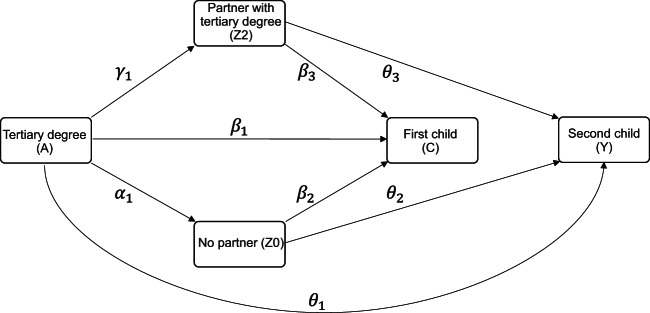 Figure 1
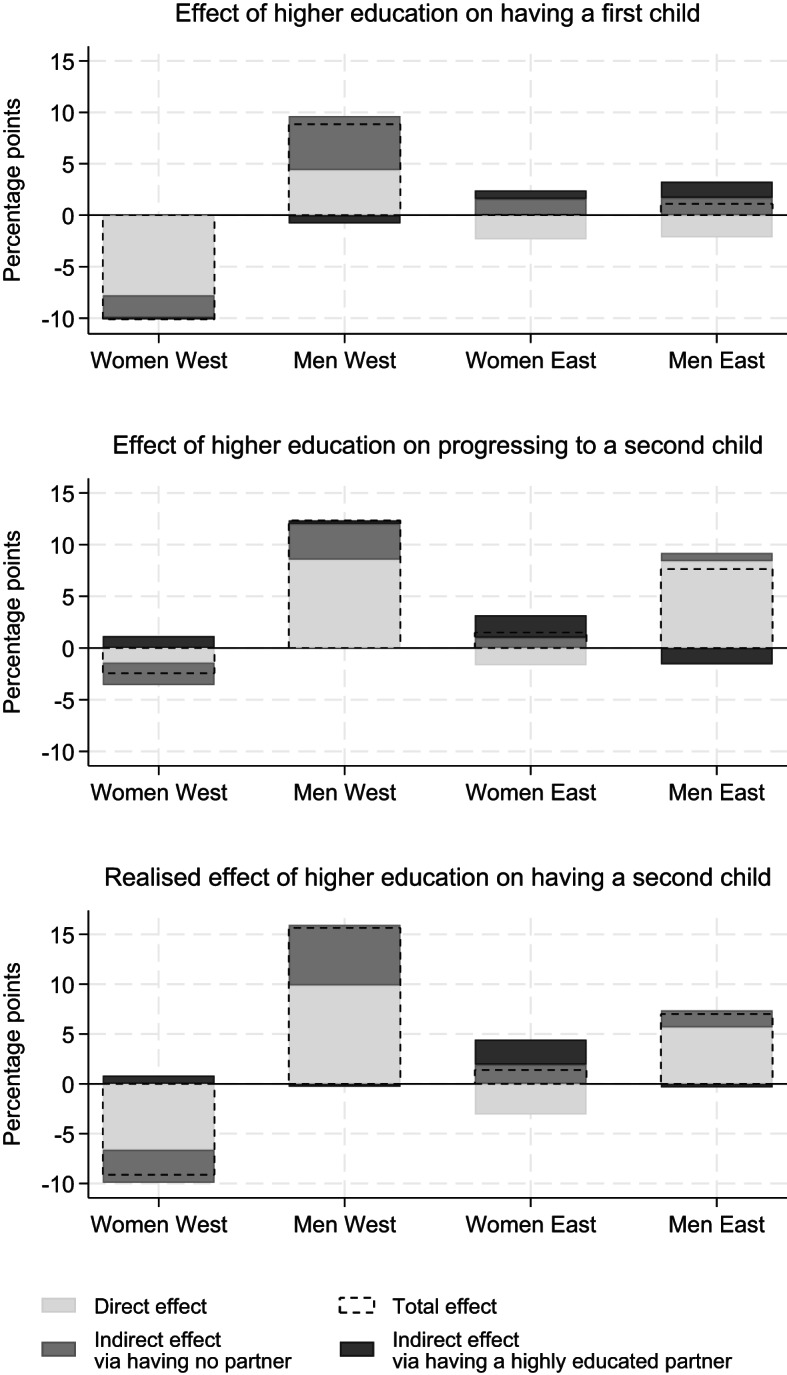 Figure 2
Peer Reviews
No public reviews on file for this paper yet. If you reviewed it on a platform where reviews are public (OpenReview, ICLR, NeurIPS, ICML), you can paste yours below so the community can read it here.
Videos
No videos yet. Explain this paper in a talk, walkthrough, or lecture? Add one.
Taxonomy
TopicsFamily Dynamics and Relationships · Work-Family Balance Challenges · Evolutionary Psychology and Human Behavior