Clinical feasibility test of 60 kVp double-low-dose coronary CT angiography with a deep learning reconstruction algorithm
Xi Wu, Manman Zhu, Yixuan Zou, Jialin Luo, Weiling He, Wenjie Sun, Hui Shi, Peng Liu, Feng Huang

TL;DR
This study shows that a new low-dose CT scan for heart arteries using deep learning can safely reduce radiation and contrast use while keeping diagnostic accuracy.
Contribution
A novel deep learning reconstruction algorithm enables double-low-dose coronary CT angiography with high diagnostic consistency.
Findings
60 kVp double-low-dose CCTA reduced radiation dose by 86.5% and contrast dose by 36.4%.
DLR improved coronary stenosis assessment specificity, positive predictive value, and accuracy compared to HIR.
LD-DLR showed high consistency in CT-FFR values with routine-dose CCTA across multiple vessel levels.
Abstract
To test the feasibility of 60 kVp double-low-dose coronary CT angiography (CCTA) with a deep learning reconstruction (DLR) algorithm. Eighty-nine patients (44 females, 59.9 ± 13.2 years, 23.1 ± 3.3 kg/m2) with known or suspected coronary artery disease were prospectively enrolled. Each patient underwent the double-low-dose CCTA (60-kVp, 28 mL contrast at 2.5 mL/s) and was immediately followed by routine-dose CCTA (100-kVp, 44 mL contrast at 4.0 mL/s). Routine-dose data were reconstructed using hybrid iterative reconstruction (RD-HIR), and double-low-dose data were reconstructed using both HIR (LD-HIR) and DLR (LD-DLR). The consistency of both coronary stenosis assessments and CT-derived fractional flow reserve (CT-FFR) values between low-dose and routine-dose images was quantified using receiver operating characteristic analysis at various levels. Segment-level image quality scores…
Genes, proteins, chemicals, diseases, species, mutations and cell lines named across the full text — each resolved to its canonical identifier and authoritative record.
Click any figure to enlarge with its caption.
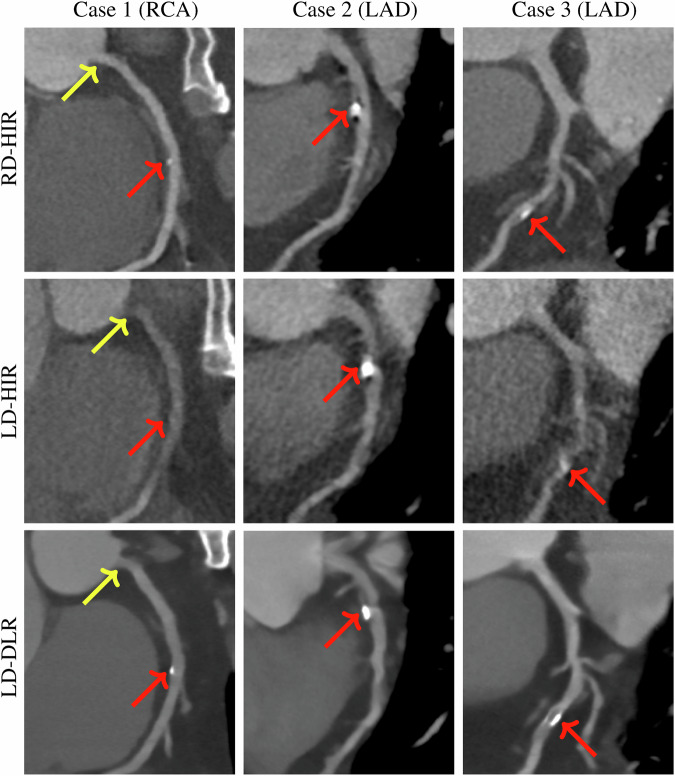 Figure 1
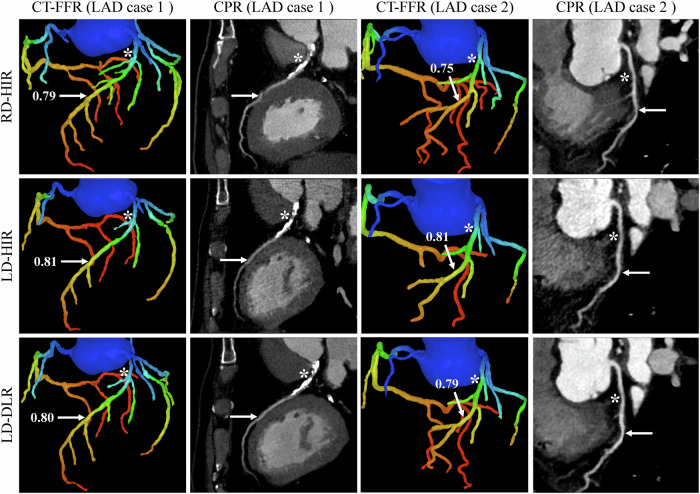 Figure 2
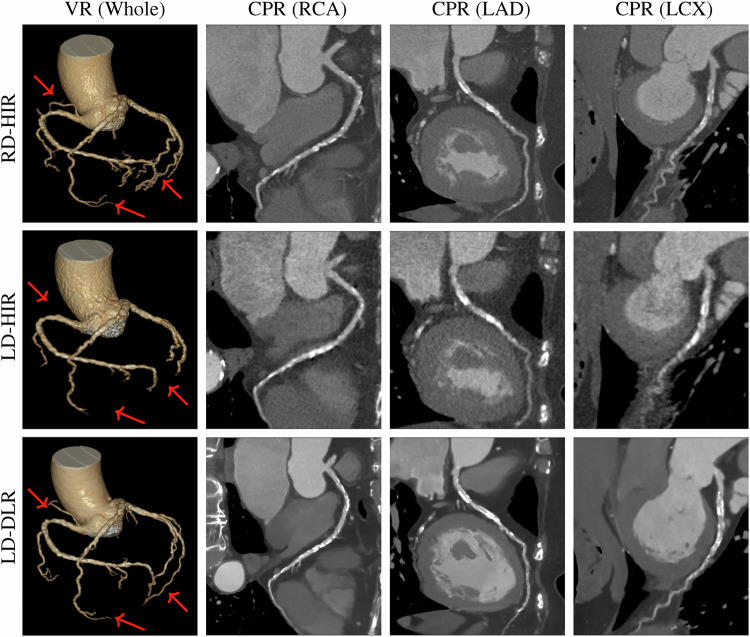 Figure 3
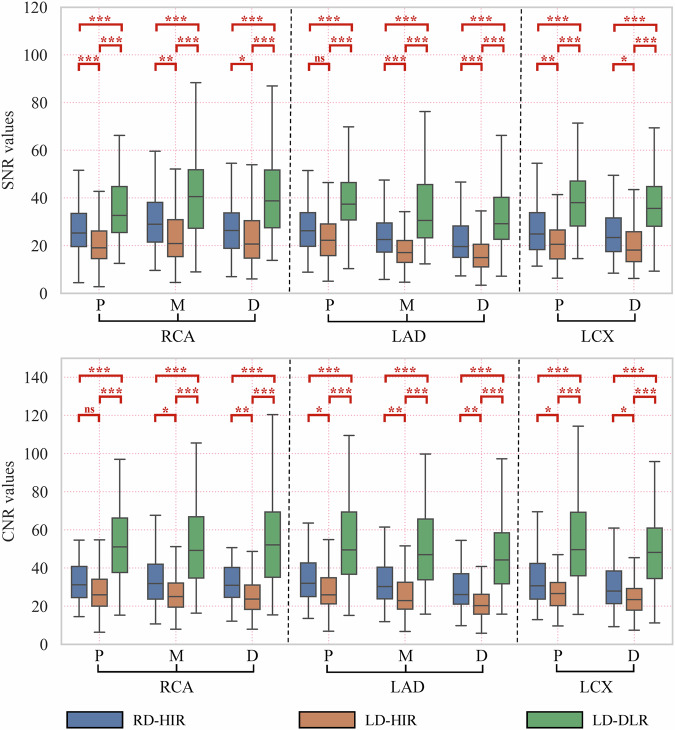 Figure 4
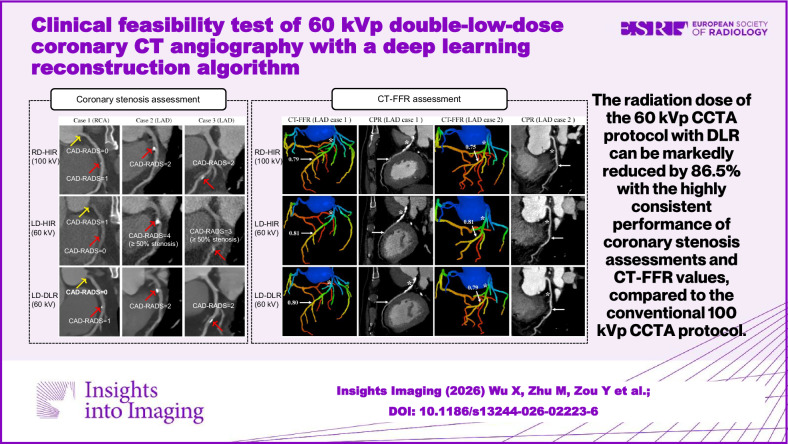 Figure 5
Peer Reviews
No public reviews on file for this paper yet. If you reviewed it on a platform where reviews are public (OpenReview, ICLR, NeurIPS, ICML), you can paste yours below so the community can read it here.
Videos
No videos yet. Explain this paper in a talk, walkthrough, or lecture? Add one.
Taxonomy
TopicsCardiac Imaging and Diagnostics · Radiation Dose and Imaging · Advanced X-ray and CT Imaging