EF-Feddr: communication-efficient federated learning with Douglas–Rachford splitting and error feedback
Jiao Xue, Chundong Wang

TL;DR
EF-Feddr is a new communication-efficient federated learning algorithm that improves training efficiency and convergence in privacy-preserving settings.
Contribution
EF-Feddr combines relaxed Douglas–Rachford splitting with error feedback to achieve efficient convergence under biased compression.
Findings
EF-Feddr achieves a convergence rate of O(1/K) and communication complexity of O(1/ε²).
Experiments on FEMNIST, Shakespeare, and synthetic data show EF-Feddr's effectiveness in non-IID settings.
Error feedback prevents convergence degradation caused by biased compression methods like top-k sparsification.
Abstract
Federated learning (FL) is a distributed machine learning paradigm that preserves data privacy and mitigates data silos. Nevertheless, frequent communication between clients and the server often becomes a major bottleneck, restricting training efficiency and scalability. To address this challenge, we propose a novel communication-efficient algorithm, EF-Feddr, for federated composite optimization, where the objective function includes a potentially non-smooth regularization term and local datasets are non-IID. Our method is built upon the relaxed Douglas–Rachford splitting method and incorporates error feedback (EF)—a widely adopted compression framework—to ensure convergence when biased compression (e.g., top-k sparsification) is applied. Under the partial client participation setting, our theoretical analysis demonstrates that EF-Feddr achieves a fast convergence rate of O(1/K) and…
Genes, proteins, chemicals, diseases, species, mutations and cell lines named across the full text — each resolved to its canonical identifier and authoritative record.
Click any figure to enlarge with its caption.
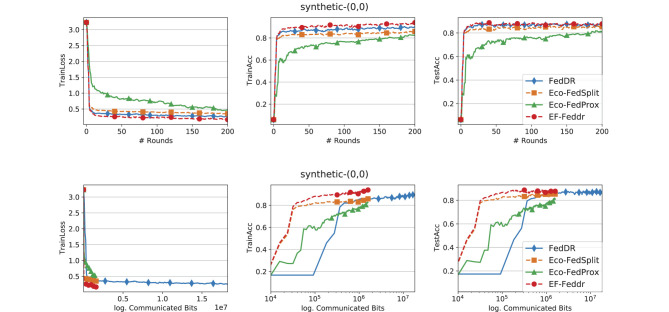 Figure 1
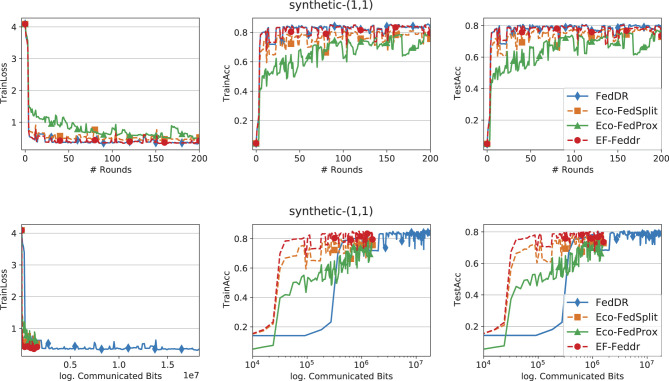 Figure 2
 Figure 3
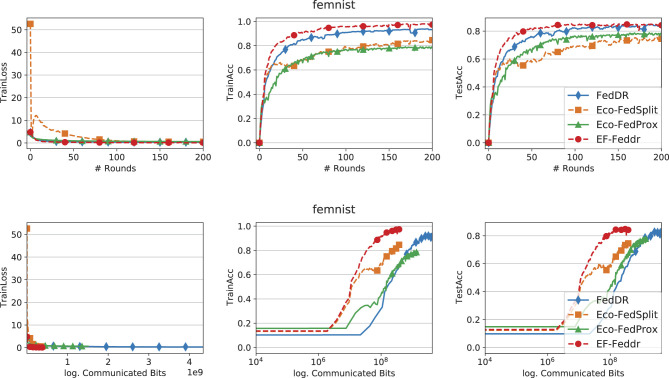 Figure 4
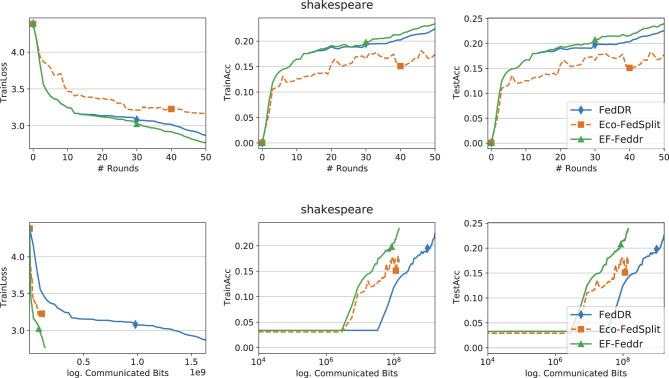 Figure 5
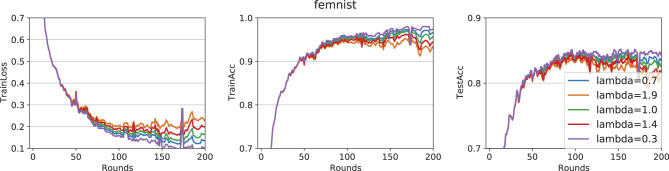 Figure 6
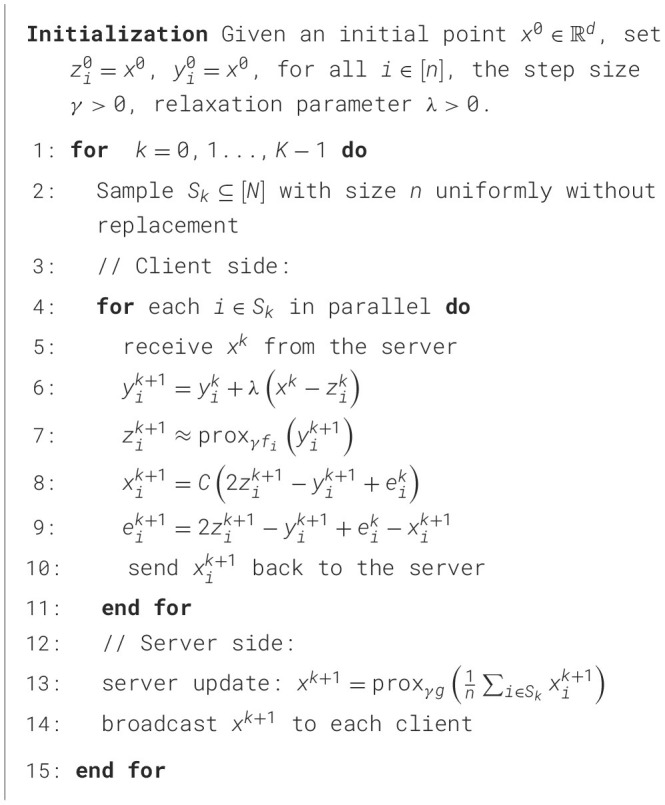 Figure 7
Peer Reviews
No public reviews on file for this paper yet. If you reviewed it on a platform where reviews are public (OpenReview, ICLR, NeurIPS, ICML), you can paste yours below so the community can read it here.
Videos
No videos yet. Explain this paper in a talk, walkthrough, or lecture? Add one.
Taxonomy
TopicsPrivacy-Preserving Technologies in Data · Stochastic Gradient Optimization Techniques · Cryptography and Data Security