The effect of age-related decline in physiological activity on the concealed information test
Robin Orthey, Yoshiyuki Tsuyama, Izumi Ikeda, Takahiro Yoshioka, Masaki Ishihara, Izumi Matsuda

TL;DR
This study examines how aging affects the accuracy of the Concealed Information Test, a physiological test used in criminal investigations.
Contribution
The study evaluates the impact of age-related physiological decline on the Concealed Information Test using senior participants.
Findings
Skin conductance response was effective but had a higher proportion of non-responders among seniors.
Heart rate could detect hidden knowledge with modified baseline correction.
Respiration was not a diagnostic measure in the test.
Abstract
A demographic shift towards aging societies necessitates a reexamination of established psychological tests with age-related decline of physiological responsivity in mind. The Concealed Information Test (CIT), a physiological test to detect memory of crime details, is frequently and effectively used in criminal investigations in Japan, a severe case of an aging society. Its validity has been well established, but almost all the support stems from data of young and healthy university students. Yet, the age-related decline in physiological activity is well documented, but it is unclear how the CIT is affected. We examined the robustness of the CIT to the effects of advanced age by subjecting 33 seniors, aged 62-80, to a standard CIT examination, measuring skin conductance response, heart rate, and respiration over two conditions. Once participants were aware of secret information and hid…
Click any figure to enlarge with its caption.
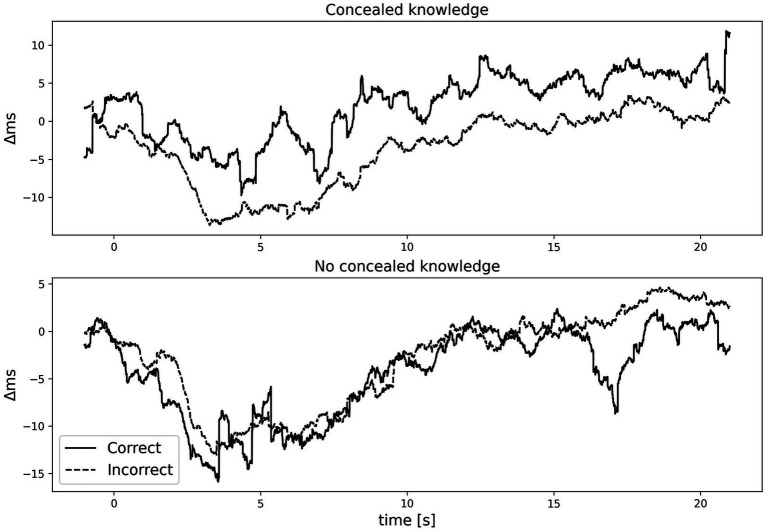 Figure 1
Peer Reviews
No public reviews on file for this paper yet. If you reviewed it on a platform where reviews are public (OpenReview, ICLR, NeurIPS, ICML), you can paste yours below so the community can read it here.
Videos
No videos yet. Explain this paper in a talk, walkthrough, or lecture? Add one.
Taxonomy
TopicsDeception detection and forensic psychology · Memory Processes and Influences · Face Recognition and Perception