Replanting the Birthing Trees to support Aboriginal and Torres Strait Islander parents and babies: protocol for developmental evaluation of a comprehensive culturally responsive, trauma-aware, healing-informed, continuity of care(r) model
Catherine Chamberlain, Jacqui Sundbery, Leonie Segal, Jacynta Krakouer, Marcia Langton, Jillian Donnelly, Jayne Kotz, Ellen McEvoy, Maddy Lyon, Neve Mucabel-Bue, Amalia Karahalios, Paul Gray, Emmanuel Gnanamanickam, Caroline Atkinson, Kimberley A. Jones, Helen Henderson

TL;DR
This paper outlines a protocol to evaluate a culturally responsive care model for Aboriginal and Torres Strait Islander parents and babies aimed at addressing intergenerational trauma.
Contribution
The study introduces a comprehensive, culturally tailored continuity of care model with trauma-aware and healing-informed approaches.
Findings
The RBT project includes five workstreams to support Aboriginal and Torres Strait Islander families during the first 2000 days of a child's life.
Mixed methods will assess acceptability, feasibility, costs, and effectiveness of the care model.
Participatory action research will ensure cultural and emotional safety for participants and communities.
Abstract
Aboriginal and Torres Strait Islander people experience intergenerational trauma as a legacy of the impacts of colonisation. Replanting the Birthing Trees (RBT) aims to transform compounding cycles of intergenerational trauma and harm to positively reinforcing cycles of intergenerational nurturing and recovery for Aboriginal and Torres Strait Islander parents and babies. This paper describes the protocol for developmental evaluation of the culturally responsive, trauma-aware, healing-informed, continuity of care(r) model to support Aboriginal and Torres Strait Islander parents during the first 2000 days (pregnancy, birth and the first 5 years after birth). The RBT project will be conducted in partnership with seven health services across Victoria (Royal Women’s Hospital and Mercy Hospital for Women) and Western Australia (WA) [Armadale Hospital, Western Australian Country Health…
Genes, proteins, chemicals, diseases, species, mutations and cell lines named across the full text — each resolved to its canonical identifier and authoritative record.
Click any figure to enlarge with its caption.
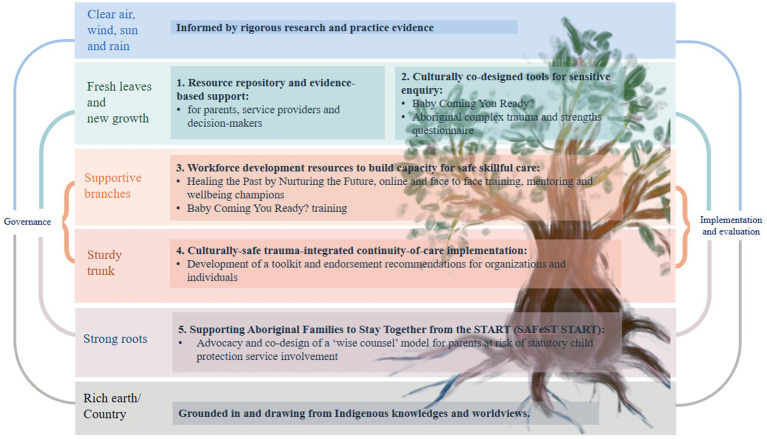 Figure 1
Peer Reviews
No public reviews on file for this paper yet. If you reviewed it on a platform where reviews are public (OpenReview, ICLR, NeurIPS, ICML), you can paste yours below so the community can read it here.
Videos
No videos yet. Explain this paper in a talk, walkthrough, or lecture? Add one.
Taxonomy
TopicsIndigenous Health, Education, and Rights · Health Policy Implementation Science · Child Abuse and Trauma