Probing molecular interactions of cellulose fibers with isomeric deep eutectic solvents using NMR spectroscopy
Mohan Rangaswamy, Yashu Kharbanda, Otto Mankinen, Juho Antti Sirviö, Sarah E. Mailhiot, Mehmet Zafer Köylü, Mateusz Urbańczyk, Henrikki Liimatainen, Ville-Veikko Telkki

TL;DR
This study uses NMR spectroscopy to explore how different deep eutectic solvents interact with cellulose fibers, revealing how their molecular structures affect fiber swelling and modification.
Contribution
The paper introduces a novel NMR-based approach to probe molecular interactions between cellulose fibers and isomeric deep eutectic solvents.
Findings
TEMACl–Imi caused significant cellulose fiber swelling, indicated by changes in NMR relaxation times and diffusion coefficients.
13C NMR showed increased cellulose mobility in TEMACl–Imi due to swelling, while TEMACl–Pyra showed minimal interaction and no cellulose signal.
Imidazole in TEMACl–Imi likely forms stronger hydrogen bonds with cellulose hydroxyl groups compared to pyrazole in TEMACl–Pyra.
Abstract
Deep eutectic solvents (DESs) are promising media for cellulose fiber (CF) modifications, such as swelling, dissolution, functionalization, and disintegration, owing to their low toxicity, biodegradability, and versatility. These modifications are governed by CF–DES interactions, regulated by the chemical structures of DES constituents. Here, nuclear magnetic resonance (NMR) spectroscopy was used to investigate the molecular interactions and dynamics between CFs and two isomeric non-derivatizing DESs comprising triethylmethylammonium chloride (TEMACl) with imidazole (Imi), TEMACl–Imi, or TEMACl with pyrazole (Pyra), TEMACl–Pyra. The NMR approach encompassed variable-temperature 1H diffusion, T1-and-T2-relaxation, and 13C NMR experiments. Significant CF swelling occurred in TEMACl–Imi, highlighted by reduced Imi and almost unchanged TEMACl relaxation times. This indicated that Imi…
Genes, proteins, chemicals, diseases, species, mutations and cell lines named across the full text — each resolved to its canonical identifier and authoritative record.
Click any figure to enlarge with its caption.
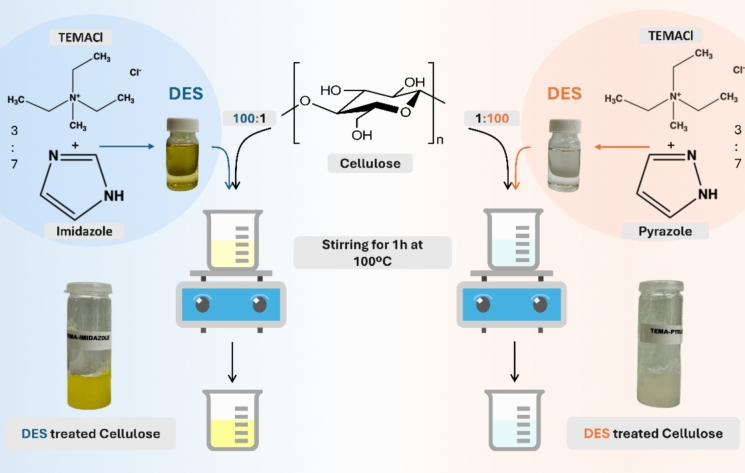 Figure 1
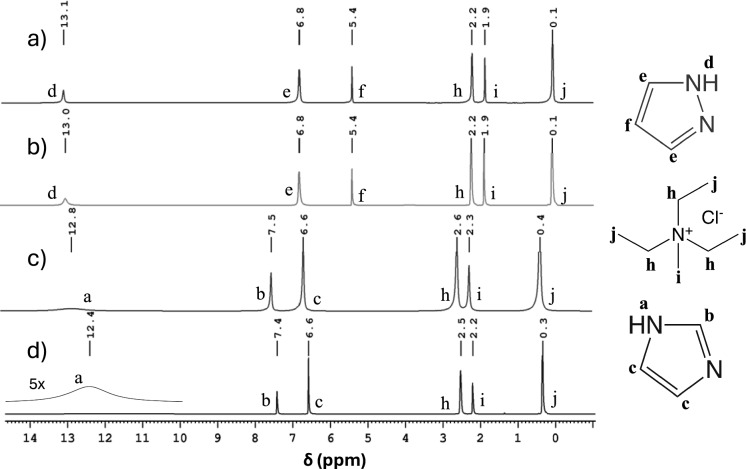 Figure 2
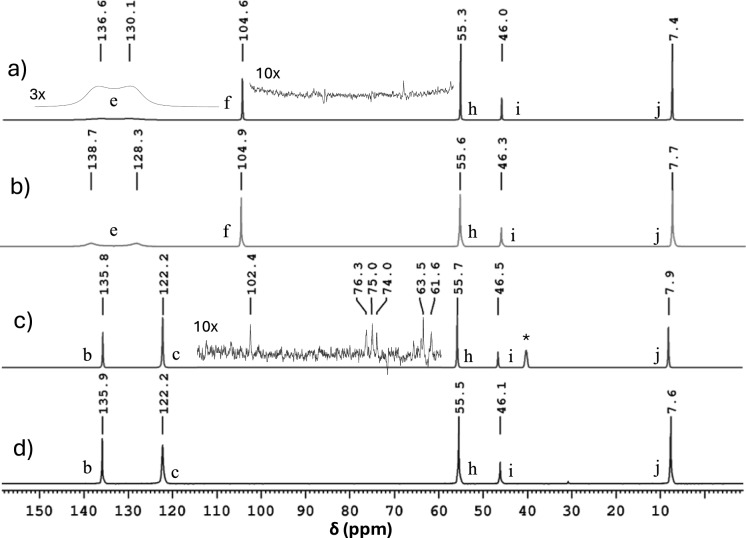 Figure 3
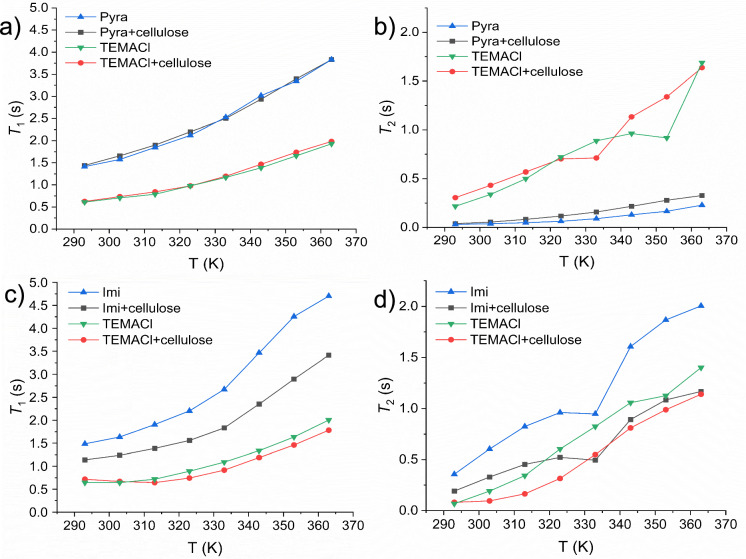 Figure 4
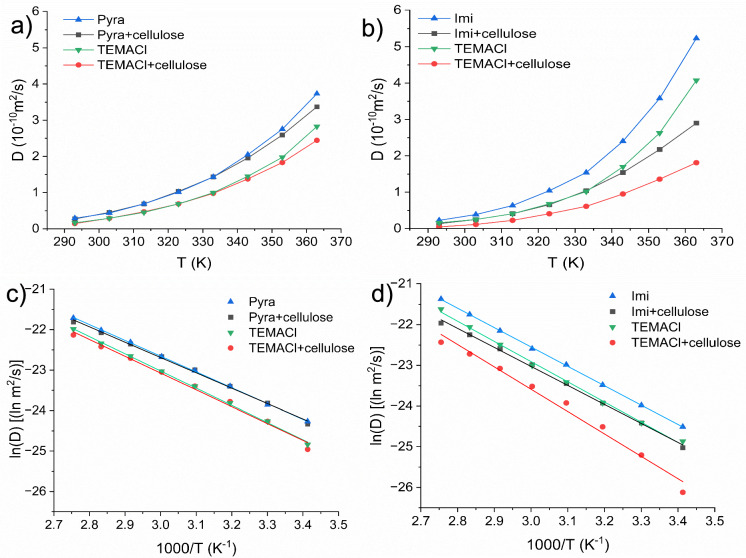 Figure 5
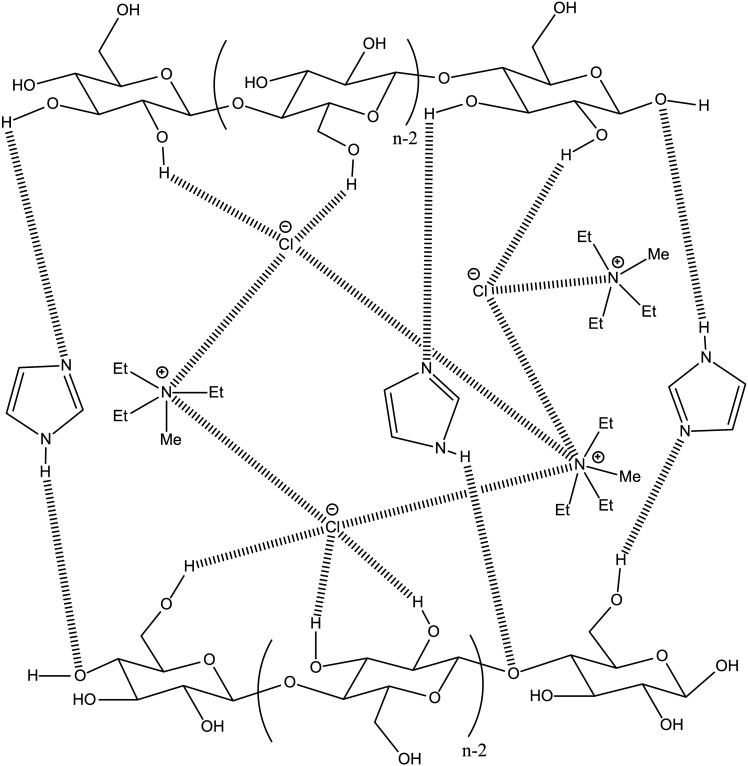 Figure 6
Peer Reviews
No public reviews on file for this paper yet. If you reviewed it on a platform where reviews are public (OpenReview, ICLR, NeurIPS, ICML), you can paste yours below so the community can read it here.
Videos
No videos yet. Explain this paper in a talk, walkthrough, or lecture? Add one.
Taxonomy
TopicsAdvanced Cellulose Research Studies · Fiber-reinforced polymer composites · Ionic liquids properties and applications