The effect of motor skills and imagery application on psychomotor development in children
Ozan Yilmaz, Betul Bayazit

TL;DR
This study explores how motor skills and imagery training affect the psychomotor development of 13-year-old boys.
Contribution
The study introduces a novel approach combining motor skills and imagery to enhance psychomotor development in adolescents.
Findings
Significant improvements in balance, ball transport, and target throwing were observed in experimental groups.
Imagery application was found to be important for motor learning and development.
The repetitive physical work method was shown to be effective in psychomotor development.
Abstract
This study aimed to investigate the psychomotor development effect of motor skills and imagery application in 13 year-old boys. The research group consisted of 40 male volunteer children who had 13 studied at Kocaeli/İzmit 29 Ekim Secondary School. The research groups were divided into four groups (control, experiment-1, experiment-2, experiment-3) had 13 with a random method as n=10 children per group. A skill track consisting of eight stations, including fine and gross motor skills, was applied as a data collection tool. Motor skills and imagery programs were applied to the experimental groups 2 days a week for 8 weeks. The control group did not participate in imagery and motor skills exercises. The station scores and track finishing time that constitute the results of the pre- and post-tests of the intervention were recorded. Data analysis was performed using SPSS 21.0. According to…
Click any figure to enlarge with its caption.
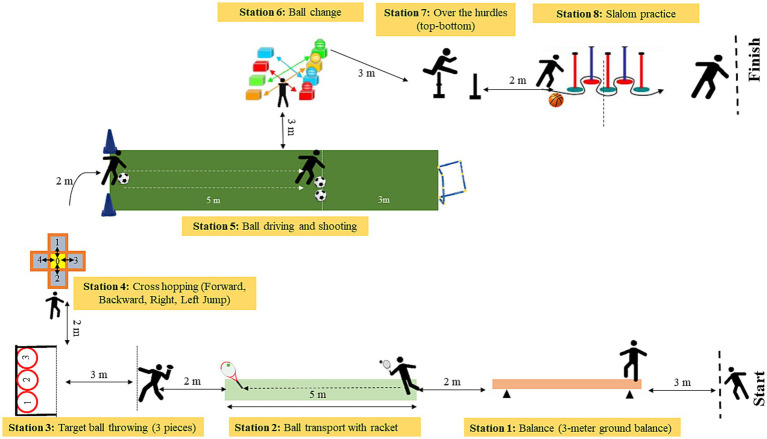 Figure 1
Peer Reviews
No public reviews on file for this paper yet. If you reviewed it on a platform where reviews are public (OpenReview, ICLR, NeurIPS, ICML), you can paste yours below so the community can read it here.
Videos
No videos yet. Explain this paper in a talk, walkthrough, or lecture? Add one.
Taxonomy
TopicsChildren's Physical and Motor Development · Sport Psychology and Performance · Writing and Handwriting Education