Optimising anti-seizure medication timing using a dynamic network model of seizure rhythms
Jake Ahern, Udaya Seneviratne, Wendyl D’Souza, Mark J. Cook, John R. Terry

TL;DR
This paper uses a dynamic model to show how timing anti-seizure medications according to biological rhythms can improve treatment effectiveness.
Contribution
A novel dynamic network model integrating seizure rhythms and ASM pharmacology to optimize medication timing.
Findings
Short half-life ASMs showed up to 20% greater efficacy when administered 6 hours before seizure likelihood peaks.
Phase dependence was minimal for longer half-life drugs due to flatter concentration profiles.
The model offers a mechanistic approach to personalize treatment timing in epilepsy care.
Abstract
Epileptic seizures and interictal discharges exhibit robust circadian and multidien rhythms, yet the interaction between these biological cycles and anti-seizure medication (ASM) pharmacology remains poorly understood. Here, we present a dynamical network model that integrates rhythmic fluctuations in cortical excitability with pharmacokinetic properties of common ASMs to explore how treatment timing influences efficacy. The framework embeds a slow, rhythm-generating process directly within the governing equations, allowing seizure-like dynamics to emerge endogenously. We simulated ASMs with a range of distinct half-lives under single-daily and twice-daily dosing schedules. For the short half-life ASM, efficacy depended strongly on the phase of administration, with doses delivered approximately 6 h before the peak in seizure likelihood achieving up to 20% greater reduction in…
Genes, proteins, chemicals, diseases, species, mutations and cell lines named across the full text — each resolved to its canonical identifier and authoritative record.
Click any figure to enlarge with its caption.
 Figure 1
 Figure 2
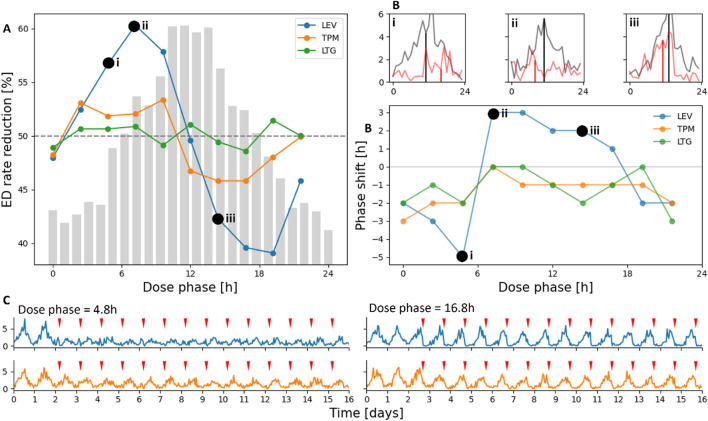 Figure 3
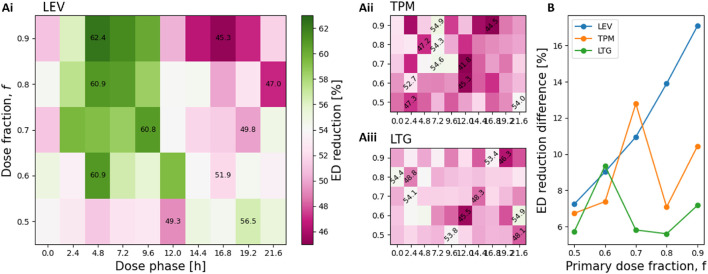 Figure 4
Peer Reviews
No public reviews on file for this paper yet. If you reviewed it on a platform where reviews are public (OpenReview, ICLR, NeurIPS, ICML), you can paste yours below so the community can read it here.
Videos
No videos yet. Explain this paper in a talk, walkthrough, or lecture? Add one.
Taxonomy
TopicsFunctional Brain Connectivity Studies · Epilepsy research and treatment · Neural dynamics and brain function