Mitochondria as Inducers of Neutrophil Extracellular Traps
Emil Bečka, Letícia Hudecová, Michal Pastorek

TL;DR
This paper explores how mitochondrial molecules trigger immune responses called NETs, which can be both protective and harmful in non-infectious inflammation.
Contribution
The paper reviews mechanisms by which mitochondrial damage-associated molecules induce neutrophil extracellular trap formation and their clinical implications.
Findings
Mitochondrial DNA, ATP, and other mtDAMPs activate pattern recognition receptors to induce NETosis.
mtDAMP-induced NET formation involves complex signaling through membrane receptors and MAPK pathways.
NETosis outcomes depend on neutrophil phenotype, mtDAMP concentration, and temporal dynamics in trauma and wound healing.
Abstract
Neutrophil extracellular traps (NETs) represent a critical immune defense mechanism that can become pathological in sterile inflammation. Mitochondrial damage-associated molecular patterns (mtDAMPs) emerge as particularly potent triggers of NET formation due to their bacterial-like molecular features inherited from endosymbiotic origins. This review examines the mechanisms by which key mtDAMPs, including mitochondrial DNA, ATP, cardiolipin, cytochrome c, succinate, heme and formylated peptides, induce NETosis through pattern recognition receptors typically reserved for pathogen detection. We describe the complex signaling networks downstream of mtDAMP recognition, highlighting the roles of membrane and intracellular receptors and mitogen-activated protein kinase pathways in orchestrating mtDAMP-induced NET formation. The clinical relevance of mtDAMP-induced NETosis is explored across…
Genes, proteins, chemicals, diseases, species, mutations and cell lines named across the full text — each resolved to its canonical identifier and authoritative record.
Click any figure to enlarge with its caption.
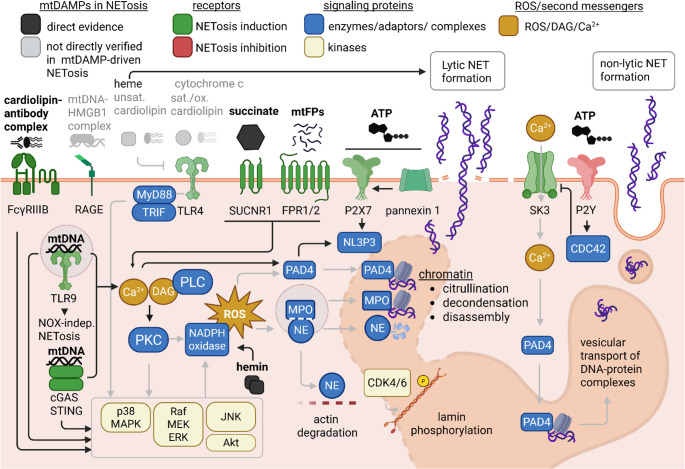 Figure 1
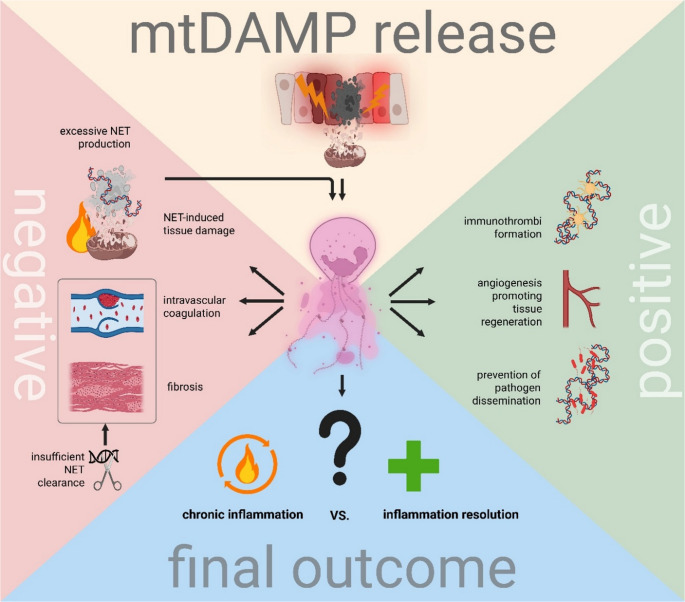 Figure 2
Peer Reviews
No public reviews on file for this paper yet. If you reviewed it on a platform where reviews are public (OpenReview, ICLR, NeurIPS, ICML), you can paste yours below so the community can read it here.
Videos
No videos yet. Explain this paper in a talk, walkthrough, or lecture? Add one.
Taxonomy
TopicsNeutrophil, Myeloperoxidase and Oxidative Mechanisms · Neonatal and Maternal Infections · Blood disorders and treatments