Search for resonances decaying to an anomalous jet and a Higgs boson in proton–proton collisions at √s = 13 Te V
A. Hayrapetyan, A. Hayrapetyan, V. Makarenko, A. Tumasyan, W. Adam, J. W. Andrejkovic, L. Benato, T. Bergauer, M. Dragicevic, C. Giordano, P. S. Hussain, M. Jeitler, N. Krammer, A. Li, D. Liko, M. Matthewman, I. Mikulec, J. Schieck, R. Schöfbeck, D. Schwarz, M. Shooshtari

TL;DR
This study searches for new particles decaying into a Higgs boson and another particle using data from proton collisions at 13 TeV.
Contribution
A novel method using an autoencoder to identify anomalous jets enhances the search for multiple decay scenarios in a single analysis.
Findings
No significant excess above standard model predictions is observed in the data.
The most stringent upper limits on signal cross sections for X and Y particles are established.
Multiple decay scenarios for Y are considered, including W boson pairs and top quark pairs.
Abstract
This paper presents a search for new physics through the process where a massive particle, X, decays into a Higgs boson and a second particle, Y. The Higgs boson subsequently decays into a bottom quark–antiquark pair, which is reconstructed as a single large-radius jet. The decay products of Yare also assumed to produce a single large-radius jet. The identification of the Yparticle is enhanced by computing the anomaly score of its candidate jet using an autoencoder, which measures deviations from typical quark- or gluon-induced jets. This allows a simultaneous search for multiple Ydecay scenarios within a single analysis. In the main benchmark process, Yis a scalar particle that decays into a Wboson pair. Two other scalar Ydecay processes are also considered as benchmarks: decays to a light quark–antiquark pair, and decays to a top quark–antiquark pair. A fourth benchmark process…
Genes, proteins, chemicals, diseases, species, mutations and cell lines named across the full text — each resolved to its canonical identifier and authoritative record.
Click any figure to enlarge with its caption.
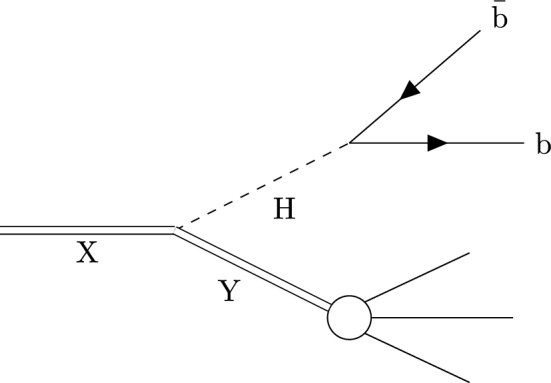 Figure 1
 Figure 2
 Figure 3
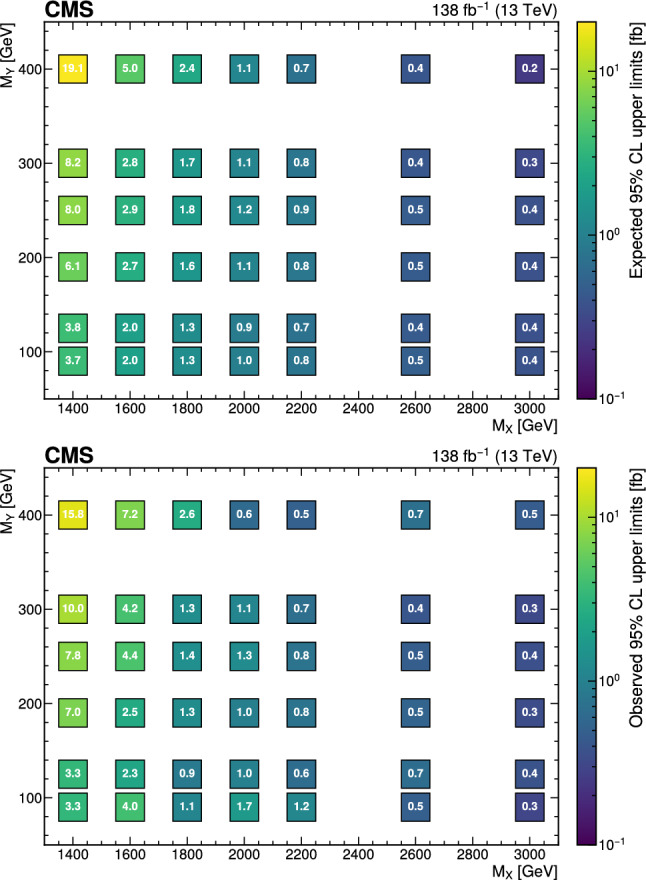 Figure 4
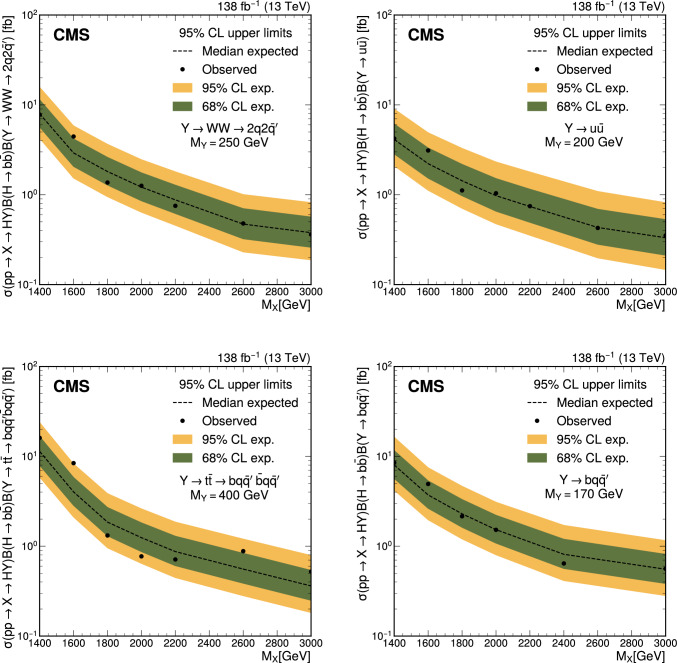 Figure 5
Peer Reviews
No public reviews on file for this paper yet. If you reviewed it on a platform where reviews are public (OpenReview, ICLR, NeurIPS, ICML), you can paste yours below so the community can read it here.
Videos
No videos yet. Explain this paper in a talk, walkthrough, or lecture? Add one.
Taxonomy
TopicsParticle physics theoretical and experimental studies · Quantum Chromodynamics and Particle Interactions · High-Energy Particle Collisions Research