Sebaceous filaments of the nose treated with a 1726-nm diode laser: A case report and description of the “Lunar crater sign”
Abdulaziz Almufadhi, Mohammed Alosaimi

Abstract
Click any figure to enlarge with its caption.
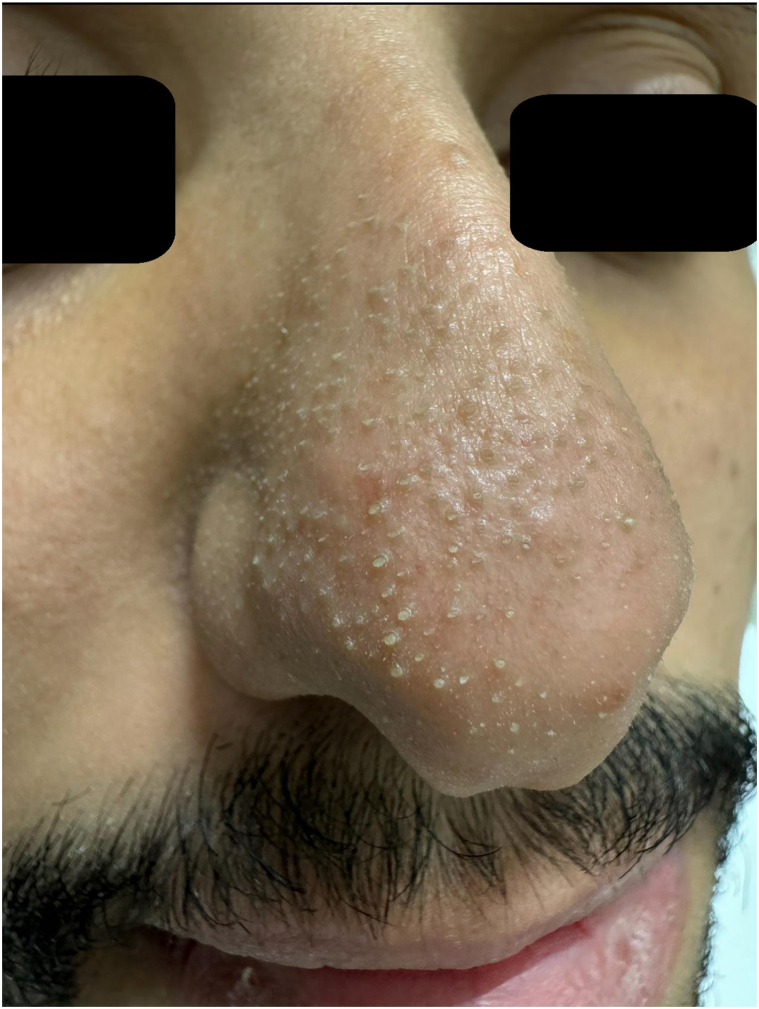 Figure 1
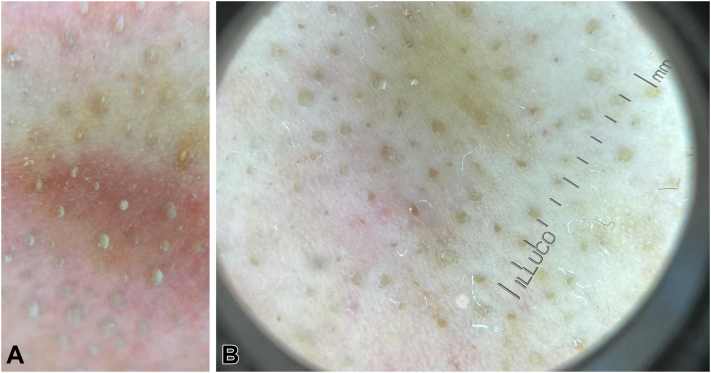 Figure 2
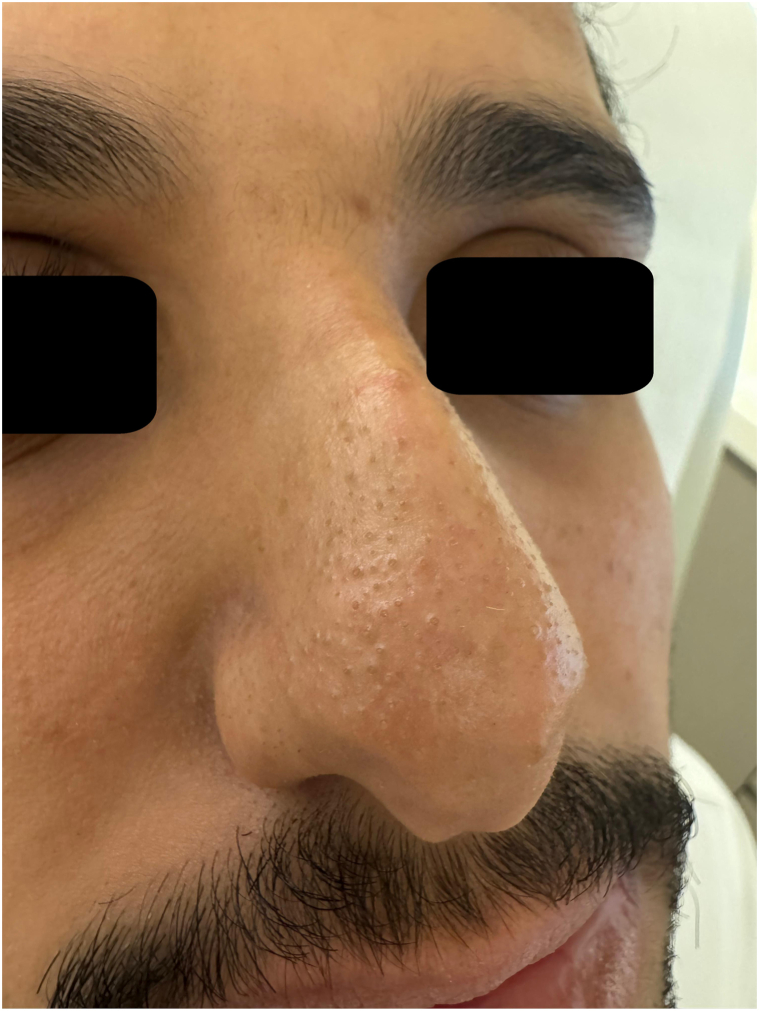 Figure 3
Peer Reviews
No public reviews on file for this paper yet. If you reviewed it on a platform where reviews are public (OpenReview, ICLR, NeurIPS, ICML), you can paste yours below so the community can read it here.
Videos
No videos yet. Explain this paper in a talk, walkthrough, or lecture? Add one.
Taxonomy
TopicsNonmelanoma Skin Cancer Studies · Planetary Science and Exploration · Reconstructive Facial Surgery Techniques
Case presentation
A 30-year-old man with no significant medical history, Fitzpatrick skin phototype IV, presented with prominent nasal sebaceous filaments for more than 5 years.
The patient was treated with topical retinoid (tretinoin 0.05 cream once daily) for 6 months with minimal improvement.
Dermoscopy (polarized contact, ILLUCO IDS-1100C, × 20) demonstrated uniform yellowish plugs consistent with sebaceous filaments.1 (Fig 1 and Fig 2, A).Fig 1. Baseline clinical photo of the nose showing prominent sebaceous filaments.Fig 2. Dermoscopy (ILLUCO IDS-1100C, × 20): A, baseline showing yellowish follicular plugs; B, one month post-treatment showing brown-to-tan crateriform globules “Lunar crater sign.”
Intervention
Device: AviClear (CUTERA), 1726-nm diode; integrated contact cooling.
Settings: Single session; 3.0-mm spot; fluence 18 J/cm^2^; 20 pulses; PRILA 5% (lidocaine/prilocaine cream) for 30 minutes before the procedure.
Immediate response included vaporization of the sebaceous material, without purpura or blistering.
Aftercare: Broad-spectrum sunscreen (sun protection factor 50).
Outcomes
At 4 weeks, clinical improvement was evident (Fig 3).Fig 3. Post-treatment clinical photo of the nose at 4 weeks.
Dermoscopy showed brown-to-tan crateriform globules, proposed as the “Lunar crater sign” due to resemblance to lunar craters (Fig 2, B).
Adverse effects: None reported by the patient, with no scarring or postinflammatory hyperpigmentation.
Discussion
Sebaceous filaments are physiologic accumulations of sebum and corneocytes in the follicular infundibulum and appear as uniform off-white/yellowish plugs on dermoscopy.1 They should be differentiated from trichostasis spinulosa and pityriasis folliculorum; prior reports describe improvement with topical keratolytics/retinoids.2
Light-based modalities such as intense pulsed light and the 1450-nm diode laser have previously been used to target sebaceous-gland activity, mainly in acne vulgaris and seborrhea.3 These devices achieve photothermal damage of sebaceous glands with transient sebum reduction. However, no prior reports describe their use for isolated sebaceous filaments. The 1726-nm wavelength offers greater lipid absorption and thus more selective sebaceous-gland photothermolysis.4
The 1726-nm wavelength targets sebum with higher absorption than water, enabling selective sebaceous-gland photothermolysis.4^,^5
Prospective acne cohorts demonstrate sebaceous-gland miniaturization and progressive lesion reduction durable to at least 26 weeks, with mostly transient erythema/edema and rare significant adverse effects.5, 6, 7
To our knowledge, 1726-nm treatment of isolated sebaceous filaments has not been specifically reported; this case suggests feasibility and motivates controlled evaluation.
Limitations
Single patient, short follow-up, no histology, and photography/lighting confounders.
Conflicts of interest
None disclosed.
The reference list from the paper itself. Each links out to its DOI / PubMed record.
- 1Singh Y.Neema S.Bahuguna A.Dabbas D.Sebaceous filaments Dermatol Pract Concept 1112021 e 202114810.5826/dpc.1101 a 148PMC 787566333614220 · doi ↗ · pubmed ↗
- 2Mineroff J.P.Hyde J.T.Hsu S.A case report of sebaceous filaments Cureus 15112023 e 4865610.7759/cureus.48656 PMC 1071257538090399 · doi ↗ · pubmed ↗
- 3Huerth K.Ohanenye C.Quartey A.Jackson B.Callender V.Established and emerging laser treatments for acne vulgaris in diverse skin types J Clin Aesthet Dermatol 18620254148 PMC 1218921940575606 · pubmed ↗
- 4Scopelliti M.G.Hamidi-Sakr A.Möller S.Karavitis M.Kothare A.Selective photothermolysis in acne treatment: the impact of laser power J Cosmet Dermatol 232202445746310.1111/jocd.1602037786234 · doi ↗ · pubmed ↗
- 5Scopelliti M.G.Kothare A.Karavitis M.A novel 1726-nm laser system for safe and effective treatment of acne vulgaris Lasers Med Sci 37920223639364710.1007/s 10103-022-03645-636197599 · doi ↗ · pubmed ↗
- 6Alexiades M.Kothare A.Goldberg D.J.Dover J.S.Novel 1726 nm laser demonstrates durable therapeutic outcomes and tolerability for moderate-to-severe acne across skin types J Am Acad Dermatol 894202370371010.1016/j.jaad.2023.05.08537328000 · doi ↗ · pubmed ↗
- 7Goldberg D.J.Andriessen A.Bhatia A.C.Treatment of mild to severe acne with 1726 nm laser: a safe alternative to traditional acne therapies J Cosmet Dermatol 221120233026303210.1111/jocd.1596437596781 · doi ↗ · pubmed ↗