Inhibition of the angiotensin-converting enzyme N-terminal catalytic domain prevents endogenous opioid degradation in brain tissue
Filip Hanak, Jessica L. Swanson, Krzysztof Felczak, Prakashkumar Dobariya, Ursula C.H. Girdwood, Kenneth E. Bernstein, Swati S. More, Patrick E. Rothwell

TL;DR
Blocking a specific enzyme domain increases natural opioid signals in the brain.
Contribution
A new method to enhance endogenous opioids by inhibiting a specific enzyme domain is introduced.
Findings
Blocking the N-terminal domain of angiotensin-converting enzyme increases Met-enkephalin-Arg-Phe signals.
This inhibition prevents degradation of endogenous opioids in brain tissue.
Abstract
Natural opioid signals in the brain produced by Met-enkephalin-Arg-Phe are enhanced after blocking its degradation by the N-terminal catalytic domain of angiotensin-converting enzyme.
Genes, proteins, chemicals, diseases, species, mutations and cell lines named across the full text — each resolved to its canonical identifier and authoritative record.
Click any figure to enlarge with its caption.
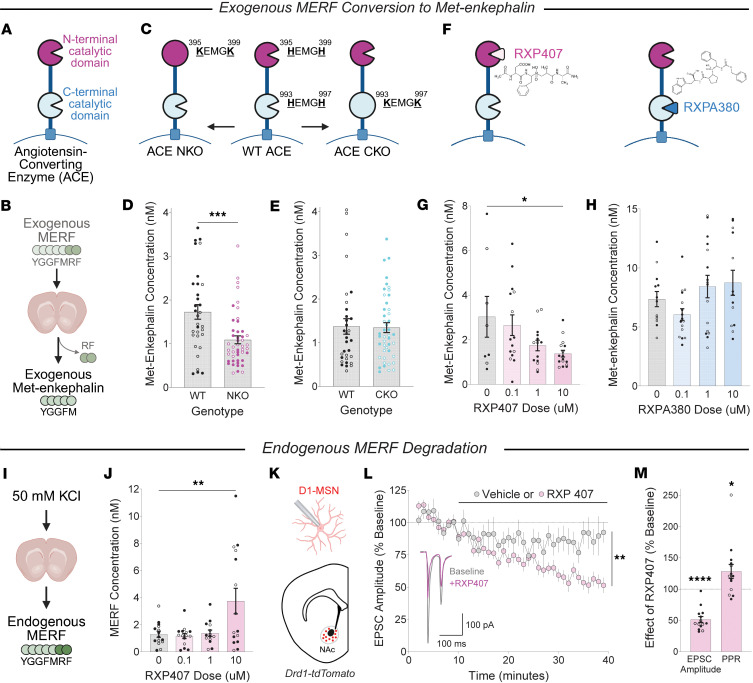 Figure 1
- —National Institute on Drug Abusehttps://doi.org/10.13039/100000026
- —National Institute on Drug Abusehttps://doi.org/10.13039/100000026
Peer Reviews
No public reviews on file for this paper yet. If you reviewed it on a platform where reviews are public (OpenReview, ICLR, NeurIPS, ICML), you can paste yours below so the community can read it here.
Videos
No videos yet. Explain this paper in a talk, walkthrough, or lecture? Add one.
Taxonomy
TopicsRenin-Angiotensin System Studies · Neuropeptides and Animal Physiology · Protein Hydrolysis and Bioactive Peptides
To the Editor: Angiotensin-converting enzyme (ACE) is a dipeptidyl carboxypeptidase, cleaving 2 amino acids from the C-terminus of peptide substrates (1). ACE is well known for regulating blood pressure by converting angiotensin I to angiotensin II. We recently identified another role for ACE in the brain (2): modulating synaptic plasticity by cleaving and degrading Met-enkephalin-Arg-Phe (MERF), an endogenous opioid peptide. ACE inhibition prevented MERF degradation (Supplemental Figure 1; supplemental material available online with this article; https://doi.org/10.1172/jci.insight.194624DS1) and enhanced endogenous opioid signaling in the nucleus accumbens, a brain region with conjointly high expression of ACE, MERF, and cognate opioid receptors. This could plausibly explain clinical reports that centrally active ACE inhibitors have unexpected secondary benefits (see Supplemental Text). However, the mechanism by which ACE cleaves MERF and regulates endogenous opioid signaling in brain tissue remains poorly understood.
ACE has 2 catalytic domains, located in the N-terminal or C-terminal region of the protein (Figure 1A), with distinct profiles of substrate specificity (1). To investigate the contribution of each catalytic domain to MERF degradation, we used liquid chromatography–tandem mass spectrometry (LC-MS/MS) to quantify extracellular enkephalin in mouse brain tissue (2, 3). Acute coronal brain slices containing the nucleus accumbens were incubated in artificial cerebrospinal fluid containing a saturating concentration of exogenous MERF, which is cleaved and degraded by ACE to produce Met-enkephalin (Figure 1B). To study the role of each catalytic domain in MERF degradation, we used mouse lines carrying mutations in the active site of either the N-terminal catalytic domain (NKO) or the C-terminal catalytic domain (CKO; Figure 1C). Crucially, these mutations are amino acid substitutions that do not change the expression level of ACE and preserve the function of the intact domain (4, 5). The NKO mutation significantly reduced conversion of exogenous MERF to Met-enkephalin (Figure 1D), whereas the CKO mutation had no effect (Figure 1E). We complemented this genetic analysis with acute pharmacological inhibition using RXP407 and RXPA380, small molecule ACE inhibitors with a high selectivity for the N-terminal and C-terminal catalytic domains, respectively (Figure 1F). RXP407 reduced Met-enkephalin production in a dose-dependent manner (Figure 1G), recapitulating our findings with NKO mice, whereas RXPA380 had no effect (Figure 1H).
To build on our analysis of exogenous MERF degradation by ACE, we next measured the degradation of endogenous MERF released from brain tissue following chemical stimulation with a high concentration of potassium chloride (Figure 1I). In the presence of RXP407, we observed a dose-dependent increase in MERF concentration (Figure 1J), but no change in the concentration of endogenous Met-enkephalin or Leu-enkephalin (Supplemental Figure 2, A and B). RXP407 had no effect in NKO mice (Supplemental Figure 2C), ruling out nonspecific effects of RXP407 on other targets. To measure the functional impact of RXP407 on synaptic transmission, we prepared acute brain slices from Drd1-tdTomato reporter mice, to guide whole-cell patch-clamp recordings from individual Drd1-expressing medium spiny neurons in the nucleus accumbens (Figure 1K and Supplemental Figure 3). Bath application of RXP407 caused long-term depression of electrically evoked excitatory postsynaptic currents (Figure 1L), as well as an increase in the paired-pulse ratio (Figure 1M), both consistent with our prior report that elevated MERF levels reduce presynaptic glutamate release (2). Please see Supplemental Methods for a methodology description.
Our results suggest that the ACE N-terminal catalytic domain is the primary site of MERF degradation in brain tissue, and that N-terminal domain inhibition is sufficient to reduce degradation of this specific endogenous opioid peptide. This conclusion is further supported by structural modeling of the probable conformation of MERF in the ACE N-terminal catalytic domain (Supplemental Figure 4), with productive catalysis due to efficient transition state stabilization, as well as conserved active site interactions previously established for domain selectivity (6). Pharmacological inhibition of the ACE N-terminal catalytic domain thus presents what we believe to be a novel strategy to enhance endogenous opioid signaling in the brain. Critically, we have previously shown that central ACE inhibition does not have obvious rewarding effects, and in fact attenuates the rewarding properties of exogenous opioids like fentanyl (2). The engagement of endogenous opioid signaling without corresponding risk of misuse would be a major advance for opioid-based pharmacotherapy, with translational potential for various neuropsychiatric conditions (see Supplemental Text). Our current work will guide the development of more specific ACE inhibitors that target the primary site of MERF degradation in the brain, resulting in tailored pharmacotherapies that target the endogenous opioid system with better efficacy and fewer side effects.
Funding support
This work is the result of NIH funding, in whole or in part, and is subject to the NIH Public Access Policy. Through acceptance of this federal funding, the NIH has been given a right to make the work publicly available in PubMed Central.
NIH grants DA060664 (to JLS), DA056331 (to SSM and PER), and DA056675 (to SSM and PER).University of Minnesota’s MnDRIVE (Minnesota’s Discovery, Research, and Innovation Economy) initiative (to FH and PER).University of Minnesota Graduate School Interdisciplinary Doctoral Fellowship (to FH).University of Minnesota Office of Academic Clinical Affairs Faculty Research Development Grant (to SSM and PER).NIH/National Cancer Institute Cancer Center Support Grant CA-77598 to the Analytical Biochemistry Shared Resource of the Masonic Cancer Center (support for mass spectrometry).
Supplementary Material
Supplemental data
Supporting data values
The reference list from the paper itself. Each links out to its DOI / PubMed record.
- 1Bernstein KE et al A modern understanding of the traditional and nontraditional biological functions of angiotensin-converting enzyme Pharmacol Rev 201365114610.1124/pr.112.00680923257181 PMC 3565918 · doi ↗ · pubmed ↗
- 2Trieu BH et al Angiotensin-converting enzyme gates brain circuit-specific plasticity via an endogenous opioid Science 202237565851177118210.1126/science.abl 513035201898 PMC 9233526 · doi ↗ · pubmed ↗
- 3Al-Hasani R et al In vivo detection of optically-evoked opioid peptide release Elife 20187 e 3652010.7554/e Life.3652030175957 PMC 6135606 · doi ↗ · pubmed ↗
- 4Fuchs S et al Role of the N-terminal catalytic domain of angiotensin-converting enzyme investigated by targeted inactivation in mice J Biol Chem 200427916159461595310.1074/jbc.M 40014920014757757 · doi ↗ · pubmed ↗
- 5Fuchs S et al Angiotensin-converting enzyme C-terminal catalytic domain is the main site of angiotensin I cleavage in vivo Hypertension 200851226727410.1161/HYPERTENSIONAHA.107.09786518158355 · doi ↗ · pubmed ↗
- 6Kroger WL et al Investigating the domain specificity of phosphinic inhibitors RXPA 380 and RXP 407 in angiotensin-converting enzyme Biochemistry 200948358405841210.1021/bi 901122619658433 · doi ↗ · pubmed ↗