Beau’s Lines on Fingernails and Toenails
Masato Shimozono, Takafumi Kato

Abstract
Click any figure to enlarge with its caption.
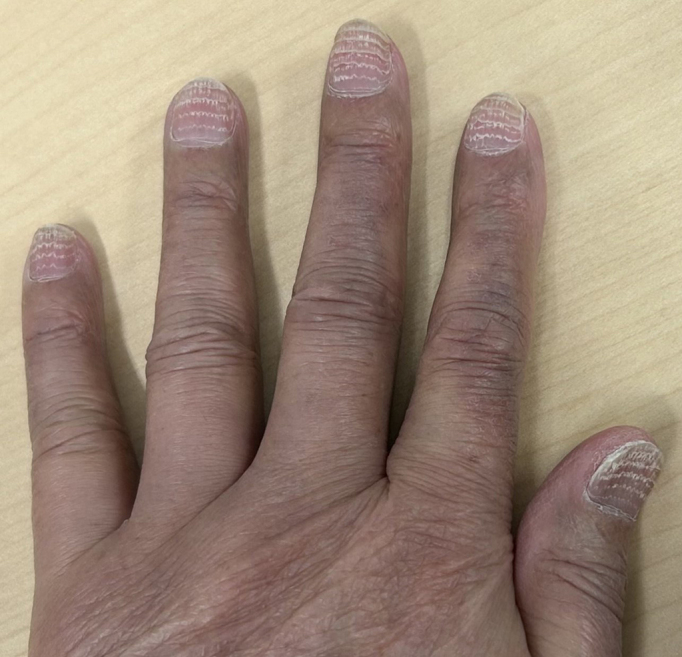 Figure 1
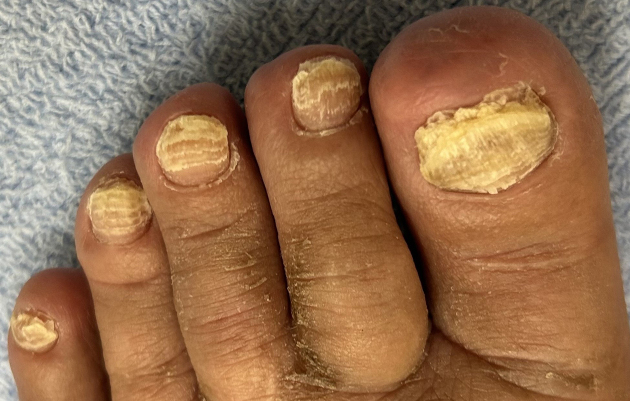 Figure 2
Peer Reviews
No public reviews on file for this paper yet. If you reviewed it on a platform where reviews are public (OpenReview, ICLR, NeurIPS, ICML), you can paste yours below so the community can read it here.
Videos
No videos yet. Explain this paper in a talk, walkthrough, or lecture? Add one.
Taxonomy
TopicsNail Diseases and Treatments · Skin Diseases and Diabetes · Dermatological and COVID-19 studies
A 77-year-old man with metastatic lung adenocarcinoma received 21 cycles of docetaxel chemotherapy at three- to five-week intervals as his third-line regimen after failures of afatinib (first-line) and carboplatin plus pemetrexed plus pembrolizumab (second-line). After docetaxel initiation, multiple transverse lines developed on the patient’s fingernails (Figure 1) and toenails (Figure 2). These nail changes were estimated to appear at the proximal nail fold approximately four to five weeks after each administration. The nail changes were not accompanied by pain or periungual erythema. Mild skin hyperpigmentation, also attributed to docetaxel, was noted on the dorsum of his fingers and toes; however, no other significant skin adverse events were observed.
These transverse grooves are known as Beau’s lines, which result from a temporary arrest of nail matrix proliferation. Cytotoxic agents, particularly docetaxel, are well-known causes ^(1), (2)^. In this case, the spacing between the lines was consistent with nail growth over the three- to five-week chemotherapy cycles. Other potential etiologies, such as severe systemic infection, major trauma, or other systemic diseases, were excluded on the basis of the patient’s clinical course. The clear temporal relationship, combined with the observation that line formation ceased after the discontinuation of docetaxel, strongly implicates docetaxel as the causative agent. These depressions should be distinguished from Mees’ lines, which are white, non-palpable transverse bands resulting from abnormal keratinization of the distal nail matrix, also associated with chemotherapy ^(1), (2)^.
Article Information
Author Contributions
Masato Shimozono and Takafumi Kato were responsible for patient management, and manuscript writing and review.
Conflicts of Interest
None
IRB Approval
Not required for a case report/image.
Patient’s Consent
Written informed consent was obtained from the patient for the submission and publication of this case report/image.
The reference list from the paper itself. Each links out to its DOI / PubMed record.
- 1Piraccini BM, Iorizzo M, Tosti A. Drug-induced nail abnormalities. Am J Clin Dermatol. 2003;4(1):31-7.12477371 10.2165/00128071-200304010-00004 · doi ↗ · pubmed ↗
- 2Kinjo T, Shibahara D, Higa F, et al. Beau’s Lines and Mees’ lines formations after chemotherapy. Intern Med. 2015;54(17):2281.26328664 10.2169/internalmedicine.54.5166 · doi ↗ · pubmed ↗