The complete chloroplast genome of Calophyllum membranaceum Gander & Champ 1849 (Calophyllaceae, Malpighiales) and its phylogenetic analysis
Nhung Ngo Thi Cam, Chinee Surita Padasas-Adalla, Natsaranyatron Singharajkomron, Yihui Tan, Liangqiang Huang, Xinmin Pan, Jingling Li, Guoan Shen

TL;DR
This paper reports the first complete chloroplast genome of Calophyllum membranaceum and shows its close relation to C. brasiliense.
Contribution
The study provides the first complete chloroplast genome assembly for Calophyllum membranaceum.
Findings
The chloroplast genome of C. membranaceum is 160,820 bp long with 36.4% GC content.
It contains 131 genes, including 86 protein-coding genes, 37 tRNAs, and 8 rRNAs.
Phylogenetic analysis shows C. membranaceum is closely related to C. brasiliense.
Abstract
This study presents the first complete chloroplast genome assembly of Calophyllum membranaceum Gander & Champ 1849, a species noted for its pharmacologically active metabolites. The chloroplast genome of C. membranaceum measures 160,820 bp in length and an overall GC content of about 36.4%. It contains a total of 131 genes, which consisted of 86 protein-coding genes, 37 tRNAs, and 8 rRNAs. The phylogenetic analysis based on chloroplast data from the Malpighiales order suggests a close relationship between C. membranaceum and C. brasiliense. Our results provide valuable genomic resource that support future research on genetic resources, conservation, and medicine.
Genes, proteins, chemicals, diseases, species, mutations and cell lines named across the full text — each resolved to its canonical identifier and authoritative record.
Click any figure to enlarge with its caption.
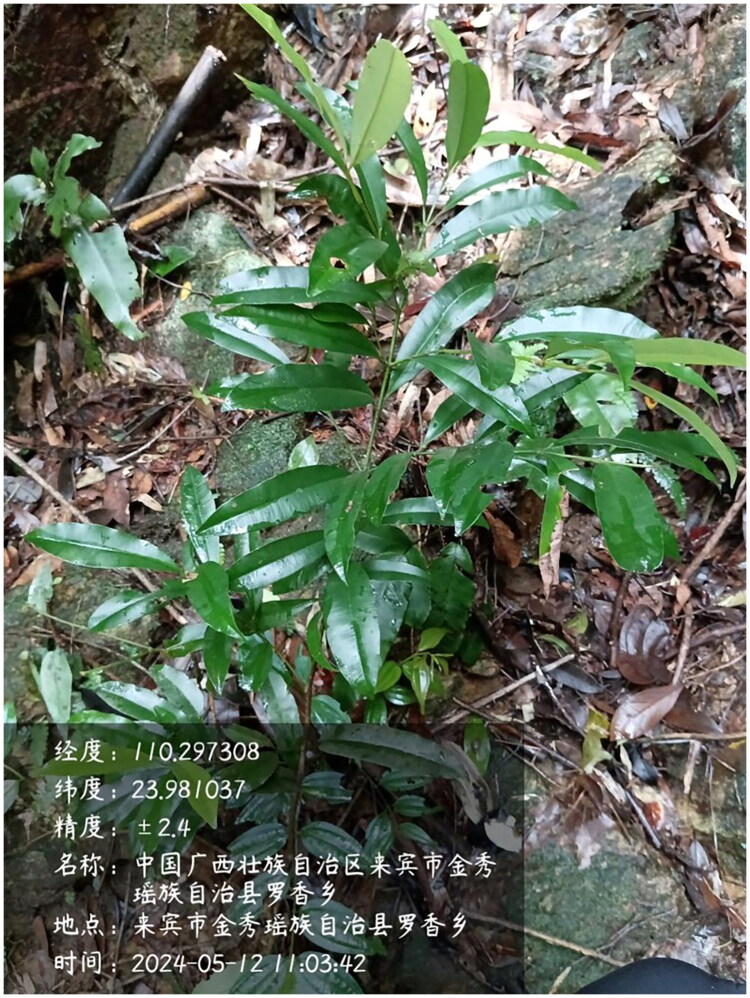 Figure 1
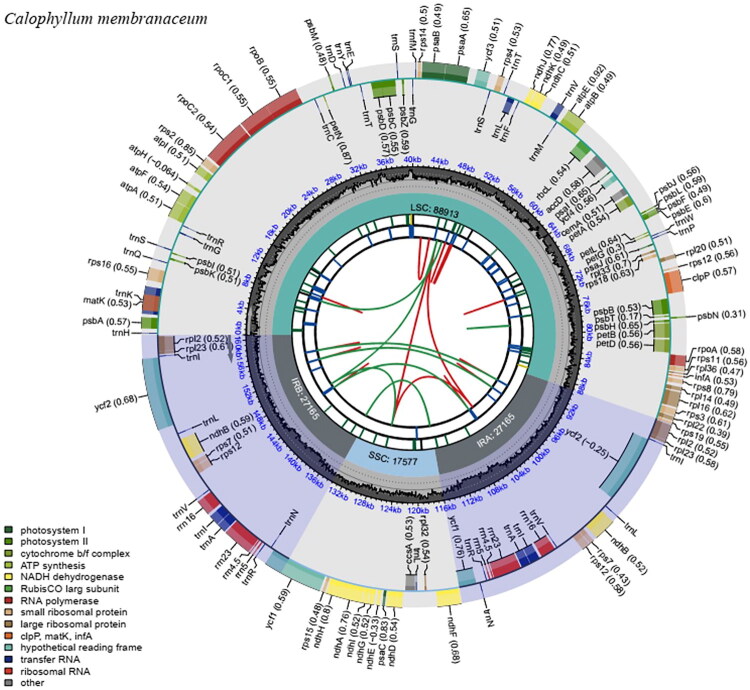 Figure 2
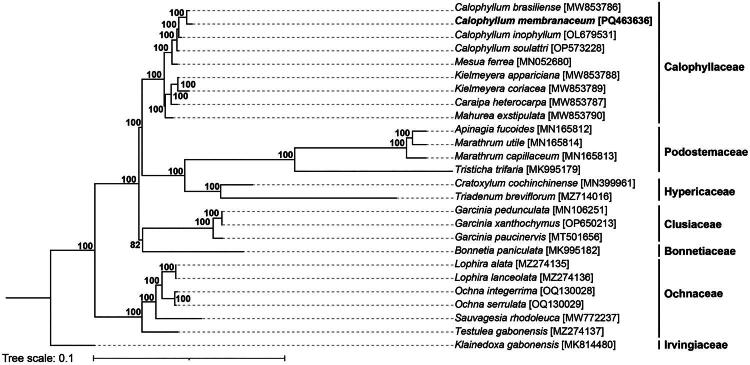 Figure 3
- —Ministry of Sciences and Technology of China
- —Laibin City Science Research and Technology Development Plan
Peer Reviews
No public reviews on file for this paper yet. If you reviewed it on a platform where reviews are public (OpenReview, ICLR, NeurIPS, ICML), you can paste yours below so the community can read it here.
Videos
No videos yet. Explain this paper in a talk, walkthrough, or lecture? Add one.
Taxonomy
TopicsGenomics and Phylogenetic Studies · Biological and pharmacological studies of plants · Phytochemistry and Biological Activities
Introduction
Calophyllum membranaceum Gander & Champ 1849, a species belonging to the Calophyllaceae family, is primarily found in tropical and subtropical regions of Southeast Asia. C. membranaceum gained attention due to its production of diverse metabolites. Numerous studies have shown that the genus Calophyllum produces various classes of secondary metabolites, including coumarins, glycosides, phenolics, flavonoids, steroids, and terpenoids, which are valuable for drug discovery and development (Gupta and Gupta 2020). Specifically, C. membranaceum is used in traditional medicine to treat conditions such as rheumatism, arthritis, lower back pain, and to promote wound healing (Zhu et al. 2018). Recent research has focused on isolating new compounds from the plant’s extracts, including chromanone acids (Shen et al. 2024), xanthones (Chen et al. 2011; Li et al. 2022; Yu et al. 2022) and C-glycosides (Zhu et al. 2018), some of which exhibit significant anti-inflammatory effects and transcriptional inhibitory activity against RXRα (Ming et al. 2016).
Despite its pharmaceutical potential, the chloroplast genome of C. membranaceum has not yet been described, representing a significant gap in understanding the species’ evolutionary relationships. Adding genetic data on this species is crucial for its classification, identification, and the conservation of biodiversity. In this study, we sequenced, assembled, and annotated the chloroplast genome of C. membranaceum. Additionally, we constructed a phylogenetic tree to provide a comprehensive view of the biological relationships within the Calophyllaceae family.
Materials and methods
Plant material, DNA extraction, and sequencing
The leaves of C. membranaceum used in this study were collected from Jinxiu county, Guangxi, China (23°98′N, 110°29′E) (Figure 1). A voucher specimen was identified by Dr. Haimei Chen (Institute of Medicinal Plant Development, Chinese Academy of Medical Sciences & Peking Union Medical College, [email protected]), and was registered at the Institute of Medicinal Plant Development, with the voucher number Y79 (contact: Guoan Shen, [email protected]). Genomic DNA was isolated using the DNeasy Plant Mini Kit (Cat. 69104, Qiagen) and sequenced on the Illumina platform with a paired-end read length of 150 bp (Porebski et al. 1997). This process yielded high-quality reads that amounted to around 13.7 Gb of data. The complete chloroplast genome of C. membranaceum was assembled de novo using the GetOrganelle v1.7.7.1 tool (Jin et al. 2020b). Genome annotation was performed with CpGAVAS2 (Shi et al. 2019), and the annotated chloroplast genome was submitted to GenBank with accession numbers PQ463636. The circular chloroplast genome map, including cis-splicing and trans-splicing gene maps, was generated using the CPGview website (Liu et al. 2023).
Photographs of Calophyllum membranaceum. This plant is a small tree or shrub-like; young branchlets are four-angled with narrow wings; leaves are thinly leathery, oblong or oblong-lanceolate, measuring 6–12 cm in length, with an acuminate, acute, or caudate apex and a cuneate base; petiole length 6–10 mm. The photo was taken by Xinmin Pan (one of authors). When the photo was taken, the camera app automatically recorded the location data (in Chinese) and marked it in the lower left corner. The information translate into English is as follows: Longitude: 110.297308; Latitude: 23.981037; Precision: ±2.4 m; Site: Luoxiang Township, Jinxiu Yao Autonomous County, Laibin City, Guangxi Zhuang Autonomous Region, China; Location: Luoxiang Township, Jinxiu Yao Autonomous County, Laibin City; Time: 2024-05-12 11:03:42.
Phylogenetic analysis
To determine the phylogenetic position of C. membranaceum, eight chloroplast genome sequences from the Calophyllaceae family and 16 from the order Malpighiales were retrieved from the GenBank database. The list of these species is provided in Table S1. Protein-coding sequences from all sampled species were extracted and aligned using MAFFT v7 with default settings (Katoh and Standley 2013). Phylogenetic reconstruction was carried out using the maximum likelihood method, based on the TVM+I + G evolutionary model as determined by ModelFinder in PhyloSuite v1.2.3 (Kalyaanamoorthy et al. 2017). The phylogenetic tree was generated using the maximum likelihood approach, with 1,000 bootstrap replications, as implemented in PhyloSuite software (Zhang et al. 2020). Klainedoxa gabonensis was utilized as an outgroup. The final tree was modified and displayed utilizing the iTOL v5 web server (Letunic and Bork 2021).
Results
The chloroplast (cp) genome of C. membranaceum was assembled de novo using 45,662,575 reads, resulting in an average coverage depth of 5735.73× and a minimum coverage of 489× (Figure S1). The plastome of C. membranaceum was characterized by a circular structure of 160,820 bp, comprising a large single-copy region (LSC) of 88,913 bp, a small single-copy region (SSC) of 17,577 bp, and two inverted repeats (IR), each measuring 27,165 bp (Figure 2). The overall GC content of the genome is approximately 36.4%, with the highest levels found in the IR regions at 42.3%. The GC content in the LSC and SSC regions is 34.0% and 30.6%, respectively.
The circular diagram of the Calophyllum membranaceum chloroplast genome was produced utilizing CPGview. The genes shown outside of the circle are transcribed clockwise, while those insides are transcribed counterclockwise. Genes belonging to different functional groups are color-coded. The dashed area in the second inner circle indicates the GC content of the chloroplast genome. The four regions of the plastome—LSC, SSC, IRa, and IRb—are illustrated in the third circle, showing their respective sizes. The next circle highlights short tandem repeats, or microsatellite sequences, shown as short bars in various colors. Each color represents a specific type of repeat: black signifies complex repeats, while green, yellow, purple, blue, orange, and red indicate repeat unit sizes from 1 to 6. The five track represents long tandem repeats using short blue bars. The innermost circle displays dispersed repeats, linked by red arcs for forward repeats and green arcs for palindromic repeats.
In total, the cp genome contains 131 annotated genes, including 86 protein-coding genes (PCGs), 37 transfer RNA (tRNA) genes, and 8 ribosomal RNA (rRNA) genes. In the IR regions, 6 PCGs (ndhB, rpl2, rpl23, rps7, rps12, ycf2, ycf1), 4 rRNAs (rrn5, rrna4.5, rrn23, rrn16) and 7 tRNAs (trnA-UGC, trnI-CAU, trnI-CAU, trnL-CAA, trnN-GUU, trnR-ACG, trnV-GAC) are duplicated. Twelve genes (rps16, atpF, rpoC1, ycf3, petB, petD, rpl16, rpl2 (×2), ndhB (×2), and ndhA) each contain one intron, while two genes (clpP and rps12) possess two introns (Figure S2). Notably, rps12 is recognized as a trans-spliced gene (Figure S3).
A phylogenetic tree was constructed using the maximum likelihood method, based on the coding sequences (CDS) from chloroplast genomes of seven families (Calophyllaceae, Podostemaceae, Hypericaceae, Clusiaceae, Bonnetiaceae, and Ochnaceae). All branches showed high bootstrap support (≥82%), indicating strong confidence in the relationships. The analysis revealed that the cp genome of C. membranaceum is closely related to that of C. brasiliense (Figure 3).
The phylogenetic tree was constructed using chloroplast protein-coding genes from 25 species within the Calophyllaceae family, employing the maximum likelihood method. Bootstrap support values are shown at each node, indicating the robustness of the inferred relationships. Bootstrap value of 100 was hidden. The sequences newly assembled in this study are highlighted in bold to distinguish them from previously published data: Calophyllum brasiliense (MW853786) (Trad et al. 2021), Calophyllum inophyllum (OL679531) (direct submission to NCBI), Calophyllum soulattri OP573228) (Pahayo et al. 2023b), Mesua ferrea (MN052680) (Wang et al. 2019), Kielmeyera appariciana (MW853788) (Trad et al. 2021), Kielmeyera coriacea (MW853789) (Trad et al. 2021), Caraipa heterocarpa (MW853787) (Trad et al. 2021), Mahurea exstipulate (MW853790) (Trad et al. 2021), apinagia fucoides (MN165812) (Bedoya et al. 2020), Marathrum utile (MN165814) (Bedoya et al. 2020), Marathrum capillaceum (MN165813)(Bedoya et al. 2020), Tristicha trifaria (MK995179) (Jin et al. 2020a), Cratoxylum cochinchinense (MN399961) (Jin et al. 2020a), Triadenum breviflorum (MZ714016) (Sudmoon et al. 2022), garcinia pedunculata (MN106251) (Yang et al. 2019), Garcinia xanthochymus (OP650213) (direct submission to NCBI), Garcinia paucinervis (MT501656) (direct submission to NCBI), Bonnetia paniculata (MK995182) (Jin et al. 2020a), Lophira alata (MZ274135) (Mascarello et al. 2021), Lophira lanceolata (MZ274136) (Mascarello et al. 2021), Ochna integerrima (OQ130028) (Nhat Nam et al. 2023), Ochna serrulate (OQ130029) (Nhat Nam et al. 2023), Sauvagesia rhodoleuca (MW772237) (direct submission to NCBI), Testulea gabonensis (MZ274137) (Mascarello et al. 2021), and Klainedoxa gabonensis (MK814480) (Jin et al. 2019). The tree was rooted using Klainedoxa gabonensis as the outgroup.
Discussion and conclusion
This study presents the first chloroplast genome of C. membranaceum, providing its annotation and characteristic analysis. It establishes the phylogenetic position of C. membranaceum within the Calophyllaceae family, marking it as the ninth plastome characterized in this family. The cp genome of C. membranaceum is 160,820 bp in length, which is consistent with the size range found in this genus, from 160,253 bp in C. brasiliense to 161,381 bp in C. soulattri (Pahayo et al. 2023). The gene content is consistent with other Calophyllum species, containing 86 PCGs, 37 tRNAs, and 8 rRNAs (Pahayo et al. 2023). Among these genes, ycf3 contains single intron, which is characteristic of the Calophyllaceae family, as noted in the study by Trad et al. (2021).
The phylogenetic tree indicates that species within the Calophyllum genus form a distinct clade, supported by a 100% bootstrap value, which is consistent with previous cp genome studies (Pahayo et al. 2023; Shi et al. 2024). Specifically, C. membranaceum is shown to be most closely related to its sister species, C. brasiliense. This finding is the first report on the phylogenetic relationship of C. membranaceum based on cp genome data.
The results of this study enhance the understanding of the cp genomic features of C. membranaceum and shed light on its evolutionary relationships within the Calophyllaceae family. This work also serves as a valuable reference for future studies on chloroplast genomes of related species in this family.
Supplementary Material
Supplemental Material
Supplemental Material
Supplemental Material
The reference list from the paper itself. Each links out to its DOI / PubMed record.
- 1Bedoya AM et al. 2020. Corrigendum: plastid genomes of five species of riverweeds (Podostemaceae): structural organization and comparative analysis in Malpighiales. Front Plant Sci. 11(2019):598458. 10.3389/FPLS.2020.59845833240307 PMC 7682716 · doi ↗ · pubmed ↗
- 2Chen GY et al. 2011. Xanthones from the roots of Calophyllum membranaceum. Chem Nat Compd. 46(6):976–978. 10.1007/S 10600-011-9802-Y/METRICS · doi ↗
- 3Gupta S, Gupta P. 2020. The genus Calophyllum: review of ethnomedicinal uses, phytochemistry and pharmacology. In: Singh J., Meshram V, Gupta M, editors. Bioactive natural products in drug discovery. Springer; p 215–242.
- 4Jin DM, Gan L, Jin JJ, Yi TS. 2019. The plastid genome of Klainedoxa gabonensis Pierre ex Engl. (Malpighiales). Mitochondrial DNA B Resour. 4(2):2541–2542. 10.1080/23802359.2019.163955733365617 PMC 7687570 · doi ↗ · pubmed ↗
- 5Jin DM, Jin JJ, Yi TS. 2020 a. Plastome structural conservation and evolution in the clusioid clade of Malpighiales. Sci Rep. 10(1):1–6. 10.1038/s 41598-020-66024-732499506 PMC 7272398 · doi ↗ · pubmed ↗
- 6Jin JJ et al. 2020 b. Get Organelle: a fast and versatile toolkit for accurate de novo assembly of organelle genomes. Genome Biol. 21(1):241. 10.1186/S 13059-020-02154-5/FIGURES/632912315 PMC 7488116 · doi ↗ · pubmed ↗
- 7Kalyaanamoorthy S, Minh BQ, Wong TKF, von HA, Jermiin LS. 2017. Model Finder: fast model selection for accurate phylogenetic estimates. Nat Methods. 14(6):587–589. 10.1038/nmeth.428528481363 PMC 5453245 · doi ↗ · pubmed ↗
- 8Katoh K, Standley DM. 2013. MAFFT multiple sequence alignment software version 7: improvements in performance and usability. Mol Biol Evol. 30(4):772–780. 10.1093/MOLBEV/MST 01023329690 PMC 3603318 · doi ↗ · pubmed ↗