Editorial: Exploring epigenetic mechanisms in cancer
Zaki A Sherif, Habtom W. Ressom, Olorunseun O Ogunwobi

Abstract
Genes, proteins, chemicals, diseases, species, mutations and cell lines named across the full text — each resolved to its canonical identifier and authoritative record.
Click any figure to enlarge with its caption.
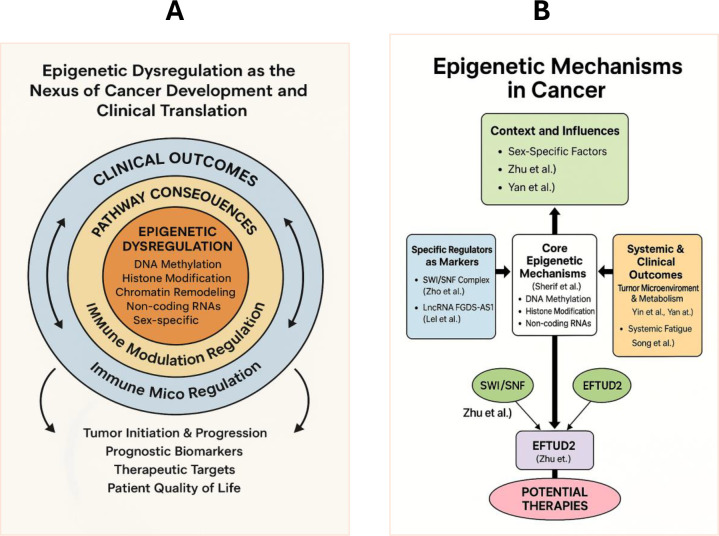 Figure 1
Peer Reviews
No public reviews on file for this paper yet. If you reviewed it on a platform where reviews are public (OpenReview, ICLR, NeurIPS, ICML), you can paste yours below so the community can read it here.
Videos
No videos yet. Explain this paper in a talk, walkthrough, or lecture? Add one.
Taxonomy
TopicsEpigenetics and DNA Methylation · Histone Deacetylase Inhibitors Research · Protein Degradation and Inhibitors
The field of cancer research has expanded beyond a sole focus on genetic mutations, increasingly acknowledging the significant role of epigenetics in the initiation, progression, and therapeutic resistance of cancer. Epigenetic mechanisms—heritable changes in gene expression that do not involve changes to the DNA sequence—are a vital layer of cellular regulation, and their disruption is a defining characteristic of cancer. This Research Topic, featuring seven contributing articles, was created to serve as a platform for diverse, advanced research and to summarize recent progress in understanding how epigenetic modifications drive the cancer development process. Our main goal was to discover new epigenetic markers and pathways that could be useful for cancer diagnosis, prognosis, and treatment.
This Research Topic was anchored by a comprehensive review by Sherif et al., which provides an overview of the key mechanisms and technologies currently explored in cancer epigenetics. This article also discusses other contributions by highlighting the established principles of DNA methylation, histone modification, and non-coding RNA regulation. Zhu et al. provided a focused review of the “transcriptomic era of cancers in females,” offering new epigenetic perspectives and therapeutic prospects, specifically for female-related malignancies. This study underscores the importance of sex-specific approaches to epigenetic research.
Several contributions in this Research Topic have examined specific epigenetic regulators and their roles as diagnostic or prognostic markers. The article by Zhao et al. provides a detailed analysis of the SWI/SNF complex, a key chromatin remodeler, and its high-frequency mutant subunits in various tumors. This study highlights how the fundamental epigenetic machinery is often dysregulated in cancer. Similarly, Lei et al. presented a meta-analysis of the prognostic significance of lncRNA FGD5-AS1 across different malignancies, suggesting its potential as a broad prognostic indicator. Additionally, Yin et al. identified EFTUD2 as a promising diagnostic and prognostic marker in lung adenocarcinoma, linking its involvement in the tumor immune microenvironment and glycolysis. Together, these studies demonstrate how a focused understanding of individual epigenetic factors can yield powerful insights into tumor progression.
The Research Topic also broadens its scope to include the influence of external factors and systemic consequences of malignancy. Yan et al. explored the relationship between the Hepatitis B virus X protein and the TGF-β pathway in the carcinogenesis of hepatocellular carcinoma, offering a unique perspective on how viral factors can engage with cellular signaling to drive cancer. Finally, Song et al. provided a scoping review of the genes related to cancer-related fatigue, a significant quality-of-life issue for patients. This contribution, while addressing a different facet of cancer, implicitly underscores the broad systemic impact of the disease, which is often mediated by epigenetic changes that regulate gene expression and cellular function.
Taken together, the diverse and innovative findings presented in this article Research Topic place the field’s discoveries in a broader context. These articles move beyond descriptive observations to mechanistic investigations, bridging the gap between epigenetic dysregulation and functional outcomes in cancer. The insights gained from this Research Topic not only advance our fundamental understanding of cancer biology but also pave the way for the development of new diagnostic and prognostic markers, as well as novel epigenetic-based therapies (Figure 1A).
Future research should focus on translating these findings into clinical practice and exploring the crosstalk between epigenetic mechanisms as conceptualized in Figure 1B.
The Editors would like to extend their sincere gratitude to all the authors and reviewers for their outstanding contributions and dedication to this Research Topic. We are confident that this Research Topic will serve as a valuable resource and catalyst for further exploration in the dynamic and critical fields of cancer epigenetics.