From yellow deserts to white mountains: confirmed occurrence and genetic affiliation of Psammophis schokari (Forskål, 1775) (Serpentes, Psammophiidae) in Lebanon
Daniel Jablonski, Rami Khashab, Riyad A. Sadek

TL;DR
Scientists confirmed the presence of a desert snake species in Lebanon and found it has a wider habitat range than previously thought.
Contribution
This study confirms the northernmost distribution of Psammophis schokari in the Levant and reveals its genetic connection to North African populations.
Findings
Psammophis schokari was found in Lebanon, including non-desert and high-altitude habitats.
Lebanese populations are genetically closer to North African than to southern Levant populations.
The species shows ecological flexibility, inhabiting diverse and cooler environments.
Abstract
The ecological and biogeographic limits of arid-adapted reptiles in the Eastern Mediterranean remain poorly understood. Here, we document the first confirmed occurrence and genetic affiliation of the desert racer, Psammophis schokari (Forskål, 1775), in Lebanon, representing the northern limit of its confirmed distribution in the western Levant, where its presence has long remained uncertain. Seventeen records from 11 localities (17–1,148 m a.s.l.) reveal that the species occupies a wide ecological gradient encompassing lowland agricultural areas, semi-arid foothills, and even seasonally snow-covered sites. Mitochondrial cytochrome b sequences place the Lebanese populations within the widespread “Middle Eastern lineage”, yet their haplotypes show a closer affinity to those from North Africa than to currently sampled populations from the southern Levant. This pattern is consistent with…
Genes, proteins, chemicals, diseases, species, mutations and cell lines named across the full text — each resolved to its canonical identifier and authoritative record.
Click any figure to enlarge with its caption.
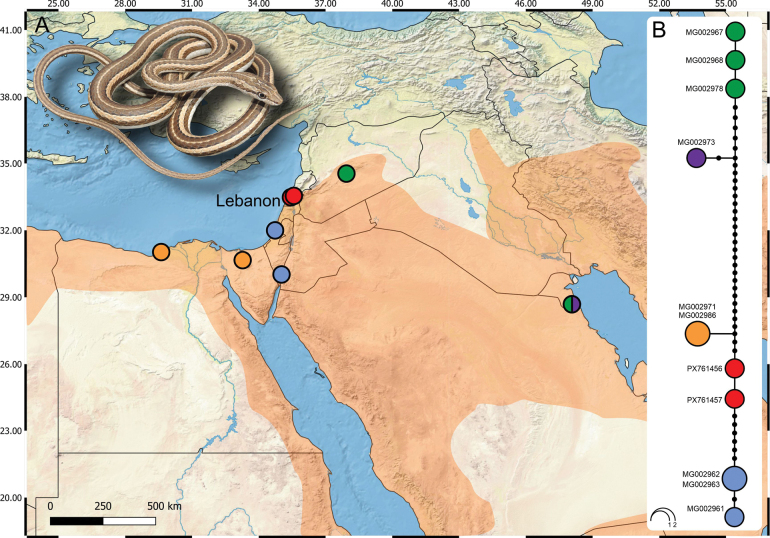 Figure 1
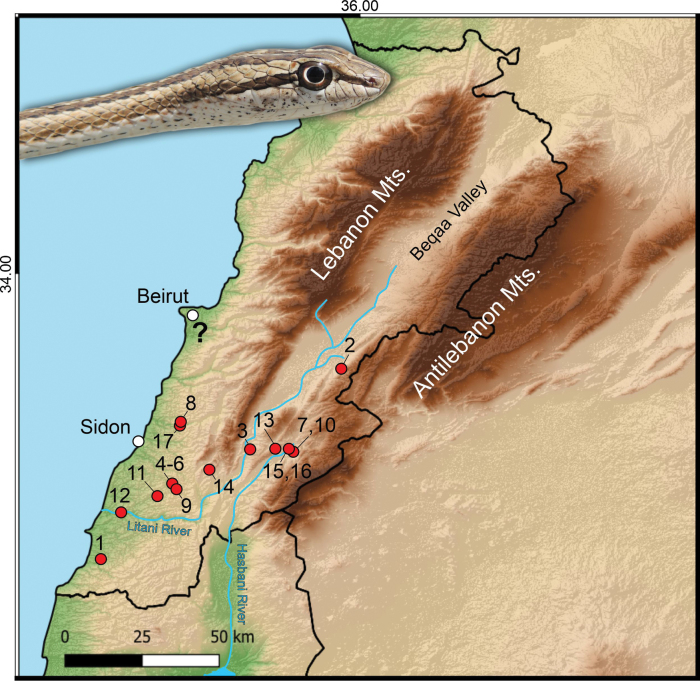 Figure 2
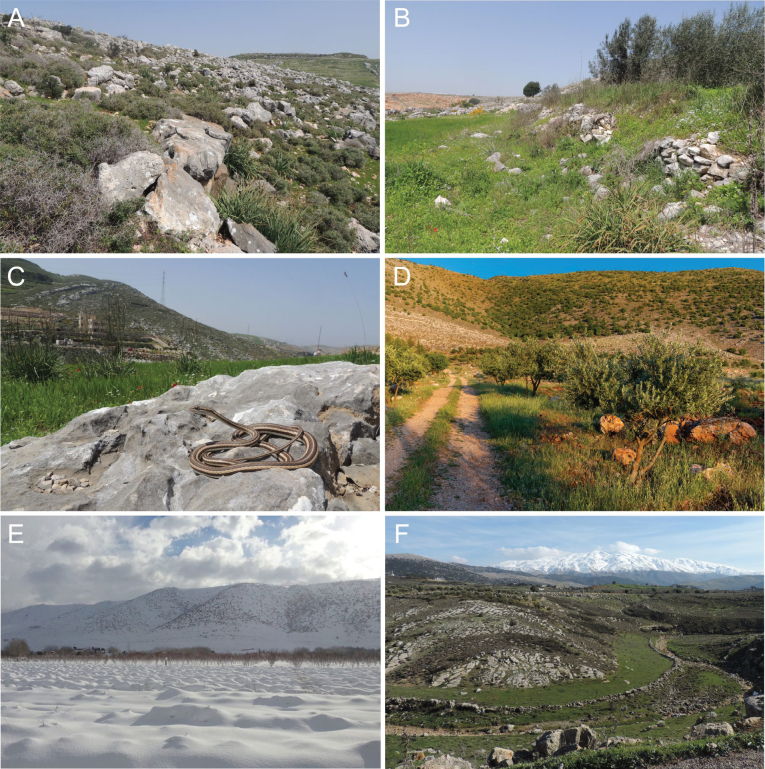 Figure 3
| Map number | Field number | Date | Locality | Geographic coordinates (°N, °E) | Elevation (m) | Age | State | Activity | Evidence | Observer |
|---|---|---|---|---|---|---|---|---|---|---|
|
| PSL001 | 11 September 2018 | Qlaileh |
| 143 | juvenile | Alive | Active, moving | Photo | Mahdi Hardan/Rami Khashab |
|
| PSL002 | 27 July 2019 | Anjar |
| 975 | adult | Alive | Basking on a rock | Video | Berj Tumberian |
|
| PSL003 | 29 June 2021 | Sohmor |
| 868 | subadult | Alive | Crossing a road | Photo | Zainab Farhat |
|
| PSL004 | 29 March 2022 | Kfar Jouz/Kfour |
| 358 | adult | Alive | Active, moving | Photo | Hamza Rida/Rami Khashab |
|
| PSL005 | 7 June 2022 | Kfar Jouz/Kfour |
| 347 | adult | Dead |
| Photo | Hamza Rida |
|
| PSL006 | 25 May 2023 | Kfar Jouz/Kfour |
| 352 | adult | Alive | Active, moving | Photo | Hamza Rida/Rami Khashab |
|
| PSL007 | 29 May 2023 | Marj El Simah |
| 911 | adult | Dead |
| Video | Tamer Talayeh |
|
| PSL008 | 2 July 2023 | Deir Al Mokhalles |
| 429 | adult | Dead | Killed by a cat | Photo | Raeda Fares |
|
| PSL009 | 31 August 2023 | Kfar Jouz/Kfour |
| 403 | subadult | Alive | Under a rock | Photo | Hamza Rida |
|
| PSL010 | 26 February 2024 | Marj El Simah |
| 889 | adult | Alive | Active, moving (grass habitat) | Photo | Borja de las Heras/Rami Khashab |
|
| PSL011 | 6 May 2024 | Ebba |
| 260 | adult | Alive | Trapped inside a greenhouse | Photo | Nidaa Hamza/Rami Khashab |
|
| PSL012 | 15 July 2024 | Bedias |
| 17 | subadult | Dead | Killed by locals | Photo | Rami Khashab |
|
| PSL013 | 14 September 2024 | Kfar Mechki |
| 1148 | juvenile | Dead | Killed by locals | Photo | Hicham El Zein |
|
| PSL014 | 15 January 2025 | Rihan |
| 1050 | adult | Alive | Passing a backyard | Photo | Elias Fatouch |
|
| PSL015 | 25 August 2025 | Marj El Simah |
| 953 | juvenile | Dead | Recorded inside a residential building | Photo | Tamer Talayeh |
|
| PSL016 | 4 October 2025 | Marj El Simah |
| 875 | adult | Alive | Active in the morning | Photo | Shady Akl/Jad Mershed/Borja de las Heras |
|
| NA | 20 November 2022 | Sfariyeh |
| 165 | NA | Alive | Active at the ruin site | NA | Haitham Darazi |
| Field number | Locality | Date | Dorsal Scales | Ventral Scales | Subcaudal Scales | SVL (mm) | HL (mm) | TL (mm) | TotL (mm) |
|---|---|---|---|---|---|---|---|---|---|
| PSL004 | Kfar Jouz/Kfour | 29 March 2022 | 17 | 168 | 116 | - | - | - | - |
| PSL011 | Ebba, Nabatieh | 6 May 2024 | 17 | 160 | 112 | - | - | - | - |
| PSL013 | Kfar Mechki, Rachaya | 14 September 2024 | 17 | 168 | 117 | 268 | 13.2 | 122 | 390 |
| PSL016 | Marj El Simah, Rachaya | 4 October 2025 | 17 | 171 | 119 | - | - | - | 750 |
Peer Reviews
No public reviews on file for this paper yet. If you reviewed it on a platform where reviews are public (OpenReview, ICLR, NeurIPS, ICML), you can paste yours below so the community can read it here.
Videos
No videos yet. Explain this paper in a talk, walkthrough, or lecture? Add one.
Taxonomy
TopicsAmphibian and Reptile Biology · Turtle Biology and Conservation · Wildlife Ecology and Conservation
Introduction
Lebanon is a small country located between the central part of the eastern Mediterranean coast and the Syrian desert, divided from north to south by two biogeographically important and high mountain chains, the Lebanon and Anti-Lebanon. Its position, combined with the highly heterogeneous landscape of these mountain chains, is unique: in the past, this setting facilitated both local speciation and the colonization of various evolutionary lineages of small vertebrates from Asia and Africa that converged in this part of Western Asia (In den Bosch et al. 1998). Nevertheless, substantial knowledge gaps in national biodiversity persist, largely due to limited local expertise, ongoing economic constraints, and recurrent socio-political instability.
The herpetofauna of Lebanon is rich and genetically diverse (Jablonski et al. 2023, 2024), comprising several dozen species representing East Mediterranean, steppe-desert, and high-mountain specialists. However, this diversity has not been comprehensively assessed recently, and an updated checklist has been lacking for over two decades (Hraoui-Bloquet et al. 2002). Despite the above-mentioned challenges, several species have been documented in recent years that are either new to science (Jablonski et al. 2023) or newly recorded for the country’s herpetofauna (Dufresnes et al. 2019; Khashab and Jablonski 2022; Tamar and Moravec 2022; Jablonski et al. 2024). This opens an opportunity for field research focusing on species that have been recorded as part of the Lebanese herpetofauna, as well as those that are expected to occur in the country. In this respect, border regions in the north, Anti-Lebanon Mountains, and the southern Mediterranean parts are the least explored and highly promising.
One such species is Psammophis schokari (Forskål, 1775), a member of the family Psammophiidae, which possesses one of the broadest geographic distributions among western Palearctic snakes. Its range spans much of North Africa, the Levant, the Arabian Peninsula, and extends eastward into Central Asia and parts of South Asia (see Bar et al. 2021). In Lebanon, however, the presence of this species remained uncertain for a long time. Only two specimens collected from the coastal cities of Sidon and Beirut are reported in the literature (Hraoui-Bloquet 1981), one mentioned to be stored in the American University of Beirut Natural History Museum, Lebanon (probably AUB AR0126 collected in 1961), and the second in the National Museum of Natural History in Paris, France, with no additional information provided.
The first known literature report of the species, however, came from Jan (1863: 90) with the location provided as “Bairut”, stored in the museum in Frankfurt, Germany. Later, Böttger (1880), probably referring to Jan (1863), mentioned the species under the name Psammophis moniliger Duméril, Bibron & Duméril, 1854 from “Beyrut,” noting their similarity to populations from northern Africa and Syria, and comparing them with var. hierosolymitana, which was then also known from Haifa, Jaffa, and Jerusalem. Later, Werner (1939) argued that since Beirut lies outside desert regions, and the species (under the name P. sibilans) was, in his view, strictly desert-dwelling (though it can occur up to 3500 m in Iran; Kamali 2020), the Beirut record appeared highly doubtful. He therefore concluded that Jan’s (not specified but probably the work from 1863) specimen was most likely purchased in Beirut but originated from the southern Levant or the Syrian Desert (Werner 1939).
This scepticism probably explains why no further attention was given to the possible presence of the genus Psammophis Fitzinger, 1826 in Lebanon that could provide further connectivity for populations in Syria or northeastern Iraq (Aidek et al. 2023; Jablonski et al. 2025). Despite various herpetological surveys carried out during the 20^th^ century (Müller and Wettstein 1933; Schmidt 1939; Zinner 1967; Esterbauer 1992; In den Bosch et al. 1998), none reported or further mentioned the species in the country, except for Hraoui-Bloquet (1981). Notably, it was also absent from the most recent comprehensive checklist of Lebanese herpetofauna (Hraoui-Bloquet et al. 2002), casting further doubt on its occurrence. On the other hand, several later sources have mentioned this species in Lebanon (e.g. Disi et al. 2001; Sindaco et al. 2013; Bar et al. 2021), but these appear to be repetitions of earlier, uncertain records.
Here, we revisit this issue and provide strong evidence regarding the presence of P. schokari in Lebanon, along with extensive distribution data and genetic affiliation of populations from the southern part of the country.
Material and methods
Between 2018 and 2025, we conducted more than 60 field surveys (1–4 people) in southern and central Lebanon to document amphibian and reptile diversity. Surveys were based primarily on direct observations, carried out mainly from early spring to autumn, with additional visits in winter (November–February). Surveys lasted 1–3 days (mostly single-day) and included nocturnal searches; we spent ≥ 2 h at each site and typically accumulated ~10 h of active searching per survey. These efforts revealed P. schokari at multiple localities, representing the first confirmed records for Lebanon since Hraoui-Bloquet (1981). For each observation we recorded date, abundance, age/sex (when determinable), GPS coordinates, nearest village, elevation, habitat type, and relevant field notes. A small number of resident-provided records were included to our database when supported by photographic evidence.
Together with field data, DNA tissue samples were obtained from two Lebanese populations, particularly from Kfar Jouz/Kfour, Nabatieh Governorate (33.4078°N, 35.4540°E, 352 m a.s.l.) and Ebba, Nabatieh District and Governorate (33.3732°N, 35.4117°E, 260 m a.s.l.) (Table 1; Fig. 1). Based on previous research and the availability of comparative datasets, we generated new mitochondrial sequences of cytochrome b marker (cyt b) using primers and PCR conditions described by Gonçalves et al. (2018). Total genomic DNA was extracted with the E.Z.N.A.® Tissue DNA Kit, following the manufacturer’s protocol. Newly generated sequences of the species from Lebanon are available in GenBank under the accession numbers PX761456 and PX761457.
Genetic data of Psammophis schokari from Lebanon and the Western Asia. A. Geographic distribution of sampled populations with colour-coded localities (Lebanese samples = red; other localities from Gonçalves et al. 2018). Orange shaded area indicates the species’ approximate range in the region; B. Statistical parsimony haplotype network of mitochondrial cytochrome b showing relationships among haplotypes; circle sizes correspond to sample frequency and colours correspond to sampling localities in panel A. The codes with circles represent GenBank accession numbers. Lebanese haplotypes form a distinct cluster more distant from the southern Levant than from Egypt. Inset photo: P. schokari from Kfar Jouz/Kfour, Lebanon (29 March 2022; Photo Rami Khashab).
Table 1.: Records of Psammophis schokari in Lebanon between 2018 and 2025. Data include map number (corresponding to Fig. 2), field number, date, locality with geographic coordinates, and elevation, age, condition (alive or dead), observed activity, type of evidence, and observer name. DOR = dead on road. For details see Suppl. material 1.
For accurate phylogeographic assignment based on mitochondrial sequences, we included material from Gonçalves et al. (2018), particularly for so-called “Middle East lineage”, that were closely related to newly generated Lebanese data. It includes sequences from MG002961–MG002963 (southern Levant), MG002967, MG002968 (Syria), MG002971, MG002986 (Sinai), MG002973, MG002978 (Kuwait). The final sequence alignment (11 sequences, 1098 bp) was analysed with a haplotype-network approach (more effective for presentation of intraspecific evolution in closely related populations than the tree-based visualization) in Hapsolutely (Vences et al. 2024). To visualize the genetic diversity in the geographic context, distribution of the species, and update its known range in Lebanon, we prepared distribution maps using QGIS 3.44 Solothurn (QGIS Development Team 2025; https://qgis.org/).
Results
The mitochondrial cytochrome b sequences group within the widespread “Middle Eastern lineage” of the species, sensu Gonçalves et al. (2018). However, the haplotype network (Fig. 1B) reveals a distinct clustering of Lebanese haplotypes. Surprisingly, the Lebanese samples from two distinct haplotypes show a closer relationship to Egyptian haplotypes (4 mutation steps) than to those from the southern Levant (more than 7), indicating a relatively high degree of differentiation across short geographic distances.
We documented 17 records of P. schokari in Lebanon between 2018 and 2025, representing 11 localities distributed across the Beqaa Valley and southern Lebanon (Table 1; Figs 1, 2). The records span a broad elevational gradient from 17 m a.s.l. (Bedias, Qasmieh/Litani area, South Governorate) to 1,148 m a.s.l. (Kfar Mechki, Rachaya district, Beqaa Governorate), thus covering both lowland plains and foothill habitats of the Lebanon and Anti-Lebanon ranges. The southernmost and westernmost record originates from Qlaileh, South Governorate, and the northernmost and easternmost confirmed record from Anjar, Beqaa Governorate. Except for the Sfariyeh record, all records were supported by photographs (n = 14) or videos (n = 2). One specimen was deposited in the American University of Beirut Natural History Museum (AUB) under the voucher museum number AUB AR0936. Original photo vouchers of recorded individuals are available in Suppl. material 1.
Distribution of Psammophis schokari in Lebanon based on records listed in Table 1. Red circles = newly documented localities, white circles = historical data. The question mark indicates historical record from a vicinity of Beirut (Hraoui-Bloquet 1981). Background shows shaded relief with major mountain ranges (Lebanon Mts., Anti-Lebanon Mts.) and the Beqaa Valley. Two rivers, Litani and Hasbani represent possible corridors for the species colonization. Inset photo: live individual of P. schokari from Kfar Jouz/Kfour, Lebanon (29 March 2022; Photo Rami Khashab).
The first known specimen of this study was a juvenile from Qlaileh (11 September 2018). Because several P. schokari appeared simultaneously in a Beirut pet shop, likely imported illegally from Egypt, its native origin was uncertain. The individual died shortly after capture (AUB AR0936). The species’ native presence was confirmed the following year (27 July 2019) by a filmed observation of an adult at Anjar (975 m a.s.l.). A third observation came from Sohmor (29 June 2021), followed by the first well-documented specimen (with obtained DNA sample) from Kfar Jouz/Kfour (29 March 2022), the same individual was recaptured and photographed the following year (25 May 2023). Two additional records from this locality included the dead adult (7 June 2022) and a live subadult (31 August 2023). Other records include an adult killed by a cat at Deir Al Mokhalles (2 July 2023) and four observations from Marj El Simah in the Rachaya region: a dead adult specimen (29 May 2023), a live smaller adult individual (26 February 2024), exhibiting defensive biting resulting in a mild envenomation case to one of the observers, a juvenile that was killed by locals after entering a house (25 August 2025), and the most recent record of a live adult individual that was active during the morning hours (4 October 2025). The juvenile from Kfar Mechki (14 September 2024; 1,148 m a.s.l.) represents the highest elevation record for Lebanon (record PSL013: the specimen was dead and collected). Additional observations comprise an adult trapped in a greenhouse in Ebba (6 May 2024), a juvenile killed by locals in Bedias (15 July 2024; 17 m a.s.l., the lowest elevation record), and a record from Rihan (15 January 2025; 1,050 m a.s.l.). In total, records comprise 10 adults, three subadults, three juveniles, and one unaged individual, of which 11 were observed alive and six as dead individuals (Table 1).
All documented individuals belonged to the longitudinally striped morph. Metric and meristic data were obtained for four individuals from four localities (see Table 2). Ventrals averaged 166.8 ± 4.7 (160–171) and subcaudals 116.0 ± 2.9 (112–119); dorsal scale rows were constant (17 in all individuals).
Table 2.: Selected morphometric and meristic data on Psammophis schokari from Lebanon.
The seasonal presence of the 17 records shows that most observations fall within the expected activity period of snakes in the region, from late spring to summer (May–August; n = 10). Additional records were obtained in March (n = 1), September (n = 2), and October (n = 1), whereas three observations surprisingly derive from winter months: January (n = 1), February (n = 1), and November (n = 1).
Despite generally being considered as species of arid habitats, in Lebanon, it inhabits rocky, shrubby hillsides with poor tree cover as well as open agricultural areas with rocky walls and even dry rocky riversides (Fig. 3). During the winter, few localities with confirmed presence are irregularly covered by snow (Fig. 3E). The species shares the habitat with other reptiles, i.e. Testudo graeca, Pseudopus apodus levantinus, Chalcides guentheri, Chalcides ocellatus, Heremites vittatus, Eumeces schneideri, Ablepharus rueppellii, Laudakia vulgaris, Phoenicolacerta laevis, Lacerta media, Ophisops elegans, Ptyodactylus puiseuxi, Hemidactylus turcicus, Mediodactylus orientalis, Xerotyphlops syriacus, Letheobia simoni, Eryx jaculus, Micrelaps muelleri, Dolichophis jugularis, Hemorrhois nummifer, Platyceps collaris, Eirenis rothii, E. decemlineatus, E. lineomaculatus, Rhynchocalamus melanocephalus, Telescopus fallax, Malpolon insignitus, Natrix tessellata, and Daboia palaestinae.
Typical habitats of Psammophis schokari in Lebanon, illustrating a mosaic of rocky karstic (carbonate) terrain, grasslands, and agrohabitats. A. Rocky karst slope with low-shrub vegetation; B. Grassy field margin with stone terraces/low walls; C. Individual basking on a large carbonate boulder (all from Kfar Jouz/Kfour; 30 March 2022); D. Open olive-grove landscape interspersed with rocky karst (Anjar; 8 May 2022); E. The same Anjar area in winter, with seasonal snow cover (10 January 2013); F. Karstic plateau with a shallow valley (Marj El Simah; 27 February 2024). Photographs by Rami Khashab, Tsolag Hergelian, and Daniel Jablonski.
Discussion
More than 160 years after the first doubtful report of the species from Beirut (Jan 1863), we have confirmed the well-established presence of P. schokari in Lebanon and, for the first time, investigated its basic genetic affiliation. This represents an important step toward understanding the species’ occurrence and ecological adaptability at the northern edge of its range, where Lebanon lies. As noted earlier, the presence of P. schokari in the country was either uncertain (Hraoui-Bloquet 1981) or explicitly questioned, partly due to the possibility of imports from Egypt for the pet trade (Werner 1939). However, our data clearly confirm that the species has an extensive distribution across the southern part of Lebanon, linked to populations from the south-western parts of the species range (Figs 1, 2 and Aidek et al. 2023).
Our results fit into the broader phylogeographic framework outlined by Gonçalves et al. (2018), who identified six major mitochondrial lineages of P. schokari across North Africa and Western Asia. Unexpectedly, the genetic relationships recovered here are not geographically straightforward. Although the Lebanese samples belong to the “Middle Eastern lineage”, the two haplotypes detected in southern Lebanon (sampled ~5 km apart) form a tight local cluster (separated by a single mutational step) yet show closer affinity to northeastern African/Sinai haplotypes than to those currently documented from the southern Levant. This pattern is consistent with a scenario of historical range expansion from North Africa into the Levant via the Sinai corridor, followed by local persistence and differentiation at the northern range margin. In Lebanon, the Litani–Hasbani drainage may have functioned as a biogeographic filter shaping local structure, while the associated river valleys could also have acted as dispersal corridors facilitating movements within southern Lebanon.
From a temporal perspective, divergence among major P. schokari lineages was placed in the Pliocene, with subsequent structuring during the Pleistocene (Gonçalves et al. 2018). The Lebanese haplotypes may therefore represent signatures of late Pleistocene expansions, preserved in peripheral populations at the northern edge of the species’ range. This interpretation is consistent with recent evidence for other African-derived lineages in southern Lebanon (e.g. Letheobia simoni; see discussion by Jablonski et al. 2024), suggesting that the region may have repeatedly received colonizers from Africa through distinct historical dispersal events. Gonçalves et al. (2018) further emphasized the role of climatic oscillations and ecological connectivity between North Africa and the Levant in shaping diversification and distribution patterns in P. schokari. Accordingly, the affinity of Lebanese haplotypes to Egypt/Sinai is compatible with historical colonization followed by persistence in local refugia during unfavourable climatic periods. However, large parts of the species’ range remain unsampled, and the inferred phylogeographic structure may change with denser geographic coverage.
Regarding regional connectivity, although the southern Levant currently harbours different mitochondrial haplotypes (Fig. 1), we cannot exclude that these haplotypes also occur in southern Lebanon but remain undetected due to sparse sampling (e.g. localities 7, 10, 13, 15; Fig. 2). Broader genetic sampling, particularly along putative dispersal axes such as the Litani and Hasbani River corridors (Fig. 2), will be necessary to test this prediction and to clarify whether the observed pattern reflects true historical colonization dynamics, secondary contact, or gaps in sampling.
A potential historical introduction, as suggested by Werner (1939), may explain the record from Beirut (Jan 1863), since this locality lies far north of the populations discovered here, and no data confirm its current presence despite extensive fieldwork around the capital. Beirut is known for the snake pet trade (e.g. Natrix tessellata from Syria; Khashab pers. obs.), although direct evidence for Psammophis in this context is lacking. Alternatively, if a population had indeed existed in Beirut due to past natural dispersions, it may have become extinct due to intense urban expansion and overpopulation in and around the city, which have led to the disappearance of suitable habitats in western and southwestern Beirut over recent decades. In contrast, the second historical record from Sidon falls within the currently known range of the species (see localities 8 and 17 in Fig. 2).
Psammophis schokari is a species with high habitat tolerance, and our data from Lebanon highlight important ecological particularities at the northern edge of its distribution. Contrary to Werner’s (1939) and subsequent assumptions that the species is strictly desert-dwelling, our observations document its ability to occupy rocky hillsides with Mediterranean vegetation and even agricultural landscapes, consistent with reports from other parts of its range (e.g. Amr and Disi 2011; Bar et al. 2021). As suggested by a few studies, the colour polymorphism (light snakes without stripes are rather present in deserts) may be an adaptation to habitats that allow better survival (Lahav and Dmi’El 1996; Kark et al. 1997). In Lebanon, the species appears to be represented exclusively by the longitudinally striped morph, which may be adaptive in the rocky and grassy habitats it occupies. The limited morphological data we collected (Table 2) fall within the range previously reported from the region, although subcaudal counts are slightly higher (cf. Kark et al. 1997). The species also occurs at elevations exceeding 1,100 m a.s.l. (and up to 3,500 m in Iran; Kamali 2020) and was repeatedly recorded during the coldest months (January, February, and November; Table 1), when reptile surface activity is typically strongly reduced. These winter records likely reflect opportunistic activity during favourable microclimatic windows and the buffering effects of relatively mild lowland habitats, consistent with its thermophilic ecology. Such ecological flexibility aligns with the broad niche breadth and apparent capacity to persist under fluctuating climatic regimes inferred for P. schokari in North Africa (Gonçalves et al. 2018), indicating that the species is not restricted to deserts but can occupy a wide spectrum of habitats, including areas that are seasonally snow-covered (Fig. 3).
This ability to exploit heterogeneous environments suggests that P. schokari is less constrained by seasonality than many other snakes in the Levant and Western Asia, which may help explain its capacity to disperse and establish populations in biogeographically complex regions across wide areas of the central and southern Western Palearctic, including mountainous Lebanon. Our results also highlight the Levant as an important biogeographic bridge connecting African and Asian faunas and underscore the need for further integrative research to reconstruct the colonization routes and adaptive history of desert reptiles at the margins of their ranges.
The reference list from the paper itself. Each links out to its DOI / PubMed record.
- 1Amr ZS, Disi AM (2011) Systematics, distribution and ecology of the snakes of Jordan. Vertebrate Zoology 61(2): 179–266. 10.3897/vz.61.e 31150 · doi ↗
- 2Dufresnes C, Mazepa G, Jablonski D, Sadek RA, Litvinchuk SN (2019) A river runs through it: Tree frog genomics supports the Dead Sea Rift as a rare phylogeographical break. Biological Journal of the Linnean Society 128(1): 130–137. 10.1093/biolinnean/blz 076 · doi ↗
- 3Esterbauer H (1992) Die Herpetofauna des östlichen Golan- und Hermongebietes: Funde und Bemerkungen zur Systematik und Ökologie. Zoology in the Middle East 7(1): 21–54. 10.1080/09397140.1992.10637623 · doi ↗
- 4Gonçalves DV, Martínez-Freiría F, Crochet PA, Geniéz P, Carranza S, Brito JC (2018) The role of climatic cycles and trans-Saharan migration corridors in species diversification: Biogeography of Psammophis schokari group in North Africa. Molecular Phylogenetics and Evolution 118: 64–74. 10.1016/j.ympev.2017.09.00928919506 · doi ↗ · pubmed ↗
- 5Hraoui-Bloquet S (1981) Les reptiles du Liban: 1 - Nomenclature et notes écologiques. Ecologia Mediterranea 7(2): 93–101. 10.3406/ecmed.1981.997 · doi ↗
- 6Hraoui-Bloquet S, Sadek RA, Sindaco R, Venchi A (2002) The herpetofauna of Lebanon: New data on distribution. Zoology in the Middle East 27(1): 35–46. 10.1080/09397140.2002.10637939 · doi ↗
- 7Jablonski D, Ribeiro-Júnior MA, Simonov E, Šoltys K, Meiri S (2023) A new, rare, small-ranged, and endangered mountain snake of the genus Elaphe from the Southern Levant. Scientific Reports 13(1): 4839. 10.1038/s 41598-023-30878-4PMC 1003899536964263 · doi ↗ · pubmed ↗
- 8Jablonski D, Khashab R, Rida H, Sadek RA (2024) A snake genus new to the reptile list of Lebanon: Genetic affiliation and distribution of Letheobia simoni (Boettger, 1879). Zootaxa 5543(1): 145–150. 10.11646/zootaxa.5543.1.1039646115 · doi ↗ · pubmed ↗