Cholangioscopy-guided retrieval of a migrated stent using a novel thin cholangioscope in a patient with Roux-en-Y gastrectomy
Yuki Tanisaka, Shomei Ryozawa, Masafumi Mizuide, Akashi Fujita, Ryuichi Watanabe, Ryosuke Hamamura, Suguru Ito

Abstract
Genes, proteins, chemicals, diseases, species, mutations and cell lines named across the full text — each resolved to its canonical identifier and authoritative record.
Click any figure to enlarge with its caption.
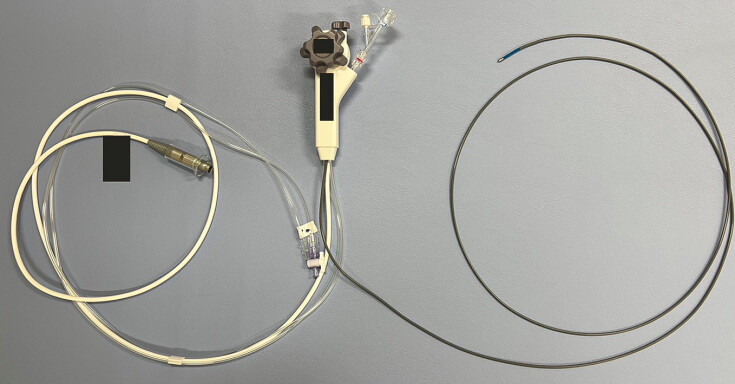 Fig. 1
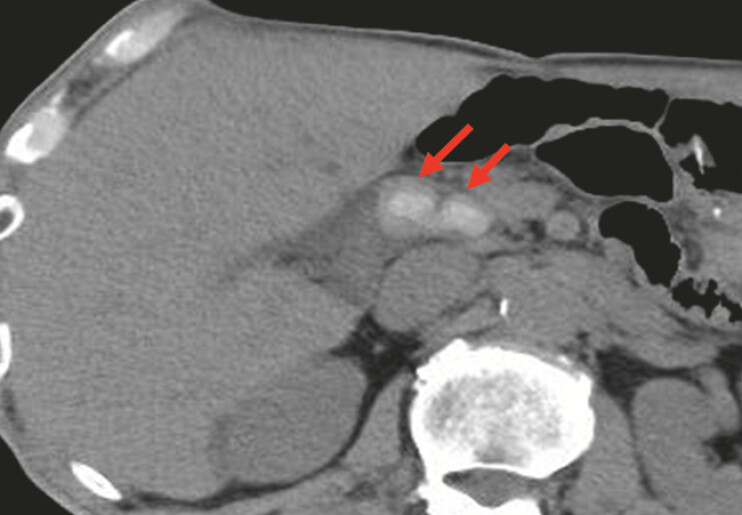 Fig. 2
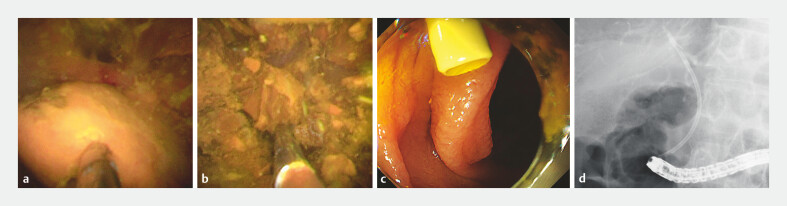 Fig. 3
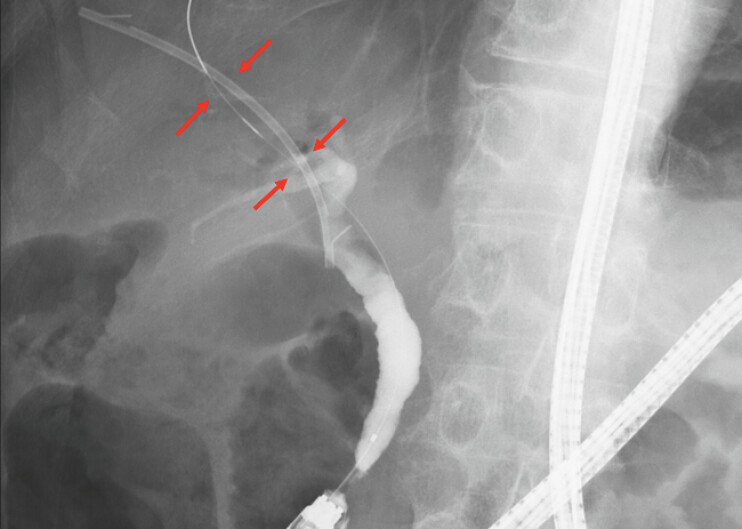 Fig. 4
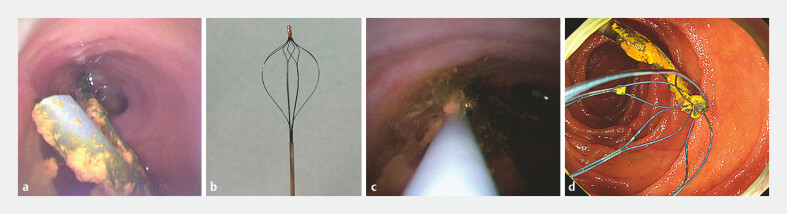 Fig. 5
Peer Reviews
No public reviews on file for this paper yet. If you reviewed it on a platform where reviews are public (OpenReview, ICLR, NeurIPS, ICML), you can paste yours below so the community can read it here.
Videos
No videos yet. Explain this paper in a talk, walkthrough, or lecture? Add one.
Taxonomy
TopicsGallbladder and Bile Duct Disorders · Minimally Invasive Surgical Techniques · Esophageal and GI Pathology
Stent migration can occur after endoscopic retrograde cholangiopancreatography (ERCP)-related procedures. Although various retrieval techniques have been reported 1 2 , removing a migrated stent remains technically challenging, particularly in patients with Roux-en-Y gastrectomy using a balloon enteroscope. Recently, a novel thin cholangioscope (eyeMAX; Micro-Tech, China), with a length of 219 cm and a diameter of 9-Fr ( Fig. 1 ), has enabled cholangioscopy-guided interventions to be performed under balloon enteroscopy 3 4 . We report a case of the successful cholangioscopy-guided retrieval of a migrated stent using a novel thin cholangioscope in a patient with Roux-en-Y gastrectomy.
A thin cholangioscope (eyeMAX; Micro-Tech, China) measuring 219 cm in length, with a diameter of 9-Fr.
A 74-year-old man with multiple large stones in the common bile duct, who had previously undergone Roux-en-Y gastrectomy, was referred to us ( Fig. 2 ). ERCP was performed using a short-type single-balloon enteroscopy (SIF-H290; Olympus Marketing, Japan) with a working length of 152 cm and a working channel of 3.2 mm in diameter 5 . Cholangioscopy-guided lithotripsy using a novel thin cholangioscope was performed, followed by the placement of a plastic stent due to the presence of residual stones ( Fig. 3 ). Two months later, residual stone extraction was attempted; however, upon reaching the papilla, the plastic stent was found to have migrated into the bile duct ( Fig. 4 ). Because fluoroscopy-guided stent retrieval using a basket catheter or a balloon catheter was unsuccessful, cholangioscopy-guided stent retrieval was attempted ( Video 1 ). The migrated stent was clearly visualized under cholangioscopy ( Fig. 5 a ). Therefore, we decided to capture the stent using a retrieval basket (SpyGlass Retrieval Basket; Boston Scientific, USA; Fig. 5 b ), which can be inserted through the thin cholangioscope. A distal flap of the stent was successfully grasped under direct cholangioscopic visualization ( Fig. 5 c ). Finally, a stent retrieval was achieved ( Fig. 5 d ).
Computed tomography revealing multiple large stones in the common bile duct (red arrow).
Findings of endoscopic retrograde cholangiopancreatography-related procedures. a and b Cholangioscopy revealing cholangioscopy-guided lithotripsy using a novel thin cholangioscope. Successful stone fragmentation was achieved. c and d Endoscopic and fluoroscopic findings revealing plastic stent placement due to the presence of residual stones.
Cholangiography revealing the plastic stent migrated into the bile duct (red arrow).
Successful cholangioscopy-guided retrieval of a migrated stent using a novel thin cholangioscope in a patient with Roux-en-Y gastrectomy.Video 1
Cholangioscopic and endoscopic findings for stent retrieval. a Cholangioscopy revealing the migrated stent in the bile duct. b The retrieval basket (SpyGlass Retrieval Basket; Boston Scientific, USA), which can be inserted through the thin cholangioscope. c Cholangioscopy revealing the successful grasping of the stent flap. d Endoscopic findings revealing successful stent retrieval of a migrated stent.
Since the retrieval of a migrated stent using a balloon enteroscope is technically challenging, cholangioscopy-guided retrieval with a novel thin cholangioscope is highly beneficial in such cases.
Endoscopy_UCTN_Code_TTT_1AR_2AL
The reference list from the paper itself. Each links out to its DOI / PubMed record.
- 1Yalaka RR Kedarisetty CK Narayankar SMA novel technique of migrated biliary stent retrieval Endoscopy 202254 E 522E 52310.1055/a-1662-392034695850 · doi ↗ · pubmed ↗
- 2Hirakawa N Mukai S Itoi T Peroral digital cholangioscopy-assisted removal of a migrated biliary plastic stent using a novel small dilating balloon Dig Endosc 20253730630710.1111/den.1495039489719 PMC 11884957 · doi ↗ · pubmed ↗
- 3Tanisaka Y Ryozawa S Mizuide M Peroral cholangioscopy-guided basket extraction of intrahepatic bile duct stones, using a novel thin cholangioscope under balloon enteroscopy, in a patient with Roux-en-Y anatomy Endoscopy 202557 E 75E 7639875136 10.1055/a-2512-5414 PMC 11774654 · doi ↗ · pubmed ↗
- 4Tanisaka Y Ryozawa S Mizuide M Peroral cholangioscopy-guided laser lithotripsy using a thin cholangioscope under balloon enteroscopy for Roux-en-Y anastomosis Endoscopy 202557 E 1315 E 131710.1055/a-2738-729841260579 PMC 12629838 · doi ↗ · pubmed ↗
- 5Tanisaka Y Ryozawa S Itoi T Efficacy and factors affecting procedure results of short-type single-balloon enteroscopy-assisted ERCP for altered anatomy: a multicenter cohort in Japan Gastrointest Endosc 202295310318034534494 10.1016/j.gie.2021.09.008 · doi ↗ · pubmed ↗