[Corrigendum] p57KIP2-mediated inhibition of human trophoblast apoptosis and promotion of invasion in vitro
Guo-Qian He, Guang-Yu Liu, Wen-Ming Xu, Hui-Juan Liao, Xing-Hui Liu, Guo-Lin He

Abstract
Genes, proteins, chemicals, diseases, species, mutations and cell lines named across the full text — each resolved to its canonical identifier and authoritative record.
Click any figure to enlarge with its caption.
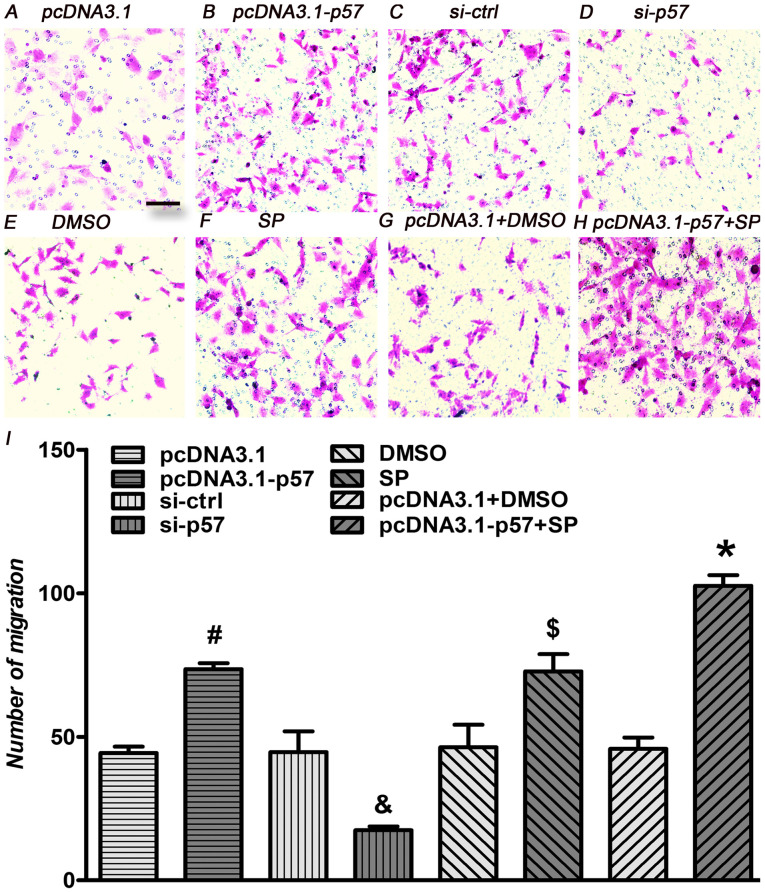 Figure 1
Peer Reviews
No public reviews on file for this paper yet. If you reviewed it on a platform where reviews are public (OpenReview, ICLR, NeurIPS, ICML), you can paste yours below so the community can read it here.
Videos
No videos yet. Explain this paper in a talk, walkthrough, or lecture? Add one.
Taxonomy
TopicsRNA regulation and disease · Single-cell and spatial transcriptomics · bioluminescence and chemiluminescence research
Int J Mol Med 44: 281-290, 2019; DOI: 10.3892/ijmm.2019.4175
Following the publication of the above article, an interested reader drew to the authors' attention that, concerning the Transwell migration assay images shown in Fig. 6 on p. 287, the data panels for figure parts 6E (the DMSO experiment) and 6G (the pcDNA3.1+DMSO experiment) contained strikingly similar data, albeit with different sizing of the images, suggesting that these data had been derived from the same original source.
Upon investigating this figure, the authors realized that this figure had inadvertently been assembled incorrectly: The data panel for the DMSO group in the HTR-8/SVneo cell migration assay (Fig. 6E) had been duplicated from the correctly displayed pcDNA3.1+DMSO group panel. The revised version of Fig. 6, now showing the correct data panel for Fig. 6E, is shown on the next page. The authors confirm that the error associated with this figure did not have any significant impact on either the results or the conclusions reported in this study, and all the authors agree with the publication of this Corrigendum. The authors are grateful to the Editor of International Journal of Molecular Medicine for allowing them the opportunity to publish this Corrigendum; furthermore, they apologize to the readership of the Journal for any inconvenience caused.