Deciphering the conserved catalytic step of PAL-driven salicylic acid biosynthesis pathway in plants
Qian Hu, Gaofeng Liu, Zixin Zhang

Abstract
Genes, proteins, chemicals, diseases, species, mutations and cell lines named across the full text — each resolved to its canonical identifier and authoritative record.
Click any figure to enlarge with its caption.
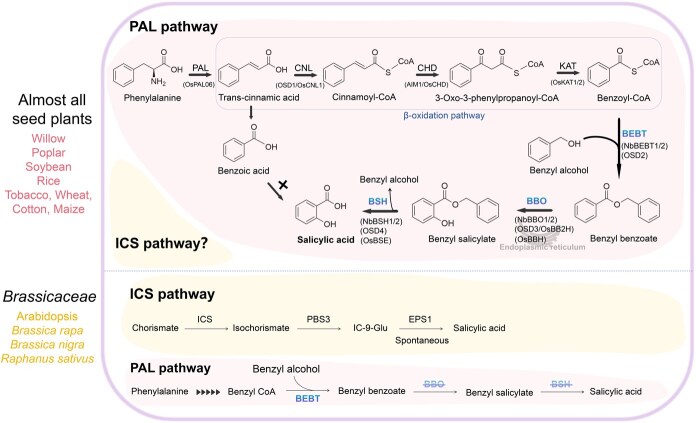 Figure 1
- —Southwest University Talent Introduction Research Startup Project
- —National Natural Science Foundation of China10.13039/501100001809
Peer Reviews
No public reviews on file for this paper yet. If you reviewed it on a platform where reviews are public (OpenReview, ICLR, NeurIPS, ICML), you can paste yours below so the community can read it here.
Videos
No videos yet. Explain this paper in a talk, walkthrough, or lecture? Add one.
Taxonomy
TopicsPlant nutrient uptake and metabolism · Biofuel production and bioconversion · Plant tissue culture and regeneration
Salicylic acid (SA), a pivotal phenolic hormone implicated in plant defense mechanisms, was first isolated from willow bark. It has attracted considerable attention for its capacity to initiate immune responses in plants when they are attacked by pathogens [1–3]. The biosynthesis of SA in plants originates from chorismate and primarily occurs via two distinct pathways: the isochorismate synthase (ICS) pathway and the phenylalanine ammonia lyase (PAL) pathway [4]. Studies reveal that Arabidopsis thaliana (Arabidopsis) sustains constitutively low SA levels, while pathogen or stress triggers activate SA biosynthesis predominantly via the ICS-dependent pathway [5]. Extensive studies on most members of the Brassicaceae family have confirmed the functional conservation of this pathway [6]. Notably, while ICS-encoding genes are widely distributed across plants, no changes in SA content were detected in the ICS-deficient mutants of non-Brassicaceae species (rice, barley, wheat) [7–9]. It is suggested that the ICS-mediated pathway may have evolved relatively recently in Brassicaceae family and is unlikely to represent the primary route for SA biosynthesis in most plant species [1, 7]. Current evidence points to PAL-mediated pathways as the principal SA synthesis routes beyond Brassicaceae, though mechanistic details remain poorly characterized. Earlier hypotheses posited benzoic acid 2-hydroxylase (BA2H) as a putative catalyst converting benzoic acid to SA, yet the molecular identity of BA2H remains elusive [10]. Crucially, emerging evidence now challenges this premise, demonstrating that SA biosynthesis is not from phenylalanine but from benzoic acid in Arabidopsis [3].
In a groundbreaking work published in the latest Nature issue, Liu et al. [1] have unveiled a novel benzoyl-CoA-dependent three-step biosynthesis of SA in plants, which resolves the perplexity by demonstrating that SA is synthesized via an alternative route in most seed plants (Fig. 1). Concurrently, in companion studies [2, 3] published in tandem with this work, the rice PAL pathway for SA biosynthesis (PAL-SA pathway) was also elucidated. These two seminal articles collectively offer interlocking validation through phylogenetic and functional complementation analyses, while establishing an evolutionarily conserved core module for SA biosynthesis. Together, they mark a paradigm-shifting advance in research on plant specialized metabolism, resolving decades-long ambiguities concerning the SA biosynthesis pathway. The latest research Liu et al. [1] systematically demonstrated pathogen-induced pathway specialization: Pseudomonas syringae pv. tomato (Pst) DC3000 infection triggered coordinated upregulation of multiple PAL genes concurrent with suppression of two ICS homologs, strongly implicating PAL-mediated rather than ICS-dependent SA biosynthesis. Transient overexpression of hairpin RNAs (hp-RNAs) that specifically target PAL genes, but not ICS genes, led to a significant reduction in SA accumulation, confirming pathway divergence. Then, an ethyl methane sulfonate mutagenesis screen was conducted to isolate nine Pst DC3000-insensitive loss-of-function mutants, thereby facilitating the identification of key regulators of this pathway. Combined genetic mapping and positional cloning revealed that a mutation in NbL18g16990 caused SA deficiency. This gene encodes a benzoyl-CoA transferase (BEBT), confirming its essential role in SA biosynthesis. Utilizing Nicotiana benthamiana as a model, the authors identified benzoyl-CoA and benzyl alcohol as substrates for BEBT, catalyzing the formation of benzyl benzoate (BB) through esterification. Subsequent hydroxylated by benzyl benzoate oxidase (BBO) to benzyl salicylate (BS), and finally, hydrolysis of BS leads to SA production (Fig. 1). Complementation experiments using orthologs from dicots, including willows, poplars, and soybeans, as well as monocots, such as rice, confirming the pathway’s universality. Enzymes from diverse species have been shown to rescue SA-deficient phenotypes in N. benthamiana. Notably, the Brassicaceae family (e.g. Arabidopsis, Brassica rapa, B. nigra, Raphanus sativus) lacks functional BBO and BS hydrolase (BSH) homologs, which explains their reliance on the ICS pathway [1]. This conservation highlights the evolutionary adaptability of the BEBT-BBO-BSH pathway and suggests its primacy in non-Brassicaceae species. Moreover, the involvement of peroxisomal β-oxidation in generating benzoyl-CoA (via cinnamic acid) links SA biosynthesis to lipid metabolism, opening new avenues for metabolic engineering to optimize SA production. In another concurrent studies in Nature, Zhu et al. [2] and Wang et al. [3] identified the PAL-SA pathway in rice. Comprehensive biochemical and genetic evidence unequivocally establishes the SA biosynthetic pathway in rice as a three-step enzymatic cascade: benzoyl-CoA → BB → BS → SA (Fig. 1). This sequential transformation is mediated by Oryza sativa SA-Deficient gene 2 (OSD2, homolog of BEBT); OSD3/OsBB2H, benzyl benzoate 2-hydroxylase (homolog of BBO/BBH, benzylbenzoate hydroxylase); and OSD4 (homolog of BSH/BSE, benzylbenzoate hydroxylase)–with subcellular fractionation confirming their cellular compartmentalization during catalysis [2, 3]. Subsequently, through an evolutionary analysis [2] and the key enzymes respectively identified [2, 3] as being involved in SA biosynthesis, it was revealed that the PAL-SA pathway emerged prior to the divergence of gymnosperms and has been conserved in most seed plants. And this finding was also corroborated by isotope tracing experiments.
By establishing a conserved framework for SA production in seed plants, these three works not only resolve long-standing controversies but also pave the way for precision engineering of plant immunity. Genetic studies have revealed that the ICS-SA pathway is absent in tobacco and rice plants [1, 7]. And whether the residual SA is derived from the ICS-mediated pathway remains to be elucidated. Although the ICS pathway is proposed as Brassicaceae-specific, this hypothesis requires validation in additional plant species by experiments. Similarly, in the Brassicaceae family, further exploration of potential pathways other than the main ICS-dependent SA synthesis pathway that may lead to the accumulation of residual SA is highly instructive and will add a significant stroke to the genetic evolution of the species. Both studies employed forward genetic screening, genetic evolutionary analysis, and functional validation to identify the conserved PAL–SA biosynthetic pathway in most seed plants (Fig. 1). Liu et al.’s research [1] initiated from enzymes identified in N. benthamiana and performed genetic transformation verification and evolutionary analysis across multiple species, demonstrating the high conservation of the three-step SA biosynthesis pathway originating from benzoyl-CoA in seed plants outside the Brassicaceae family. Zhu et al.’s study [2] focused on rice and identified key genes (OSD1–OSD4) involved in the PAL-SA biosynthetic pathway from phenylalanine to SA, elucidating their biochemical functions and subcellular localization. Wang et al.’s complementary [3] in vivo isotope labeling and enzyme reconstitution experiments established the sequential action of BBH and BSE in converting benzylbenzoate to SA through the benzylsalicylate intermediate. Meanwhile, evolutionary analyses revealed that the PAL–SA pathway emerged prior to the divergence of gymnosperms and has been conserved in most crops, such as maize, wheat, and cotton. Furthermore, Zhu et al.’s study [2] demonstrated that activating this pathway (e.g. overexpression of OSD1) significantly enhances SA levels and pathogen resistance in rice, providing new targets for crop disease-resistance breeding.
The identification of SA synthetic pathway provides a robust and reliable foundation for the subsequent clarification of how pathogen-induced signal transduction regulates the activity of the BEBT-BBO-BSH pathway. Continued exploration of the compartmentalized storage and transport mechanisms of SA within cells is of great significance, particularly in elucidating how cytotoxicity can be avoided at elevated SA levels. Future studies integrating systems biology and synthetic biology approaches will undoubtedly unlock the full agronomic potential of this ancient metabolic pathway.
The reference list from the paper itself. Each links out to its DOI / PubMed record.
- 1Liu Y, Xu L, Wu M. et al. Three-step biosynthesis of salicylic acid from benzoyl-Co A in plants. Nature. 2025;645:201–740702178 10.1038/s 41586-025-09185-7 · doi ↗ · pubmed ↗
- 2Zhu B, Zhang Y, Gao R. et al. Complete biosynthesis of salicylic acid from phenylalanine in plants. Nature. 2025;645:218–2740702181 10.1038/s 41586-025-09175-9PMC 12408352 · doi ↗ · pubmed ↗
- 3Wang Y, Song S, Zhang W. et al. Deciphering phenylalanine-derived salicylic acid biosynthesis in plants. Nature. 2025;645:208–1740702180 10.1038/s 41586-025-09280-9PMC 12408371 · doi ↗ · pubmed ↗
- 4Zhang Y, Li X. Salicylic acid: biosynthesis, perception, and contributions to plant immunity. Curr Opin Plant Biol. 2019;50:29–3630901692 10.1016/j.pbi.2019.02.004 · doi ↗ · pubmed ↗
- 5Wildermuth MC, Dewdney J, Wu G. et al. Isochorismate synthase is required to synthesize salicylic acid for plant defence. Nature. 2001;414:562–511734859 10.1038/35107108 · doi ↗ · pubmed ↗
- 6Hong K, Nakano M, Tang Y. et al. Emergence of isochorismate-based salicylic acid biosynthesis within Brassicales. Proc Natl Acad Sci USA. 2025;122:e 250617012240674416 10.1073/pnas.2506170122 PMC 12305054 · doi ↗ · pubmed ↗
- 7Wang Z, Yang G, Zhang D. et al. Isochorismate synthase is required for phylloquinone, but not salicylic acid biosynthesis in rice. a BIOTECH. 2024;5:488–9639650133 10.1007/s 42994-024-00166-4PMC 11624176 · doi ↗ · pubmed ↗
- 8Qin Y, Torp AM, Glauser G. et al. Barley isochorismate synthase mutant is phylloquinone-deficient, but has normal basal salicylic acid level. Plant Signal Behav. 2019;14:e 1671122–210.1080/15592324.2019.1671122 PMC 680469431559895 · doi ↗ · pubmed ↗