mimicDetector: a pipeline for protein motif mimicry detection in host-pathogen interactions
Kaylee D Rich, James D Wasmuth

TL;DR
This paper introduces a new tool called mimicDetector that helps find protein motifs in pathogens that mimic host proteins, which could help explain how pathogens evade the immune system.
Contribution
The novel contribution is a k-mer-based pipeline for detecting protein motif mimicry in host-pathogen interactions with improved sensitivity and specificity.
Findings
mimicDetector identified biologically plausible mimicry candidates in 17 important pathogens.
Examples include helminth proteins mimicking human complement system components and a Leishmania infantum mimic of Reticulon-4.
The pipeline is freely available and compatible with Unix-based systems.
Abstract
Molecular mimicry is used by pathogens to evade the host immune system and manipulate other host cellular processes. It is often mediated by short motifs in non-homologous proteins, whose detection challenges the sensitivity and specificity of existing bioinformatics tools. We present mimicDetector, a k-mer-based pipeline for identifying protein-level molecular mimicry between pathogens and their hosts. Applied to 17 globally important pathogens, mimicDetector identified a broad and biologically plausible set of mimicry candidates, including helminth proteins mimicking components of the human complement system and a Leishmania infantum mimic of Reticulon-4, a regulator of immune cell recruitment. mimicDetector is freely available at https://github.com/kayleerich/mimicDetector/, implemented in Python and Snakemake, and compatible with Unix-based systems.
Genes, proteins, chemicals, diseases, species, mutations and cell lines named across the full text — each resolved to its canonical identifier and authoritative record.
Click any figure to enlarge with its caption.
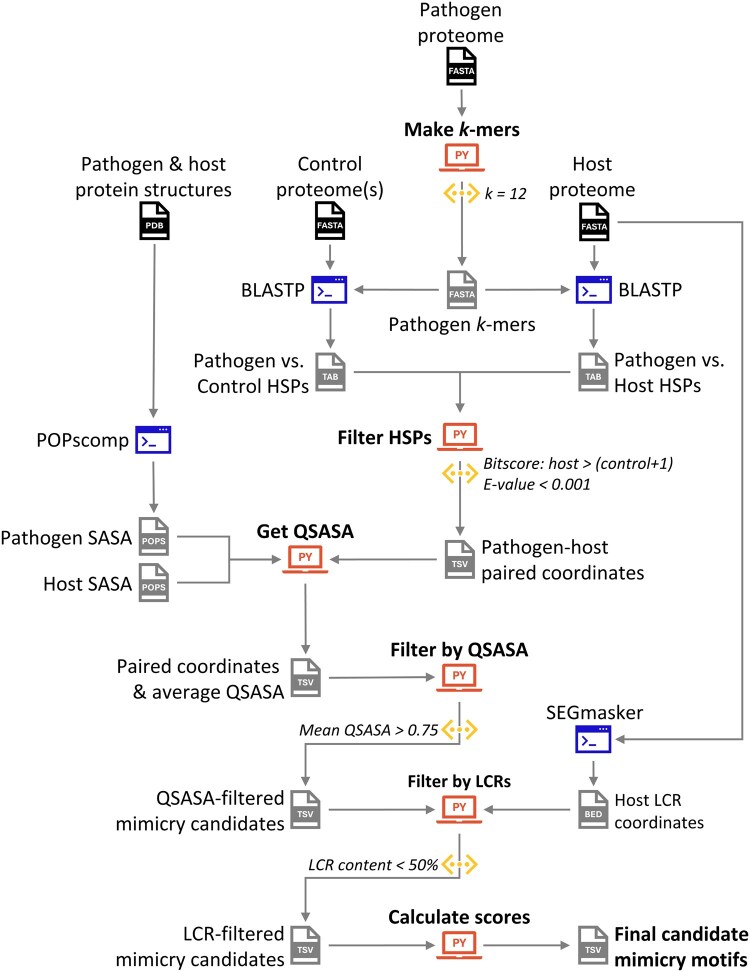 Figure 1
- —Natural Science and Engineering Research Council of Canada (NSERC)
- —University of Calgary10.13039/100008459
Peer Reviews
No public reviews on file for this paper yet. If you reviewed it on a platform where reviews are public (OpenReview, ICLR, NeurIPS, ICML), you can paste yours below so the community can read it here.
Videos
No videos yet. Explain this paper in a talk, walkthrough, or lecture? Add one.
Taxonomy
Topicsvaccines and immunoinformatics approaches · Bioinformatics and Genomic Networks · Machine Learning in Bioinformatics
1 Introduction
Pathogens often evade immune detection through molecular mimicry, where their molecules structurally or functionally imitate those of the host. Mimicry has been described in glycans, lipids, and nucleic acids, with protein mimicry arguably the most widely studied (van Die and Cummings 2010, Buck et al. 2014, Bosch et al. 2021, Maguire et al. 2024). Identifying mimicry is important for understanding immune evasion, identifying therapeutic targets and revealing co-evolution.
Protein mimicry typically involves short motifs (5-to-20 amino acids in length), that mediate host-pathogen interactions by altering signaling, protein binding, or immune recognition [as reviewed by Sámano-Sánchez and Gibson (2020)]. However, these short motifs are difficult to detect computationally. Current state-of-the-art motif discovery tools, including those from the MEME suite or SLiMFinder, are designed to find overrepresented motifs among non-homologous, functionally related sequences (e.g. co-regulated genes) (Edwards et al. 2007, Bailey et al. 2015). Other tools, such as SLiMPred and SLiMDisc, predict motifs documented in curated databases like ELM (Mooney et al. 2012, Palopoli et al. 2015). These approaches work well for short linear motifs (SLiM) and post-translational modification (PTM) sites, but assume recurrence for prior motif knowledge. These assumptions do not hold for molecular mimicry, where motifs are typically rare, non-recurrent, and largely unknown. Consequently, many mimicry exploration studies rely on local-local sequence alignment tools despite their default parameters being poorly suited for short sequence fragments (Ludin et al. 2011, Doxey and McConkey 2013, Pearson 2013, Armijos-Jaramillo et al. 2021, Emiliani et al. 2022).
We previously resurrected a k-mer-based strategy that aligned pathogen-derived peptides against host and control proteomes (Ludin et al. 2011, Rich et al. 2023). While effective, it relied on strict identity thresholds that may exclude biologically relevant mimics with subtle sequence divergence. Additionally, homologue filtering—intended to reduce noise—risked discarding genuine mimics.
Here, we present mimicDetector, an optimized and scalable pipeline for identifying mimicry motifs across divergent proteomes without prior motif knowledge. Unlike existing motif-finding tools, mimicDetector addresses a distinct biological problem with different biological assumptions: detecting short, non-recurrent mimicry motifs that other algorithms are not designed to uncover. To achieve this, we systematically evaluated alignment algorithms, scoring matrices, homologue handling, and filtering strategies to improve sensitivity and specificity.
2 Benchmarking and optimization
2.1 Overall approach
To guide tool selection and parameter optimization for mimicDetector, we designed benchmarking experiments using identical-hit and similar-hit peptide datasets from three well-annotated, phylogenetically diverse reference proteomes used in prior mimicry studies: Plasmodium falciparum 3D7, Mycobacterium tuberculosis H37Rv, and Brugia malayi (Ludin et al. 2011, Muthye and Wasmuth 2023, Rich et al. 2023, Yanik et al. 2023). A full list of the proteomes used in this study is provided in Table S1, available as supplementary data at Bioinformatics online.
We evaluated the recall performance of five protein alignment search tools (BLASTP, DIAMOND, PHMMER, TOPAZ, and Glam2Scan), comparing substitution matrices (BLOSUM62 and PAM30), and, where possible, the wordsize (2 and 3) used for seeding the alignments (Fig. S1, available as supplementary data at Bioinformatics online) (Altschul et al. 1990, Frith et al. 2008, Eddy 2011, Buchfink et al. 2015, Medlar and Holm 2018). Peptides were extracted as overlapping k-mers (lengths 5-to-14), and 10 sets of 1000 k-mers were randomly sampled from the proteome (Li 2018). We used each tool and various parameter combinations to align these k-mers back to each original proteome (Table S2, available as supplementary data at Bioinformatics online), and used a custom script to measure the number of identical and similar k-mers, allowing up to k-3 mismatches.
Workflow for the mimicDetector pipeline with suggested thresholds.
2.2 Alignment recall
BLASTP consistently outperformed other alignment tools for both identical and similar alignments (Figs S2 and S3, available as supplementary data at Bioinformatics online). For exact matches, the PAM30 substitution matrix outperformed BLOSUM62 when *k *≤ 9 and was equivalent at *k *≥ 10. Reducing wordsize to 2 improved recall for *k *= 5, where seeding was a limiting factor. For similar-hit alignments, BLASTP again led, though performance varied. PAM30 outperformed BLOSUM62 when: (i) *k *≤ 9; (ii) *k *≥ 10 with few mismatches. In contrast, BLOSUM62 was slightly better PAM30 for the longer k-mers. Reducing wordsize helped with PAM30-scored alignments, but had little effect on BLOSUM62-scored alignments.
TOPAZ performed well for identical k-mer alignments. However, it was excluded due to a mismatch-counting error and weaker similar-hit performance. DIAMOND and PHMMER underperformed compared to BLASTP across all tests. Glam2Scan showed perfect recall for identical-hits but was excluded due to excessive runtimes (Fig. S4, available as supplementary data at Bioinformatics online).
2.3 Proteome coverage
Beyond recall, we assessed how much of the proteome was matched by the query k-mers. We consider it desirable to find a higher coverage of the target proteome, so reducing the likelihood of excluding potentially relevant motifs early in the pipeline. Merging overlapping alignments, we found that BLASTP with PAM30 and wordsize = 2 provided the highest coverage, plateauing at k = 12 (Fig. S5, available as supplementary data at Bioinformatics online).
2.4 False discovery rate
We estimated the empirical false discovery rate (FDR) using a target–decoy approach, with the human proteome as the target and shuffled human sequences as the decoy:
where Ntarget is the number of hits to the target database, Ndecoy is the number of hits to the decoy database, and c is a correction factor for the number of unique peptides (UP) in the target and decoy databases (Käll et al. 2008, Lee et al. 2021):
We calculated FDR for runs of mimicDetector for combinations of threshold value ranges for bitscore difference (0≤*b *≤ 3), minimum E-value (range 0.05≥*e *≥ 0.0005) and minimum solvent accessibility (*q *= 0.50 or 0.75) for the three aforementioned species. We found that combinations of 0≤*b *≤ 2, 0.01≥*e *≥ 0.001, and *q *= 0.75 produced FDR < 0.05 for all three species but runs with *b *= 1 and *e *= 0.001 consistently had the lowest FDR, regardless of dataset (Fig. S6, available as supplementary data at Bioinformatics online).
2.5 Homologue removal
The original pipeline filtered full-length pathogen proteins with significant alignments to host proteins, presumably to reduce the number of k-mers to consider in later searches. However, this may exclude proteins due to a shared promiscuous domain or biologically relevant mimics contains within homologous genes that duplicated and undergone subfunctionalization (Pastrana et al. 1998, Armijos-Jaramillo et al. 2021, Huang et al. 2022). We found that removing this step led to a small increase in the number of candidate motifs in P. falciparum and a marked increase in helminth species, which are discussed in the next section (Fig. S7, available as supplementary data at Bioinformatics online).
3 Implementation
mimicDetector integrates optimized alignment parameters and refined filtering strategies into a streamlined, modular pipeline (Fig. 1). We selected the BLASTP search algorithm, with the PAM30 substitution matrix and *wordsize *= 2 (Table S3, available as supplementary data at Bioinformatics online). The default k-mer length is 12 amino acids. A further change to early versions is the use of bitscore, rather than percent identity, to compare k-mer alignments.
Users provide proteomes for the pathogen, host, and negative control species (typically non-pathogen) in FASTA format. The pathogen proteome is fragmented into overlapping k-mers, which serve as queries for ungapped local-local alignments.
Post-alignment, mimicDetector applies a series of biologically motivated filters. To achieve an FDR < 0.05 (see section 2.4), we retain alignments where E-value is ≤0.001 and the pathogen-host alignment bitscore exceeds that of the best pathogen-control alignment by at least one bit. Overlapping k-mer alignments are merged into a single preliminary mimicry candidate. Finally, hits with a mean solvent accessible surface area >75%, via POPSCOMP, are kept, and hits where >50% of the sequence is low-complexity, via Segmasker, are removed (Wootton and Federhen 1996, Kleinjung and Fraternali 2005).
The final output includes a ranked list of predicted mimicry candidates, which includes pathogen and host protein sequences with positional information and recalculated alignment scores and E-values. The pipeline and its accompanying documentation are freely available on GitHub.
4 Results and discussion
We applied mimicDetector to 17 eukaryotic pathogen proteomes to identify protein-level mimicry targeting the human proteome (Table S1, available as supplementary data at Bioinformatics online). The updated pipeline consistently identified more mimicry candidates than our previous approach, particularly when homologous proteins were retained and evaluated at the k-mer level.
In Leishmania infantum, we identified two notable mimics. The first protein, LINF_180015000 (UniProt: A4HXX0), shares a motif with CD244 (2B4; UniProt: Q9BZW8), an immune checkpoint receptor expressed on natural killer cells (De Freitas et al. 2021, Sanz et al. 2021). The second protein, LINF_310020500 (UniProt: A4I6R4), shared a motif with Reticulon-4B (Nogo-B; UniProt: Q9NQC3), a modulator of leukocyte migration and TLR9 trafficking, which has been implicated in Leishmania-driven changes to macrophage behavior (Kimura et al. 2015, Bhattacharya et al. 2023).
In helminths (parasitic worms), mimicDetector uncovered possible mimicry of complement components. Four Schistosoma mansoni proteins had similarity to C1qA and four nematode species matched C1qB (Table S4, available as supplementary data at Bioinformatics online). Many helminth species, including those mentioned here, secrete a calreticulin homologue which inhibits classical activation of the complement pathway through interaction with complement protein C1q (Floudas et al. 2017, Yadav et al. 2021, Esperante et al. 2023). Functional assays are planned to examine the potential interactions suggested by mimicDetector.
Finally, we note that the search algorithms tested here were not originally designed for our specific goal. For example, the long runtimes for Glam2Scan were in part due to formatting the data appropriately for each search. Future mimicry detection may benefit from using underlying algorithms, such as Waterman-Eggert (Waterman and Eggert 1987).
Supplementary Material
btag012_Supplementary_Data
The reference list from the paper itself. Each links out to its DOI / PubMed record.
- 1Altschul SF , Gish W, Miller W et al Basic local alignment search tool. J Mol Biol 1990;215:403–10.2231712 10.1016/S 0022-2836(05)80360-2 · doi ↗ · pubmed ↗
- 2Armijos-Jaramillo V , Espinosa N, Vizcaíno K et al A novel In silico method for molecular mimicry detection finds a formin with the potential to manipulate the maize cell cytoskeleton. Mol Plant Microbe Interact 2021;34:815–25.33755496 10.1094/MPMI-11-20-0332-R · doi ↗ · pubmed ↗
- 3Bailey TL , Johnson J, Grant CE et al The MEME suite. Nucleic Acids Res 2015;43:W 39–49.25953851 10.1093/nar/gkv 416PMC 4489269 · doi ↗ · pubmed ↗
- 4Bhattacharya P , Gannavaram S, Ismail N et al Toll-like receptor-9 (TLR-9) signaling is crucial for inducing protective immunity following immunization with genetically modified live attenuated leishmania parasites. Pathogens 2023;12:534.37111420 10.3390/pathogens 12040534 PMC 10143410 · doi ↗ · pubmed ↗
- 5Bosch M , Sweet MJ, Parton RG et al Lipid droplets and the host–pathogen dynamic: FA Tal attraction? J Cell Biol 2021;220:e 202104005.34165498 10.1083/jcb.202104005 PMC 8240858 · doi ↗ · pubmed ↗
- 6Buchfink B , Xie C, Huson DH. Fast and sensitive protein alignment using DIAMOND. Nat Methods 2015;12:59–60.25402007 10.1038/nmeth.3176 · doi ↗ · pubmed ↗
- 7Buck AH , Coakley G, Simbari F et al Exosomes secreted by nematode parasites transfer small RN As to mammalian cells and modulate innate immunity. Nat Commun 2014;5:5488.25421927 10.1038/ncomms 6488 PMC 4263141 · doi ↗ · pubmed ↗
- 8De Freitas E , Silva R, Von Stebut E. Unraveling the role of immune checkpoints in leishmaniasis. Front Immunol 2021;12:620144.33776999 10.3389/fimmu.2021.620144 PMC 7990902 · doi ↗ · pubmed ↗