Polymicrobial retroperitoneal abscess by Salmonella enteritidis and Bacteroides fragilis unmasking cecal cancer
Chee Yik Chang

Abstract
Genes, proteins, chemicals, diseases, species, mutations and cell lines named across the full text — each resolved to its canonical identifier and authoritative record.
Click any figure to enlarge with its caption.
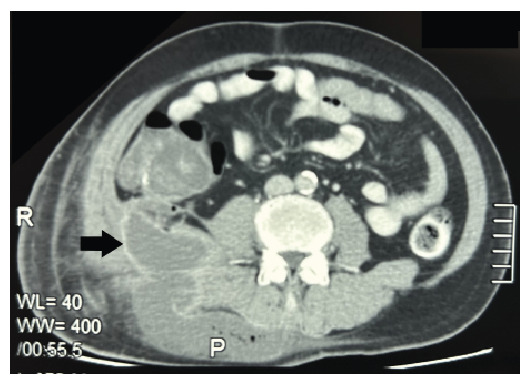 Figure 1
Peer Reviews
No public reviews on file for this paper yet. If you reviewed it on a platform where reviews are public (OpenReview, ICLR, NeurIPS, ICML), you can paste yours below so the community can read it here.
Videos
No videos yet. Explain this paper in a talk, walkthrough, or lecture? Add one.
Taxonomy
TopicsOtolaryngology and Infectious Diseases · Streptococcal Infections and Treatments · Infective Endocarditis Diagnosis and Management
A 52-year-old man presented with a 5-day history of swelling on the right side of his back without fever, altered bowel habits, or rectal bleeding. Examination revealed a large, non-tender swelling measuring 15 × 10 cm on the right mid-to-lower back. Computed tomography of the thorax, abdomen, and pelvis showed a right retroperitoneal collection involving the quadratus lumborum muscle (7.7 × 18.9 × 14.3 cm) and a cecal mass (5.4 × 5.4 × 7.1 cm) with a colocutaneous fistula ( Figure 1 ). The patient underwent incision and drainage of the abscess, followed by creation of a left ileostomy. Colonoscopy revealed a fungating cecal mass, which was confirmed as an adenocarcinoma on histopathological examination. Salmonella enteritidis and Bacteroides fragilis were isolated from the pus, both of which were susceptible to ampicillin-sulbactam. He received intravenous ampicillin-sulbactam (3 g every 6 h) for four weeks, which resulted in radiological resolution of the abscess.
FIGURE 1:CT scan of the abdomen and pelvis showing a collection in the right retroperitoneal region involving the right quadratus lumborum communicating with a cecal tumor.
Retroperitoneal abscesses and colocutaneous fistula are rare manifestations of colorectal cancer1 . Infection with S. enteritidis and B. fragilis has been linked to colorectal carcinogenesis through mechanisms such as intestinal dysbiosis, chronic inflammation, immune evasion, and activation of pro-tumorigenic signaling pathways2. Furthermore, S. enteritidis can cause life-threatening complications such as colonic perforations and pancytopenia3. Prompt surgical drainage and targeted antimicrobial therapy led to a complete recovery. The patient was subsequently scheduled for the definitive surgical removal of the cecal tumor.
The reference list from the paper itself. Each links out to its DOI / PubMed record.
- 1Skalitzky MK Zhou PP Goffredo P Guyton K Sherman SK Gribovskaja-Rupp I Characteristics and symptomatology of colorectal cancer in the young Surgery 20231735113711433687217410.1016/j.surg.2023.01.018PMC 10116569 · doi ↗ · pubmed ↗
- 2Hernández-Luna MA López-Briones S Luria-Pérez R The Four Horsemen in Colon Cancer J Oncol 20192019563627256362723166275210.1155/2019/5636272 PMC 6791268 · doi ↗ · pubmed ↗
- 3Chang CY Gan YL Lio JY Radhakrishnan AP Invasive salmonella enteritidis infection complicated by colonic perforations and pancytopenia: A case report Med J Malaysia 202277226426635338642 · pubmed ↗