Recent insights into the biological functions of hesperidin
Chanung Park, Ji Hyun Yoo, Sang Un Park

Abstract
Genes, proteins, chemicals, diseases, species, mutations and cell lines named across the full text — each resolved to its canonical identifier and authoritative record.
Click any figure to enlarge with its caption.
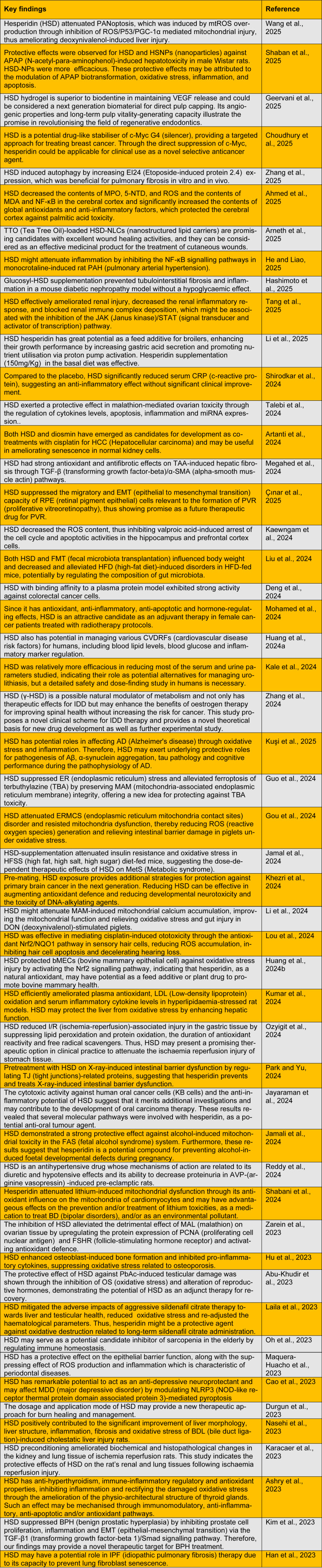 Figure 1
Peer Reviews
No public reviews on file for this paper yet. If you reviewed it on a platform where reviews are public (OpenReview, ICLR, NeurIPS, ICML), you can paste yours below so the community can read it here.
Videos
No videos yet. Explain this paper in a talk, walkthrough, or lecture? Add one.
Taxonomy
TopicsSystemic Lupus Erythematosus Research · Diabetes and associated disorders · Salivary Gland Disorders and Functions
Hesperidin (3,5,7-trihydroxyflavanone 7-rhamnoglucoside) is a β-7-rutinoside of hesperetin (4′-methoxy-3′,5,7-trihydroxyflavanone) (Sharma et al., 2021[57]). It is a flavonoid and, thus, one of the much extended flavanones, which are among the most abundantly existing phenol compounds in plants (Hajialyani et al., 2019[16]; Rahmani et al., 2023[52]). Hesperidin and its aglycone derivatives are major compounds in citrus fruits of the Rutaceae family: orange (Citrus sinensis), grapefruit (Citrus paradise), tangerine (Citrus reticulata), lime (Citrus aurantifolia) and lemon (Citrus limon) (Lee and Han, 2013[37]; Phucharoenrak et al., 2022[50]; Rodrigues and Pintado, 2024[54]; Wu et al., 2007[62]; Xu et al., 2024[63]). Their abundance in citrus fruit depends on the plant variety, fruit tissue type, climate and the stage of fruit ripening (Gattuso et al., 2007[12]; Pyrzynska, 2022[51]).
Hesperidin possesses biological and pharmacological activities, such as antioxidant, anti-inflammatory, antibacterial, antiviral, anti-allergic, anticancer, cardiovascular protective, and neuroprotective properties (El‐Shiekh et al., 2025[11]; Kowalczyk, 2024[33]; Ma et al., 2024[42]).
Both pre-clinical and clinical studies have demonstrated the beneficial effects of hesperidin on various diseases, such as bone, cardiovascular, neurological, respiratory, digestive and urinary tract diseases (Hosawi, 2023[20]; Ji et al., 2024[27]). Previously, the chemical composition and major skin application areas for hesperidin were described as follows: (i) anti-ageing and skin barrier protection, (ii) UV radiation damage, (iii) hyperpigmentation and depigmentation conditions, (iv) wound healing, and (v) skin cancer and other cutaneous diseases (Rodrigues and Pintado, 2024[54]). The novelty of this work is based on the exploitation of the encouraging skincare and elasticity applications of hesperidin, which represents a sustainable ingredient in the circular economy. Here, we discuss important recent studies that have been conducted to assess the health-promoting and pharmacological properties of hesperidin (Table 1(Tab. 1); References in Table 1: Abu-Khudir et al., 2023[1]; Ahmed et al., 2025[2]; Arneth et al., 2025[3]; Artanti et al., 2024[4]; Ashry et al., 2023[5]; Cao et al., 2023[6]; Choudhury et al., 2025[7]; Çınar et al., 2025[8]; Deng et al., 2024[9]; Durgun et al., 2023[10]; Geervani et al., 2025[13]; Gou et al., 2024[14]; Guo et al., 2024[15]; Han et al., 2023[17]; Hashimoto et al., 2025[18]; He and Liao, 2025[19]; Hu et al., 2023[21]; Huang et al., 2024[22][23]; Jamal et al., 2024[24]; Jamali et al., 2024[25]; Jayaraman et al., 2024[26]; Kaewngam et al., 2024[28]; Kale et al., 2024[29]; Karacaer et al., 2023[30]; Khezri et al., 2024[31]; Kim et al., 2023[32]; Kumar et al., 2024[34]; Kuşi et al., 2025[35]; Laila et al., 2023[36]; Li et al., 2024[38], 2025[39]; Liu et al., 2024[40]; Lou et al., 2024[41]; Maquera-Huacho et al., 2023[43]; Megahed et al., 2024[44]; Mohamed et al., 2024[45]; Nasehi et al., 2023[46]; Oh et al., 2023[47]; Ozyigit et al., 2024[48]; Park and Yu, 2024[49]; Reddy et al., 2024[53]; Shaban et al., 2025[55]; Shabani et al., 2024[56]; Shirodkar et al., 2024[58]; Talebi et al., 2024[59]; Tang et al., 2025[60]; Wang et al., 2025[61]; Zarein et al., 2023[64]; Zhang et al., 2024[65], 2025[66]).
Notes
Chanung Park and Ji Hyun Yoo contributed equally as first author.
Declaration
Acknowledgments
This research was supported by the Bio & Medical Technology Development Program of the National Research Foundation (NRF) funded by the Ministry of Science, ICT & Future Planning (2016M3A9A5919548).
Conflict of interest
The authors declare no conflict of interest.
The reference list from the paper itself. Each links out to its DOI / PubMed record.
- 1Abu-Khudir R Almutairi HH Abd El-Rahman SS El-Said KS The palliative and antioxidant effects of hesperidin against lead-acetate-induced testicular injury in male Wistar rats Biomedicines 202311923903776083110.3390/biomedicines 11092390 PMC 10525152 · doi ↗ · pubmed ↗
- 2Ahmed AS Mathew LS Mady MM Docmac OK Ibrahim HA Sengupta P Hesperidin protects the cerebral cortex of albino Wistar rats from the toxic effects of palmitic acid and preserves neurotransmitters‐associated enzymes Biotechnic & Histochemistry 202510042292394014547710.1080/10520295.2025.2482944 · doi ↗ · pubmed ↗
- 3Arneth B Abdelmonem R El-Nabarawi MA Teaima MH Rashwan KO Soliman MA Optimized Hesperidin-Loaded Lipid Nanoparticles with Tea Tree Oil for Enhanced Wound Healing: Formulation, Characterization, and Evaluation Pharmaceuticals 20251832904014306910.3390/ph 18030290 PMC 11946831 · doi ↗ · pubmed ↗
- 4Artanti AN Jenie RI Rumiyati R Meiyanto E Hesperidin and Diosmin Increased Cytotoxic Activity Cisplatin on Hepatocellular Carcinoma and Protect Kidney Cells Senescence Asian Pacific Journal of Cancer Prevention 20242512424742553973341610.31557/APJCP.2024.25.12.4247 PMC 12008348 · doi ↗ · pubmed ↗
- 5Ashry M Askar H Obiedallah MM Elankily AH Galal El-Sahra D Zayed G Hormonal and inflammatory modulatory effects of hesperidin in hyperthyroidism-modeled rats Frontiers in Immunology 20231410873973702054910.3389/fimmu.2023.1087397 PMC 10067561 · doi ↗ · pubmed ↗
- 6Cao H Yang D Nie K Lin R Peng L Zhou X Hesperidin may improve depressive symptoms by binding NLRP 3 and influencing the pyroptosis pathway in a rat model European Journal of Pharmacology 20239521756703716914310.1016/j.ejphar.2023.175670 · doi ↗ · pubmed ↗
- 7Choudhury SD Ghosh S Kumar P Bhardwaj A Singh K Singh A Attenuation of c-Myc expression in breast cancer by hesperidin-mediated stabilization of its promoter proximal G quadruplex region International Journal of Biological Macromolecules 20253091430004022251010.1016/j.ijbiomac.2025.143000 · doi ↗ · pubmed ↗
- 8Çınar AK Serttas RÇınar ACGüçlüH Erdogan S As shown hesperidin suppresses TGF-β2-induced proliferation and epithelial-mesenchymal transition of retinal pigment epithelial cells Journal of Molecular Histology 20255611010.1007/s 10735-024-10275-539612089 · doi ↗ · pubmed ↗