Efficacy and Safety of Artesunate + Amodiaquine and Artemether + Lumefantrine for the Treatment of Uncomplicated Plasmodium falciparum Malaria in Madagascar, 2020
Aina Harimanana, Dina Ny Aina Liantsoa Randriamiarinjatovo, Tovonanahary Angelo Rakotomanga, Judickaelle Irinantenaina, Leah F. Moriarty, Veronica Laird, Dhruviben Patel, Rispah A. Abdallah, Zhou Zhiyong, Samaly Souza Svigel, Laurent Kapesa, Jocelyn Razafindrakoto

TL;DR
A study in Madagascar found that two malaria treatments, ASAQ and AL, are safe and effective for treating uncomplicated P. falciparum malaria in children.
Contribution
The study provides updated evidence on the efficacy and safety of ASAQ and AL in Madagascar, confirming no artemisinin resistance.
Findings
Both ASAQ and AL showed high efficacy with polymerase chain reaction-corrected ACPR rates of 100% for ASAQ and up to 100% for AL.
No mutations associated with artemisinin resistance were detected in the pfK13 gene.
Mild adverse events were reported in 10.2% of patients, primarily gastrointestinal issues and headaches.
Abstract
The efficacy of artesunate + amodiaquine (ASAQ) and artemether + lumefantrine (AL) for treating malaria was investigated in Madagascar in 2020. A randomized parallel-group study was conducted at four health centers (Antsenavolo, Vohitromby, and Matanga in the southeastern region and Ankazomborona in the northwestern region). The therapeutic efficacy and safety of ASAQ and AL were assessed using the WHO protocol, with a 28-day follow-up period. Children aged 6 months to 14 years with uncomplicated Plasmodium falciparum (P. falciparum) malaria were randomly assigned to receive either ASAQ or AL. Genotyping assays for the pfK13 gene were conducted on P. falciparum isolates obtained from dry blood samples collected on Day 0. Of 765 enrolled patients, 709 (92.7%) reached the study endpoint. Among the per-protocol population, crude adequate clinical and parasitological response (ACPR) rates…
Genes, proteins, chemicals, diseases, species, mutations and cell lines named across the full text — each resolved to its canonical identifier and authoritative record.
Click any figure to enlarge with its caption.
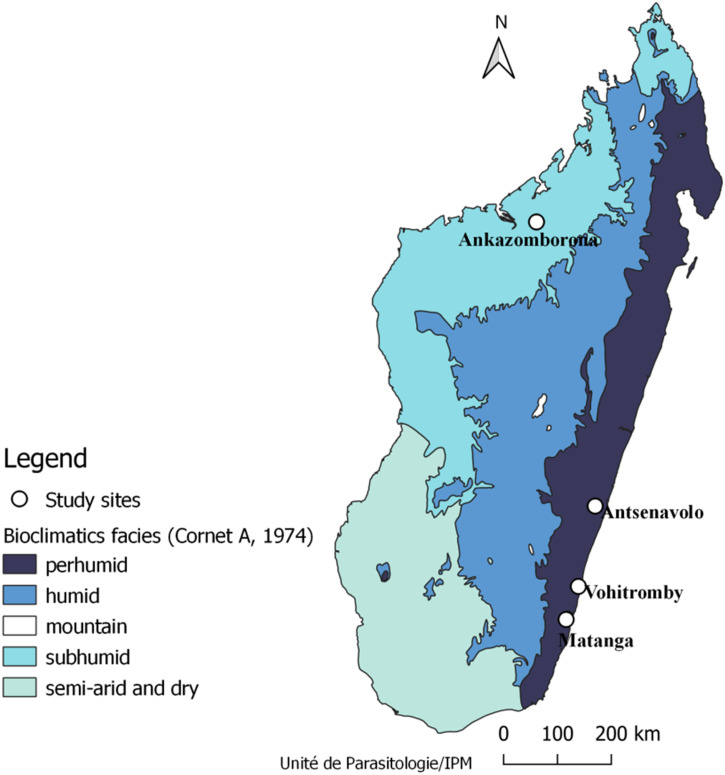 Figure 1
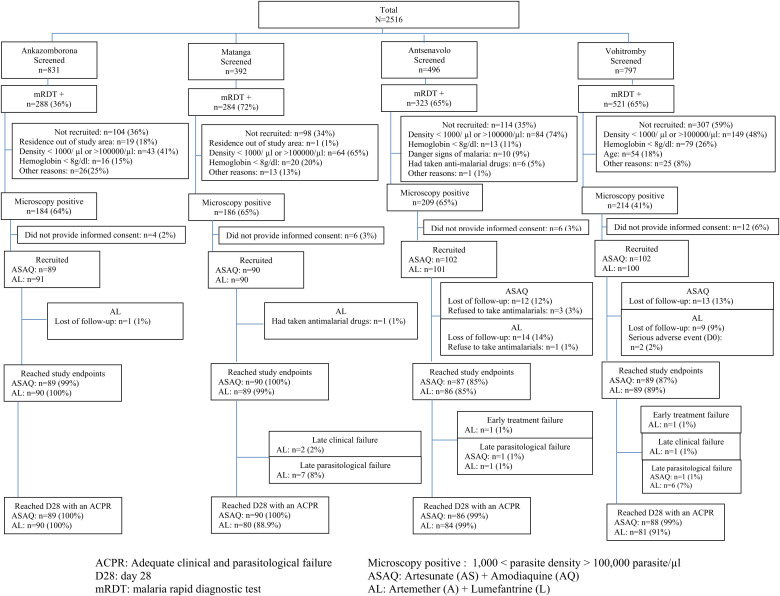 Figure 2
 Figure 3
Peer Reviews
No public reviews on file for this paper yet. If you reviewed it on a platform where reviews are public (OpenReview, ICLR, NeurIPS, ICML), you can paste yours below so the community can read it here.
Videos
No videos yet. Explain this paper in a talk, walkthrough, or lecture? Add one.
Taxonomy
TopicsMalaria Research and Control · Mosquito-borne diseases and control · Trypanosoma species research and implications