The Liquid State of RIM1α and RBP Condensates is Maintained by Lipids
Charlotte M. Fischer, Zenon Toprakcioglu, Ella de Csilléry, Gabriele S. Kaminski Schierle, Tuomas P. J. Knowles

TL;DR
This study shows that RIM1α and RBP proteins form liquid condensates at synapses, and lipids help prevent these condensates from turning solid, which could lead to dysfunction.
Contribution
The study reveals that lipids suppress the liquid-to-solid transition of RIM1α/RBP condensates, maintaining their liquid state under physiological conditions.
Findings
RIM1α and RBP can spontaneously form biomolecular condensates under physiological conditions.
These condensates can transition from liquid to solid over time, forming β-sheet-rich fibrillar aggregates.
Lipid vesicles prevent the liquid-to-solid transition, preserving the liquid state of RIM1α/RBP condensates.
Abstract
At the presynapse, RIM1α and RIM-binding protein (RBP) play a crucial role in regulating vesicle docking and priming. Emerging evidence suggests that these proteins are involved in the organization of the active zone where they cluster with membrane proteins and lipids, forming protein condensates driven by liquid–liquid phase separation (LLPS). While protein phase separation has been associated with cellular function, it has also been linked to various disorders, as liquid condensates can promote protein aggregation, leading to dysfunction. In this work, we investigated the phase behavior of RIM1α and RBP. We find that under physiological conditions and in the absence of crowding agents, RIM1α and RBP have the ability to spontaneously form biomolecular condensates. Moreover, these liquid condensates have the propensity to mature over time, resulting in a liquid-to-solid transition.…
Genes, proteins, chemicals, diseases, species, mutations and cell lines named across the full text — each resolved to its canonical identifier and authoritative record.
Click any figure to enlarge with its caption.
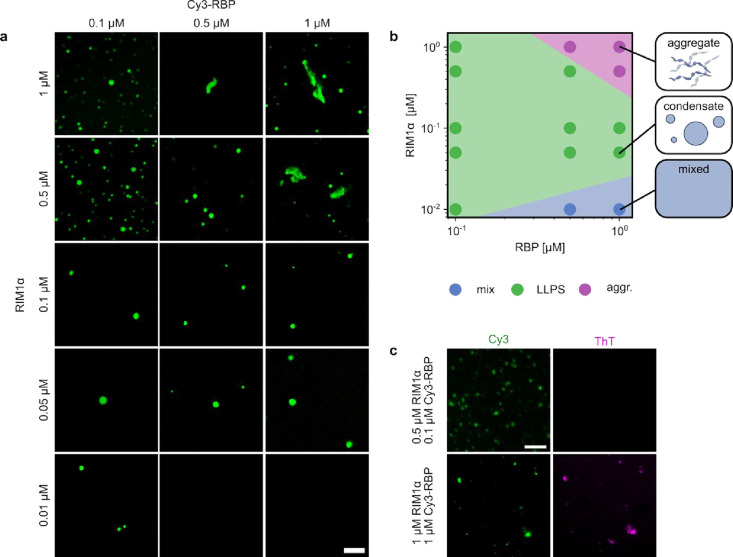 Figure 1
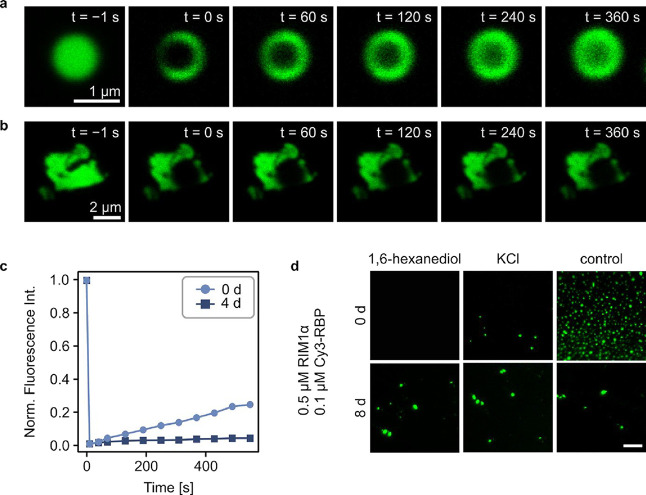 Figure 2
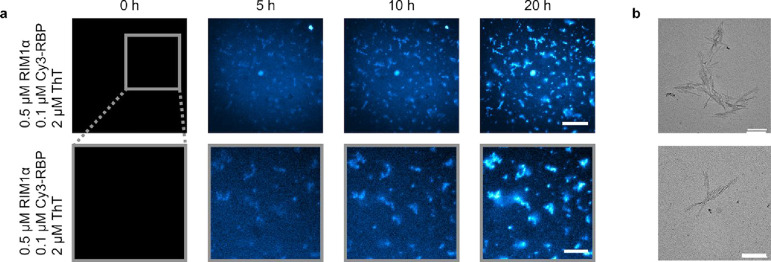 Figure 3
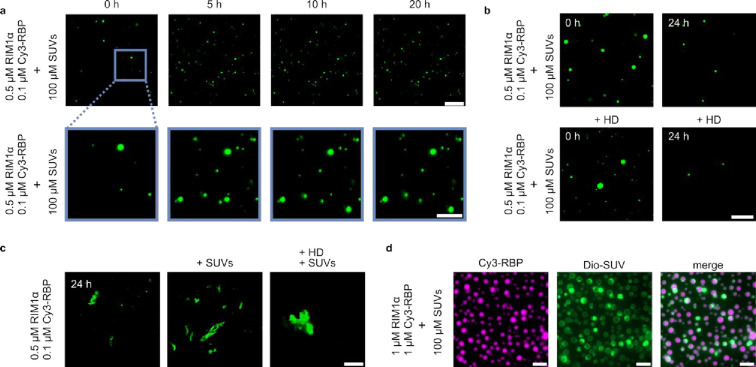 Figure 4
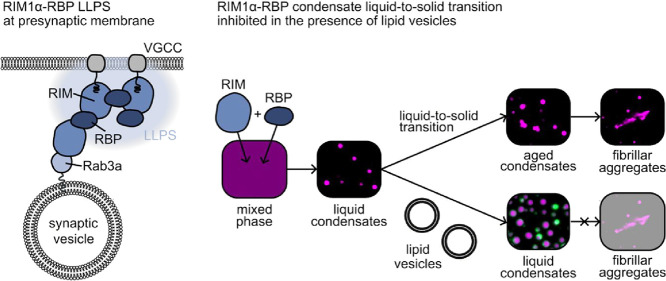 Figure 5
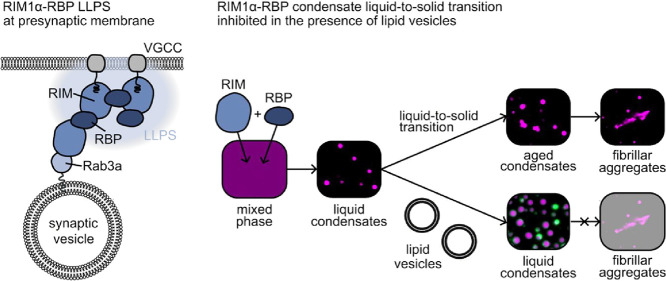 Figure 6
Peer Reviews
No public reviews on file for this paper yet. If you reviewed it on a platform where reviews are public (OpenReview, ICLR, NeurIPS, ICML), you can paste yours below so the community can read it here.
Videos
No videos yet. Explain this paper in a talk, walkthrough, or lecture? Add one.
Taxonomy
TopicsRNA Research and Splicing · Lipid Membrane Structure and Behavior · Nuclear Structure and Function