Cavity Born–Oppenheimer Coupled Cluster Theory: Toward Electron Correlation in the Vibrational Strong Light-Matter Coupling Regime
Eric W. Fischer

TL;DR
This paper introduces a new method to study electron correlation in chemical reactions under vibrational strong light-matter coupling using a coupled cluster approach.
Contribution
The novel CRP-CCSD method combines cavity reaction potential with coupled cluster theory to model cavity-modified electron correlation.
Findings
lCRP-CCSD methods provide excellent results compared to CRP-CCSD in the few-molecule limit.
Mean-field and correlated results show significant differences in both reactive and collective scenarios.
Electron correlation under vibrational strong coupling is nontrivial and requires beyond-mean-field approaches.
Abstract
We present a detailed derivation and discussion of cavity Born–Oppenheimer coupled cluster (CBO–CC) theory and address cavity-modified electron correlation in the vibrational strong coupling regime. Methodologically, we combine the recently proposed cavity reaction potential (CRP) approach with the Lagrangian formulation of CC theory and derive a self-consistent CRP-CC method at the singles and doubles excitations level (CRP-CCSD). The CRP-CC approach is formally similar to implicit solvation CC models and provides access to the CBO–CC electronic ground state energy minimized in cavity coordinate space on a CC level of theory. A hierarchy of linearization schemes (lCRP-CCSD) similar to canonical CC theory systematically lifts the self-consistent nature of the CRP-CCSD approach and mitigates numerical cost by approximating electron correlation effects in energy minimization. We provide a…
Genes, proteins, chemicals, diseases, species, mutations and cell lines named across the full text — each resolved to its canonical identifier and authoritative record.
Click any figure to enlarge with its caption.
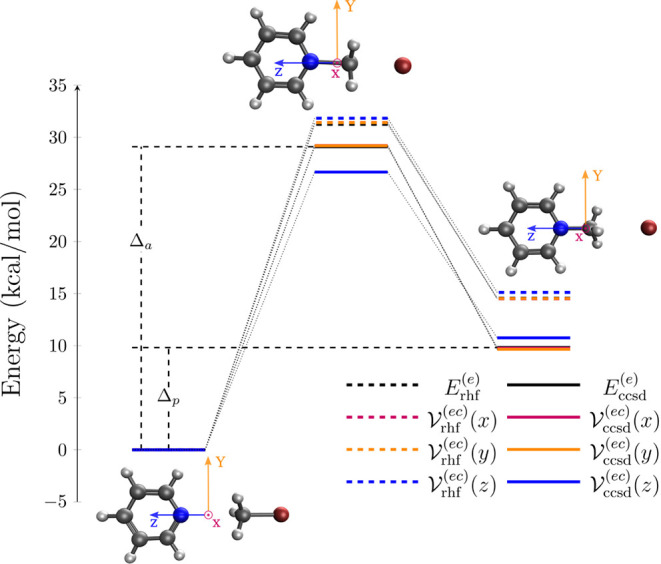 Figure 1
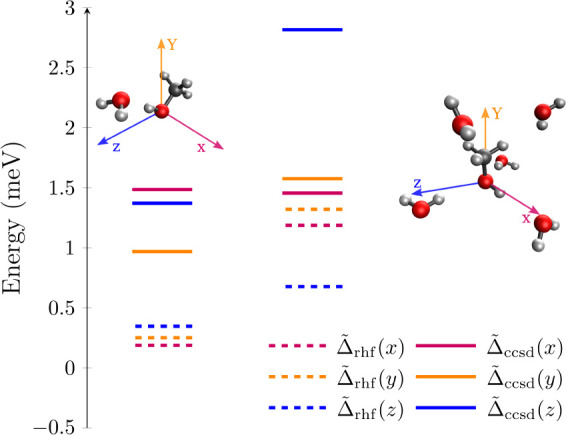 Figure 2
 Figure 3
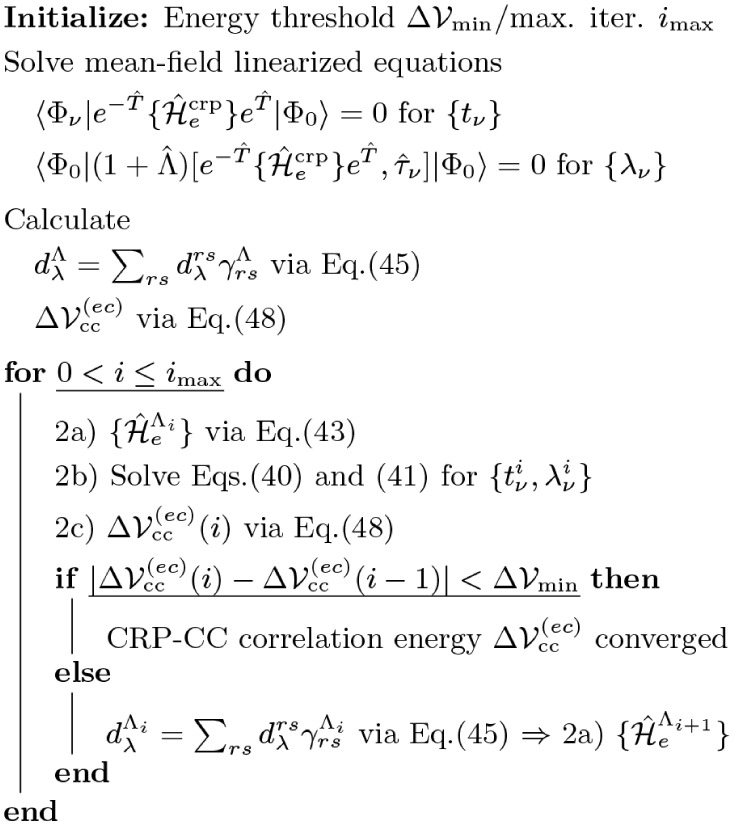 Figure 4
 Figure 5
 Figure 6
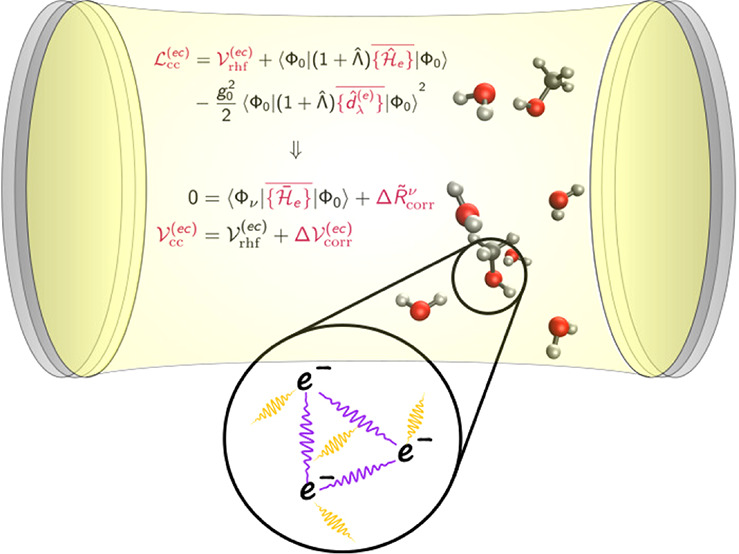 Figure 7
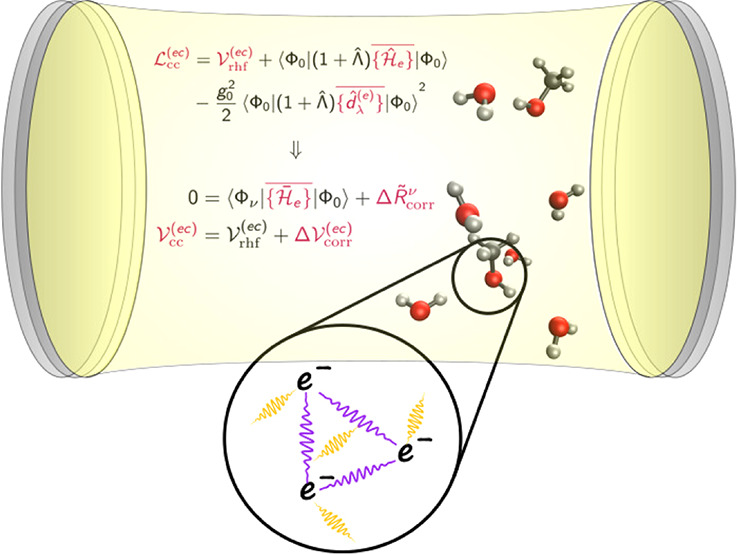 Figure 8
 Figure 9
 Figure 10
 Figure 11
 Figure 12
 Figure 13
 Figure 14
 Figure 15
 Figure 16
 Figure 17
 Figure 18
 Figure 19
 Figure 20
 Figure 21
 Figure 22
 Figure 23
 Figure 24
 Figure 25
 Figure 26
 Figure 27
 Figure 28
 Figure 29
 Figure 30
 Figure 31
 Figure 32
 Figure 33
 Figure 34
 Figure 35
 Figure 36
 Figure 37
 Figure 38
 Figure 39
 Figure 40
 Figure 41
 Figure 42
 Figure 43
 Figure 44
 Figure 45
 Figure 46
 Figure 47
 Figure 48
 Figure 49
 Figure 50
Peer Reviews
No public reviews on file for this paper yet. If you reviewed it on a platform where reviews are public (OpenReview, ICLR, NeurIPS, ICML), you can paste yours below so the community can read it here.
Videos
No videos yet. Explain this paper in a talk, walkthrough, or lecture? Add one.
Taxonomy
TopicsStrong Light-Matter Interactions · Spectroscopy and Quantum Chemical Studies · Perovskite Materials and Applications