Evaluation of Approximate Fourth-Order N‑Electron Valence Perturbation Theory (NEVPT4(SD)) for the Excited States of Organic Molecules
Emily M. Kempfer, Kantharuban Sivalingam, Frank Neese

TL;DR
This paper evaluates a new computational method for calculating excited states in organic molecules and finds it to be highly accurate and efficient.
Contribution
The study introduces and validates an approximate fourth-order N-electron valence perturbation theory (NEVPT4(SD)) for excited state calculations.
Findings
NEVPT4(SD) outperforms lower-order NEVPT and CASPT2 methods for singlet and triplet excitations.
n → π* transitions are slightly overestimated, while π → π* transitions are slightly underestimated.
NEVPT4(SD) has a narrow error distribution and is computationally more affordable than higher-order multireference methods.
Abstract
In this work, we assess the accuracy of the approximate fourth-order N-electron valence perturbation theory (NEVPT4(SD)) methodology for computing excited states of organic molecules. The well-established Thiel benchmark set was employed, comprising 225 vertical excitations spanning π → π*, n → π*, and σ → π* transition types. A state-specific canonicalization procedure was applied, enabling a direct comparison with CC3 reference data reported by Schreiber et al. J. Chem. Phys., 2008, 128, 134110. For both singlet and triplet excitations, NEVPT4(SD) systematically outperforms lower-order NEVPT variants, as well as previously reported complete active space second-order perturbation theory (CASPT2) results. A detailed analysis of the singlet excitations reveals that n → π* transitions have a slight tendency to be overestimated (by about 0.1 eV), while π → π* excitations tend to be…
Genes, proteins, chemicals, diseases, species, mutations and cell lines named across the full text — each resolved to its canonical identifier and authoritative record.
Click any figure to enlarge with its caption.
 Figure 1
 Figure 2
 Figure 3
 Figure 4
 Figure 5
 Figure 6
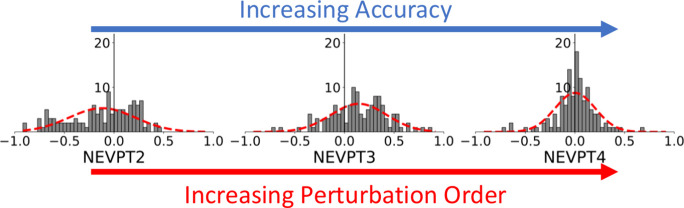 Figure 7
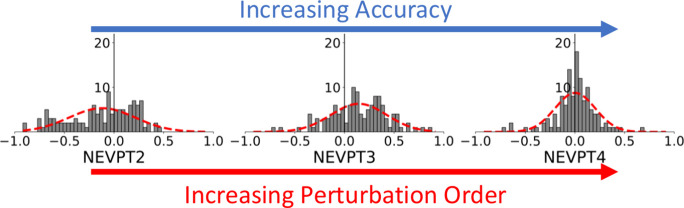 Figure 8
Peer Reviews
No public reviews on file for this paper yet. If you reviewed it on a platform where reviews are public (OpenReview, ICLR, NeurIPS, ICML), you can paste yours below so the community can read it here.
Videos
No videos yet. Explain this paper in a talk, walkthrough, or lecture? Add one.
Taxonomy
TopicsAdvanced Chemical Physics Studies · Photochemistry and Electron Transfer Studies · Spectroscopy and Quantum Chemical Studies